When Drones Become Part of the Maintenance Team: Connecting Autonomous UAV Data with Industrial Maintenance Workflows
A drone that has identified a potential defect has achieved only the first step. The true operational value manifests itself when the finding can be associated with the correct asset, reviewed by the right personnel, transferred into the maintenance environment and revisited post-corrective work.
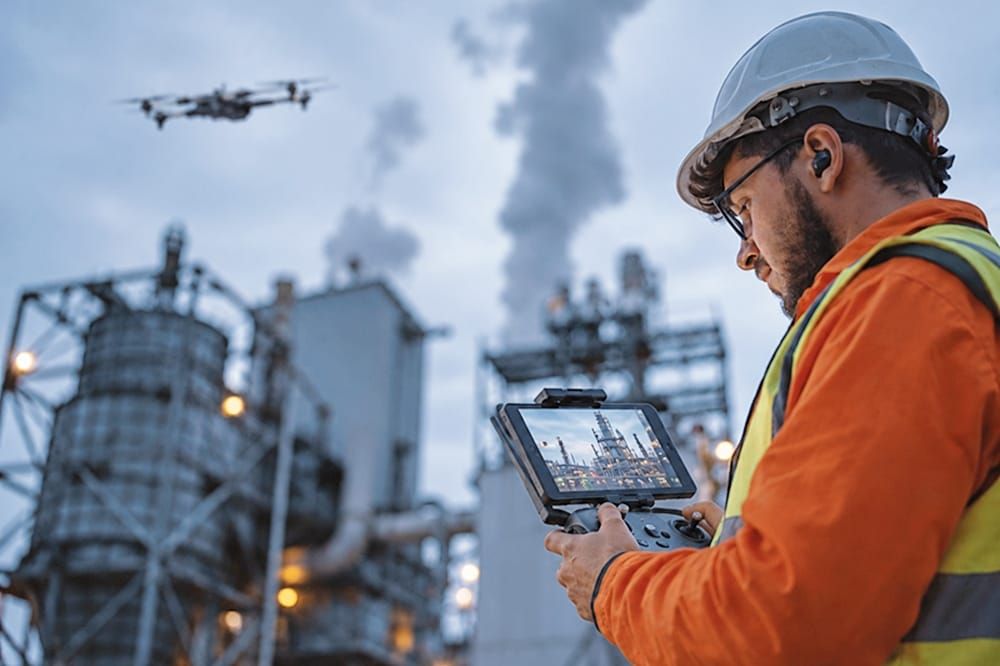
Self-driving drones are better inspection tools. With the ability to repeat paths, capture close-up images, and create 3D models of assets, autonomous drones are becoming even more reliable Inspection tools. For industrial operators, all of that data isn't the end of the process.
The harder question is: what does this all lead to?
An inspection is not very useful from an operational perspective if the drone detects corrosion, thermal differences, damage, or whatever and that information is then contained by the drone platform or within an inspection report file. For it to be integrated into an industrial maintenance regimen, the information that a UAV captures has to flow through the same systems as the asset.
The system turns the drone into a source of data in your maintenance processes.
From Detection to Maintenance Action
Not only should an effective drone inspection identify the existence of an anomaly but it should also help to identify which asset is impacted, where it is located, when it was identified, how critical it is, and whether its status has changed since an earlier inspection.
This means that asset identification and information structuring become crucial. An anomaly related to a specific transformer, pipe section, storage tank, conveyor or structure is much easier to handle than a loose collection of images.
The idea is even starting to make its way into real-life applications. UAS Vision has written about a comprehensive utility inspection solution where UAS images have been processed and then incorporated into existing enterprise asset management solutions. The goal here was not just faster image acquisition but faster transfer of information into the systems that utilities were using to manage their assets.
An efficient workflow can therefore go from UAV inspection to anomaly detection, human verification, maintenance system integration, execution of work, and post-inspection.
What really matters in such a workflow is the connections between these steps.
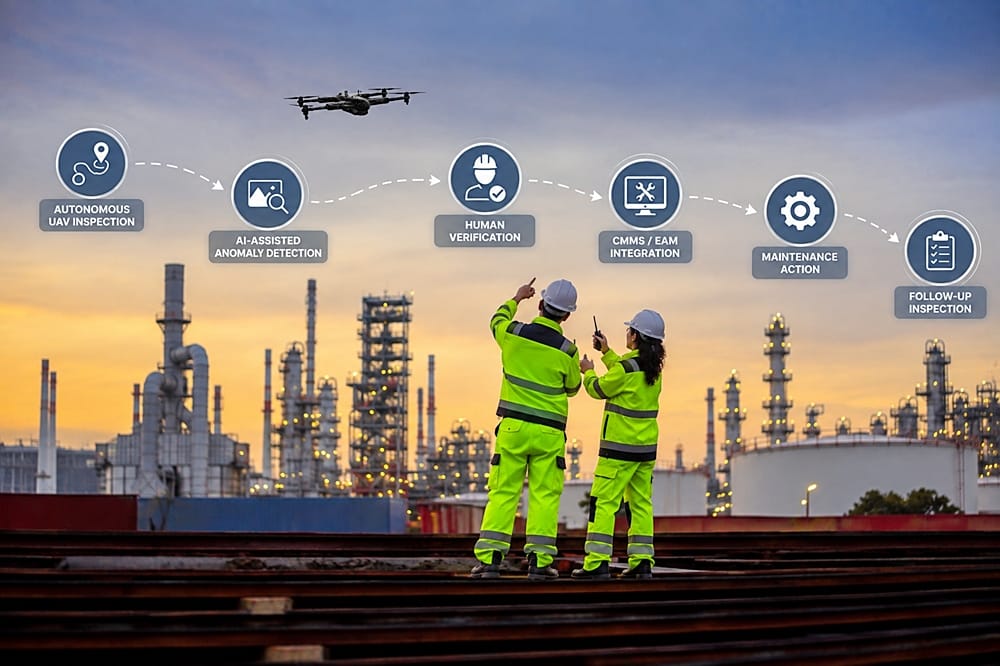
Connecting UAV Data With CMMS and EAM Systems
Much of the machinery and equipment will be managed electronically already. Many companies are already using Computerised Maintenance Management Systems (CMMS) and EAM systems to track maintenance work. They will have asset registers, records of inspections and work orders, etc.
UAV data is valuable when it is linked to existing data sets rather than left as a 'stand-alone' data set. As industrial maintenance becomes more data-driven, UAV drone technology can provide repeatable aerial data that supports asset monitoring, condition assessment, and maintenance planning while allowing qualified personnel to remain responsible for operational decisions.
For instance, a drone performing an autonomous inspection mission could take a photo of a specific asset and detect a possible surface defect. Once the image has been reviewed, the asset identification, location, date, the image itself, and the resulting classification could be linked to the asset to either create or update a work order based on specific maintenance procedures.
Studies conducted on the drone inspection of industrial facilities have also demonstrated workflows wherein the data acquisition by drones, including annotation with geolocation data, damage detection, and maintenance prioritization, are connected into a chain that greatly benefits from being part of a larger maintenance system. The two examples demonstrate why individual components are significantly improved when combined into a cohesive maintenance system.
AI Should Prioritise, Not Authorise
Computer vision can take data collection and maintenance action even closer together.
A big number of autonomous inspections would create thousands of images, and manually reviewing each image would take away part of the efficiency that one gains by collecting data automatically. Algorithms can spot patterns, compare notes and highlight suspected irregularities for human inspection.
UAS Vision has demonstrated the technique on aircraft maintenance. In one collaborative programme between Boeing, Skydio and McConnell Air Force Base, autonomous scans by drones were imported into software designed to spot defects, irregularities and other inspection-related problems.
The difference between finding something and deciding what to do about it, however, can be crucial.
An algorithm may find a suspected crack, corrosion area or thermal irregularity, but the consequences for maintenance depend on the situation. False positives, environmental influences, sensor limitations and specific tolerances must be taken into account. Algorithms can therefore act as a prioritization layer, narrowing down a large number of inspection targets to a smaller number requiring closer attention. Qualified personnel are still needed to assess each finding and decide what maintenance action, if any, is warranted.
That principle has already been applied in certain aviation operations. According to UAS Vision, Delta TechOps' drone inspection process uses semi-autonomous UAS to take pictures of the aircraft, while trained technicians and inspectors review the pictures and decide if the aircraft is safe for flight.
Closing the Loop After Repair
Do not stop the work order execution once maintenance is integrated.
The ability to fly a drone repeatedly on an asset is one of the most important attributes of autonomous UAV inspection. The same drone can come back after repairs or upgrades, using an identical inspection plan, and generate a new dataset.
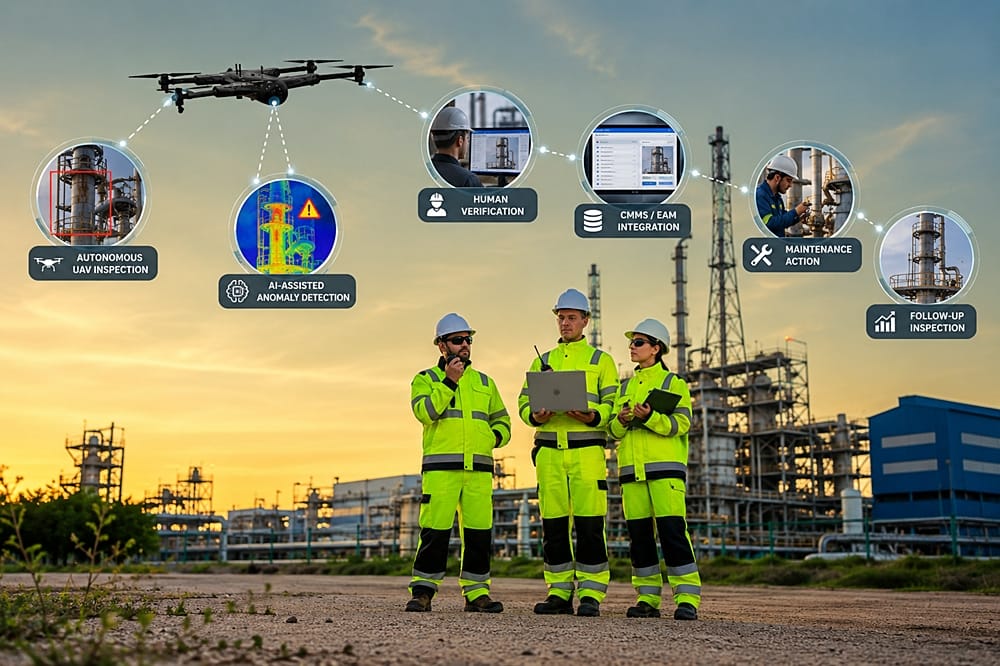
This opens up a closed loop:
Detect → Validate → Create Maintenance Action → Repair → Reinspect → Update Asset Record
The follow-up mission can record the restored state and leave a picture record of the feature for a history of the maintenance. For assets that are repeatedly observed, it also leaves a time series that can inform groups about whether a condition is holding, worsening or recurring.
This is especially true for autonomous systems since eventually repeatability will equal inspection speed.
The Integration Challenge
The technical challenge involved is not only about selecting the appropriate drone and sensor.
Industrial users require a method that allows them to relate the observations by the UAVs to asset identifiers, make decisions on which data needs to be stored, set up interfaces for CMMS or EAM solutions, define thresholds for alerts produced by the artificial intelligence, and leave certain steps for human approval.
The issue of interoperability cannot be overlooked either. The drones, analytical tools and maintenance management software will likely be supplied by different vendors. Without a clearly defined data model and a strategy of integration, industrial users are likely to create another information silo instead of making the maintenance better.
For professional UAS operators, this may turn out to be a critical component of their systems' architecture. Flying, sensing, and computer vision decide what the drones are able to observe. Integration decides on what will be operationally relevant.
From Inspection Tool to Maintenance System
The next step in the adoption of industrial UAVs may therefore be less about optimizing the inspection flight itself and more about binding the resulting information to maintenance operations.
A drone that has identified a potential defect has achieved only the first step. The true operational value manifests itself when the finding can be associated with the correct asset, reviewed by the right personnel, transferred into the maintenance environment and revisited post-corrective work.
When that loop is established, autonomous UAVs cease to be mere inspection tools. They enter the maintenance information chain.
Author: Andrew Mabry
Andrew is a technology researcher and analyst specialising in UAV and drone technology, artificial intelligence, machine learning, automation and emerging digital technologies. His work focuses on real-world applications of autonomous systems and translating complex technological developments into practical insights for professional audiences.