US Army Secretary says the Dronebuster is ‘F*cking Terrible’
Army Secretary Dan Driscoll criticized a counter-drone system that soldiers have been using for years, including as recently as last month.
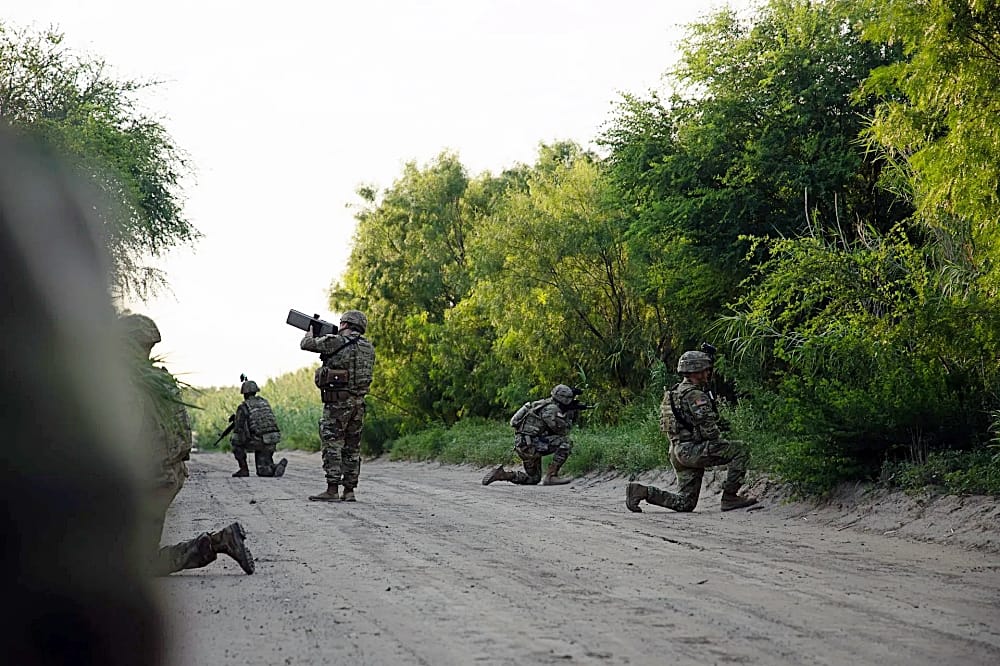
The Army’s most senior civilian official recently criticized a counter-drone system that soldiers have been employing for years, including in training and on patrols along the U.S.-Mexico border in recent months.
Army Secretary Dan Driscoll told soldiers during a town hall at Fort Drum, New York, this week that the Dronebuster — a handheld jammer designed to zap unmanned aerial systems out of the sky — is “fucking terrible” in his experience.
“It’s a joke,” he said. “It’s similar to things we deployed to Iraq with that just you’re thinking, like, ‘why is — who thought this was a good idea? What’s its use case?’ So whether that’s true or not doesn’t particularly matter, but if you agree that it’s terrible, you gotta say it.”
Driscoll’s comments come as the Army looks to boost its counter-UAS repertoire, a topic that often gets less attention compared to the snazzy, buzzing drones the military likes to showcase.
While the Defense Department has been investing in counter-UAS systems for nearly a decade, those efforts have been insufficient in “scale and urgency,” according to a September 2025 study from the Center for a New American Security, especially in the shadow of China’s massive drone industry.
“I think the broader drone issue has been talked about for a decade,” Driscoll said in part of his Dronebuster comments this week. “I think the war in Ukraine fundamentally altered the speed with which the development has occurred, and one of the reasons we haven’t gotten you what you need yet is that calcified, lowercase-c, corrupted decision-making system in the Pentagon.”
“The innovation’s occurring — it is fundamentally the ‘Silicon Valley’ of war, and it has been that way for a couple of years,” he added. “We and your senior leaders refuse to let that be the case anymore, we are actively catching up.”
Last August, the service was tapped to establish Joint Interagency Task Force 401, an Army-led effort meant to help deliver counter-small UAS (C-sUAS) capabilities across the military. As recently as Tuesday, the service was looking for C-sUAS solutions for infantry squads.
Dronebuster is a registered trademark from the company that makes the hand-held systems, DZYNE Technologies.
“DZYNE Technologies respectfully clarifies that the Secretary of the Army’s recent comments likely referred to early‑generation Dronebuster systems developed during a much earlier stage of the counter‑UAS landscape,” the company’s director of marketing, Trisha Navidzadeh told DefenseScoop in a statement in response to Driscoll’s comments, adding that earlier models requested by the Pentagon in 2016 were important at the time, but were “never designed to confront the speed, sophistication, and scale of today’s unmanned threats.”
“As drones have evolved immensely, DZYNE has heavily invested in advancing the Dronebuster platform through continuous modernization to ensure it remains fully aligned with current and emerging mission demands,” she said.
Whether Driscoll was indeed referring to older models or was lamenting hand-held anti-drone tech overall remains unclear. The Army did not respond to DefenseScoop’s multiple requests for comment, including whether the secretary was criticizing a specific Dronebuster system or the platform as a whole and why he thought it was ineffective.
The publication also asked if soldiers would continue to use the system and whether the Army would continue to buy them.
Army infantrymen in Italy were training on the new variation of DZYNE’s counter-UAS system — the Dronebuster Block 4 — as recently as last month. And soldiers were patrolling with the Dronebuster in Texas last June as part of President Donald Trump’s massive surge of troops to the U.S.-Mexico border.
“I was just at the border and the unit I was attached to — all they had for C-UAS was the Dronebuster,” a soldier who works in human intelligence told the panel, which included Driscoll, Army Chief of Staff Gen. Randy George and Sergeant Major of the Army Michael Weimer. “I’m sure there’s better stuff out there. Why can’t we field it yet?”
Military.com reported last April that Army leaders on the ground along the border were concerned about drones. George responded to the soldier by referencing JIATF-401, adding that the service had the equipment, but needed to scale and field it. He also said that the border “is going to be one of our testing areas.”
“I maintained my composure the first time Dronebuster came up — this time I can’t,” Driscoll said in his response to the soldier’s question, referencing an earlier comment in which he said the system was “a trigger word” for him. He then launched into his criticism of the system, calling it “fucking terrible.”
He noted that troops need high-quality platforms.
“There’s no points for performance theater. I think a lot of times, what is incentivized in a culture like the Army is performance theater, and that is required never,” he said. “It is you who has to deploy with this equipment. It is you who has to fight, and it is you and your buddies who need it to work. And you should demand from us that we get that for you.”
“And so it is a top priority for us that next year when we’re having this conversation, somebody can’t ask that same question, because instead they’re saying, ‘man, I saw a big change in counter drone,’” he said.
Navidzadeh said DZYNE “always welcome[s] the opportunity to host Army leadership” for field evaluations of how the newest model performs and that the company “provides an exclusive Dronebuster modernization program to the U.S. Army” that allows it to exchange its tech for an upgraded version.
Source: Defense Scoop