US Army Issues RFI for Enduring-High Energy Laser (E-HEL) C-UAS
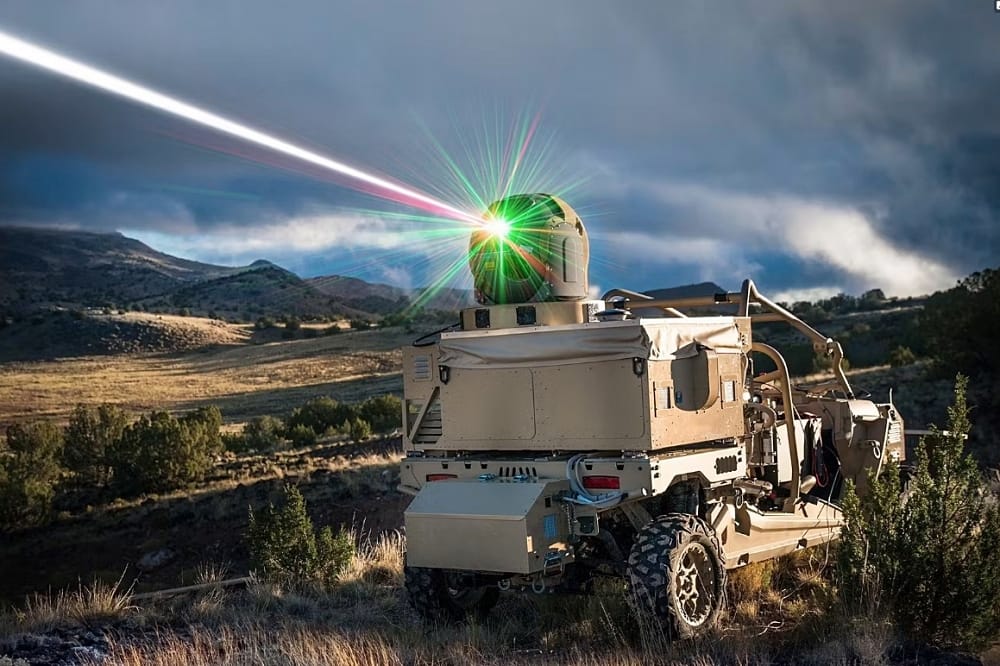
The Army Rapid Capabilities and Critical Technologies Office (RCCTO) Directed Energy Project Office (DEPO) is seeking information on potential sources that could provide the necessary technical skills, facilities, tooling, and personnel to produce a Counter-Unmanned Aircraft System (C-UAS) High Energy Laser (HEL) weapon system to protect semi-fixed and maneuver forces against Groups 1-3 UASs. This weapon system is designated as the Army Enduring-High Energy Laser (E-HEL).
Overview
a. The U.S. Government intends to produce up to twenty (20) E-HELs using a modular open system approach (MOSA) leveraging range proven laser and beam control technologies. Range proven technologies are defined as technologies demonstrated on a Government test range and witnessed by Government representatives. Paragraph 4 below identifies an opportunity for industry to demonstrate capability for Groups 1 and 3 on a test range with DEPO representatives, if vendors do not have recent Government witnessed test data available. E-HEL is expected to produce a hard kill (inability for the UAS to maintain flight) of Group 1 and 2 UAS and one-way attack (OWA) Group 3 UAS. DEPO will also witness the key attributes of fluence, tracker performance, engagement track range and laser quality track to determine if systems that do not achieve a hard kill on Group 3 UAS have the potential to scale and be lethal against Group 3 OWA threat UAS.
b. The E-HEL weapon systems shall support both semi-fixed and maneuver operations, with the E-HEL being capable of operating in a “palletized” configuration or integrated onto a standard Army Joint Light Tactical Vehicle (JLTV) vehicle. E-HEL is intended to track Group 1-3 UASs in both “blue sky” and cluttered conditions based upon accepting external Forward Area Air Defense (FAAD) cues to the UAS.
c. The E-HEL MOSA is based upon the Directed Energy Weapon System (DEWS) MOSA Reference Architecture (RA) Version 1.0 Use Guidance, June 2022. All E-HEL subsystem interfaces will come with Government Purpose Rights (GPR) and industry may leverage Government provided interface control documents (ICDs) or provide industry ICDs that have GPRs. To support deployment, E-HEL will incorporate provisions to allow for material handling using standard load-handling equipment (forklift) to enable ease of movement and emplacement, be ground transportable and meet air transport requirements for a C-17.
Source: SAM.gov