US Air Force Considers Atomic Clock Tech for Drone Swarms
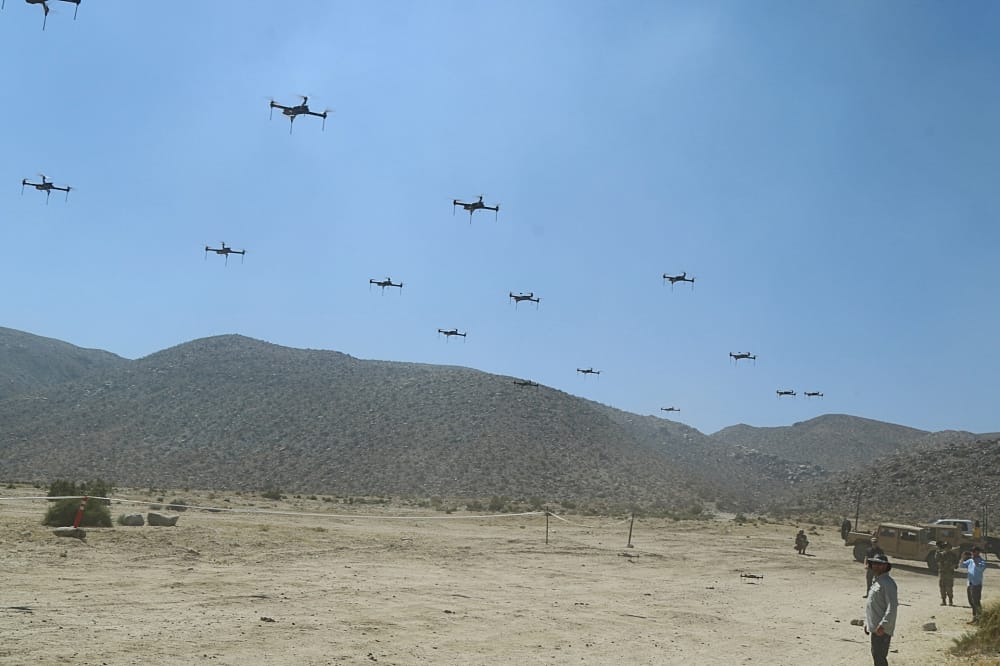
The U.S. Air Force is seeking new technological solutions to coordinate swarms of small unmanned aircraft in contested environments where traditional satellite navigation is compromised.
A new request for information (RFI) released by the Air Force Research Laboratory (AFRL) outlines plans to develop advanced position, navigation, and timing (PNT) systems for drone swarms operating in GPS-denied and spoofed environments.
According to the request, published under solicitation number FA2377-26-R-B002, AFRL’s Navigation and Communication Branch (AFRL/RYWN) is gauging industry interest in a ruggedized testbed known as the Joint Multi-INT Precision Reference (JMPR), which integrates Next Generation Atomic Clock (NGAC) technology to enable high-precision synchronization without relying on GPS.
“The government anticipates those who respond to this request for information to be focused on the ability to achieve extremely high timing coherency between UAS in the swarm, with single-digit picosecond stability and sub-nanosecond accuracy,” the RFI stated.
This initiative comes amid growing global efforts to disrupt satellite-based systems. Russian forces have employed extensive GPS jamming and spoofing in their war against Ukraine, while China is reported to be developing similar capabilities across potential regional theaters. As these threats evolve, the Pentagon is looking to secure new methods of enabling coordinated drone operations without exposure to electronic warfare vulnerabilities.
The proposed system would allow swarms of small drones to communicate and coordinate their movements by creating local reference frames using only onboard sensors and relative positioning with other platforms. The AFRL emphasized the need for a “decentralized open PNT architecture” capable of what it calls “cold-start, progressively enhanced PNT,” meaning drones would establish and refine spatial awareness even from a zero-reference state.
Among the key objectives laid out in the document are the ability to maintain sub-nanosecond timing accuracy, withstand electronic warfare attacks, and operate under low size, weight, and power (SWaP) constraints typical of small drone systems. The system must also be scalable to support larger swarms and provide the capability for mission applications including coordinated targeting, sensor fusion, and adaptive flight paths.
Industry responses are due by September 19, 2025. AFRL has specified that submissions should include performance models, test data, and an assessment of technical gaps in existing commercial radio equipment when integrated into a decentralized PNT system. Solutions should also address cold-start scenarios, where platforms must independently establish timing and location awareness without external support.
Photo: The 11th Armored Cavalry Regiment and the Threat Systems Management Office operate a swarm of 40 drones to test the rotational units capabilities during the battle of Razish, National Training Center on May 8th, 2019. This exercise was the first of many held at the National Training Center. (U.S. Army Photo by Pv2 James Newsome)
Source: Defence Blog