Drones Help US Navy Destroyer Hit Target at 250 Miles
Using a blend of information from unmanned and manned ships and aircraft, a guided-missile destroyer launched an anti-surface missile from over-the-horizon to hit a target more than 250 miles away without using active sensors as part of the Unmanned Integrated Battle Problem 21, Navy officials said on Monday.
The target was equipped with a small radar reflector and a repeater that put out an electromagnetic signal. The signal from the repeater was detectable by sensors on the uncrewed aircraft and manned and unmanned surface vessels, said Carrier Strike Group 3 commander Rear Adm. James Aiken during a Monday call with reporters.
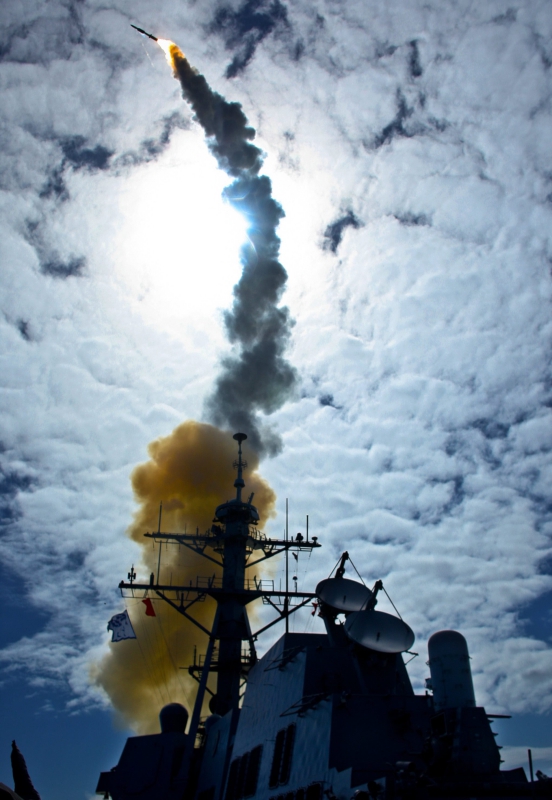
The information was relayed to USS John Finn (DDG-113), which used the blended targeting data to fire a Standard Missile-6 to hit the target more than 200 miles away and beyond the range of its powerful radar.
“It was really complex… We teamed manned and unmanned vessels together. We also used the fusing capability that we’re doing some experimentation on. It was totally passive where we didn’t have active sensors on target,” Aiken said. “We also look for space as well to actually identify the target and then once we found the target, we were able to track it because of the [electromagnetic signal] that was coming off the target, develop lines of bearing, then launched the missile.”
The anti-surface missile shot of the SM-6 is a proof of concept of how the Navy could augment its very powerful but very detectable targeting radars with a blended network of passive sensors that could share targeting data without alerting the target. The test also shows how the lethal radius of a surface-launched missile could expand well beyond a ship’s radar range, which is limited by the curvature of the Earth.
“This was an important step in moving the ball down the field to getting unmanned plugged into that targeting solution,”
U.S. Pacific Fleet Maritime Headquarters director Rear Adm. Robert Gaucher told reporters.
Driving much of the Navy’s thinking in how it develops its future surface fleet, both manned and unmanned, is the development of Chinese anti-ship missiles that are designed to threaten U.S. surface ships in areas close to the Chinese mainland like the South China Sea.
said in January
The danger of Chinese DF-21 or DF-26 anti-ship ballistic missiles finding ships from active sensors has given the Navy pause in how it’s going to develop its own future surface combatants and driven the service to consider so-called attritable unmanned systems with passive sensors that don’t give away their location to an enemy.
A passive multi-static sensor scheme, like the one demonstrated in the SM-6 shot, that would fuse several sources into a single targeting solution would better protect the surface fleet from threats like anti-ship ballistic missiles than using a single ship with a powerful active sensor.
The SM-6 shot was one of three vignettes in the battle problem that was the Navy’s largest exercise to date blending manned and unmanned. Other scenarios included using unmanned systems for anti-submarine warfare and information surveillance and reconnaissance.
The goal of the battle problem was to test the capability with fleet sailors and better inform how the service could use the systems in the future.
Aiken said last week
Source: USNI News