Ukrainian Drones Strike Russia’s Rare Be-12 Flying Boats
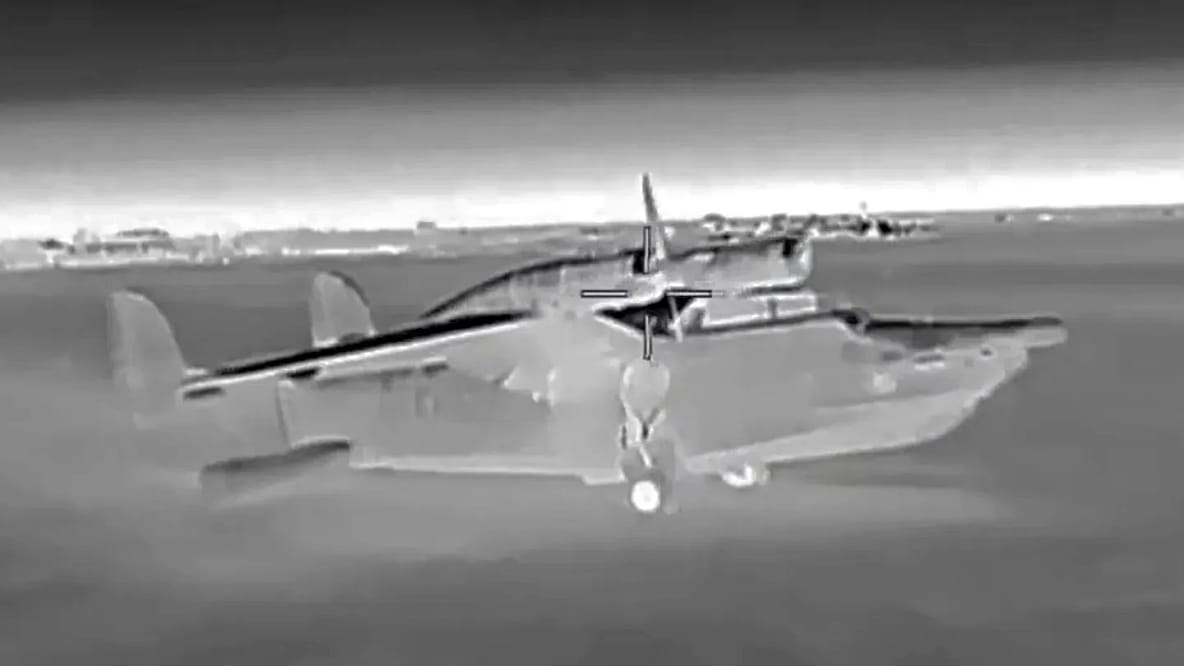
In what it claims is the first such attack in history, Ukraine has used drones to strike a pair of Russian Navy Be-12, a twin-turboprop amphibious aircraft. The raid appears to have targeted two of the extremely scarce seagoing planes, potentially halving the number of airframes available to Russia and leaving a question mark over the future service for the type.
According to the Ukrainian Ministry of Defense’s Main Intelligence Directorate (GUR), the drone strike was carried out on September 21 by the “Ghost” special forces unit.
https://x.com/DefenceU/status/1970046441318977699
The Be-12 Chayka is a Soviet anti-submarine aircraft designed in the 1950s. Built by the manufacturer Beriev to be capable of flying from both land and water, the Be-12 was the successor to the Be-6 flying boat and shares many of its predecessor’s amphibious features.
Known as Seagull in Russian and codenamed Mail by NATO, was first flown in 1960 and then served throughout the rest of the Cold War. It has played an unsung but important role since Russia’s full-scale invasion of Ukraine, most notably helping hunt for Ukrainian uncrewed surface vessels (USVs), or ‘drone boats,’ in the Black Sea.
To demonstrate its age, the photograph used in the graphic below shows a Be-12 on display at a Russian museum.
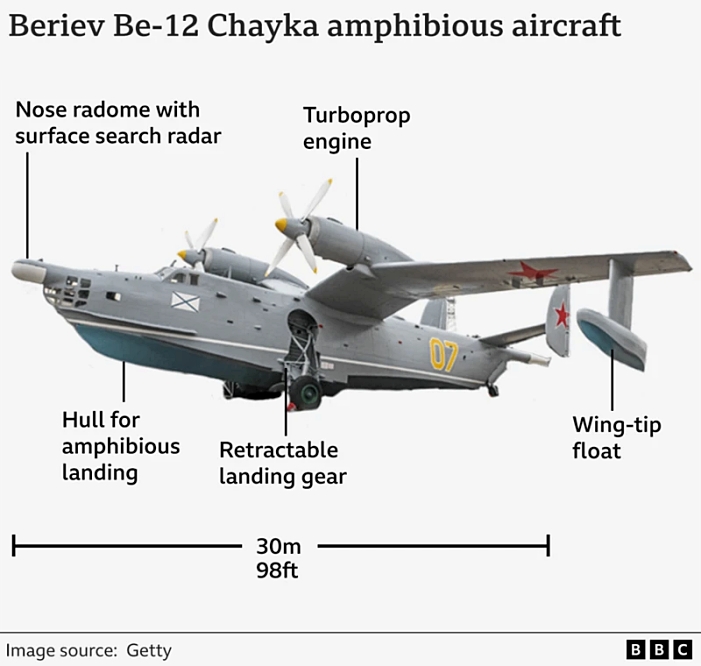
“Efforts to replace the aging Be-12s with more modern Be-200 anti-submarine aircraft have stalled in recent years,”
Alexander Lord from the Sibylline security consultancy told the BBC.
“While old and designed for a different age of naval warfare, the Be-12s have likely played a role in conducting maritime patrols and protecting Russia's Black Sea Fleet from Ukraine's uncrewed surface vehicles or maritime drones,” said Lord.
According to the UK Ministry of Defence, external, the aircraft remains a “key Russia asset” in those air patrols that are “flying out of bases in occupied Crimea.”
“It is possible that this was just a target of opportunity, or it may be that Ukraine is seeking to degrade Russia’s maritime surveillance capabilities in advance of a specific operation,”
added Mike Plunkett, a naval expert from the defence intelligence company, Janes.
What is clear, however, is that the number of these amphibians available to Russia was already strictly limited.
The U.K.-based International Institute for Strategic Studies (IISS) think tank reports that, at the beginning of 2023, Russia had six Be-12s. All were said to be in the Be-12PS search-and-rescue configuration. Recent satellite imagery of Kacha airfield in Crimea shows seven or eight Be-12s, of which four or five were airworthy, according to the Ukrainian Channel 24.
Provided that the two aircraft struck by the GUR were airworthy, and both are now either destroyed or damaged beyond repair, then the Be-12 force available to the Russian Navy may well have been halved. On the other hand, the fact that one aircraft appears to lack a propeller on one of its engines suggests it might already have been withdrawn from use. It could still be a highly valued source for spare parts though.
In an uncontested environment, the Be-12 still offers useful reconnaissance capabilities. Its radar is able to provide a basic situational awareness picture of the coastline, as well as detect ships, in a sea-control role. More importantly, especially for USV detection, is the extensively glazed nose station, accommodating the navigator/observer.
Sources: BBC; The War Zone