Ukraine Hits Russian Bomber Bases with FPV Drone Swarm
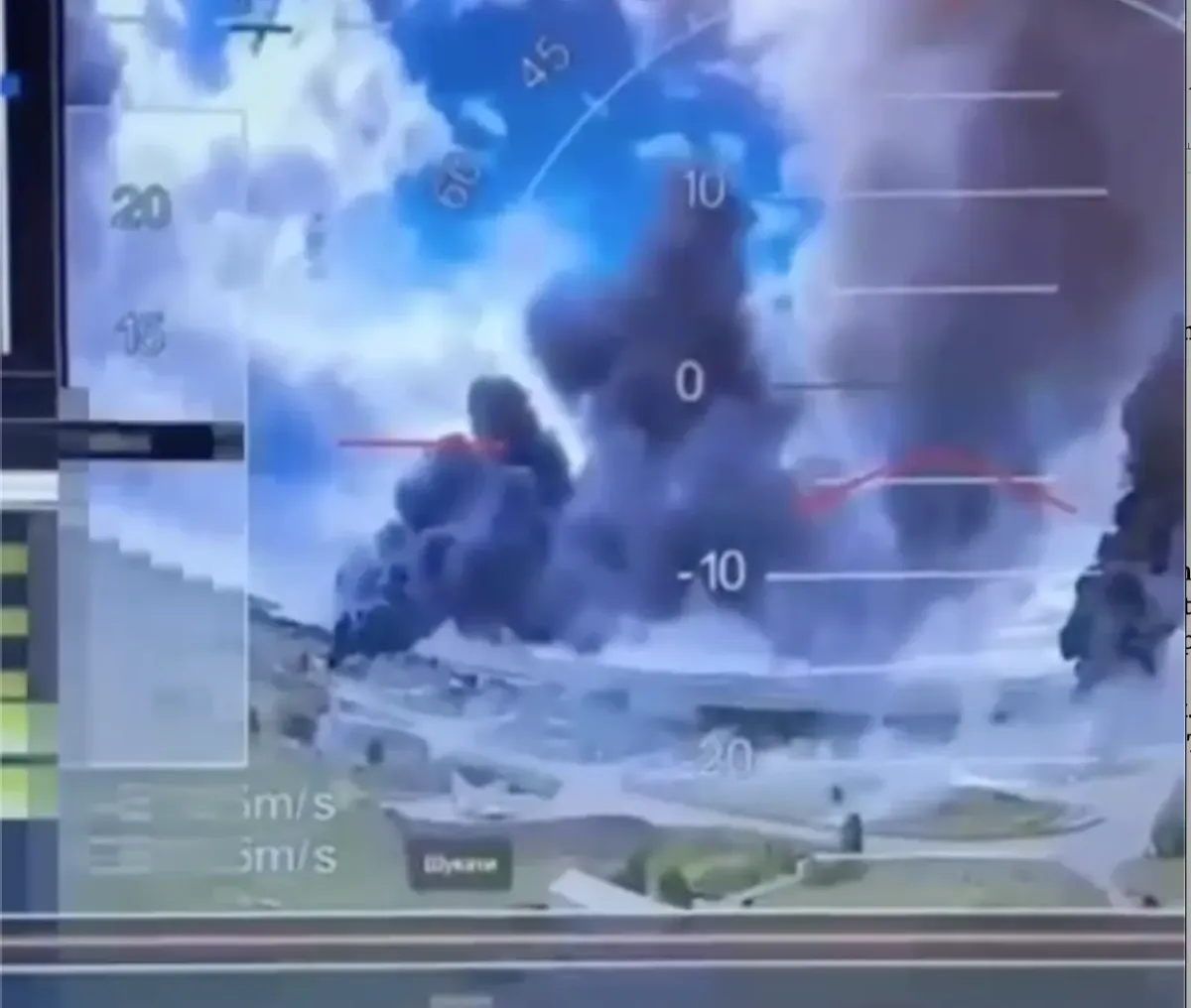
Ukraine has launched what appears to be its largest drone-based operation to date, striking key Russian air bases that house strategic bombers used in long-range attacks against Ukrainian cities.
An operation by Ukraine's Security Service (SBU) using first-person-view (FPV) drones smuggled deep into Russian and hidden inside trucks has hit 41 Russian heavy bombers at four airfields across the country, a source in the agency told the Kyiv Independent on June 1.
The operation — codenamed "Web" and a year-and-a-half in the planning — appears to have dealt a major blow to the aircraft Moscow uses to launch long-range missile attacks on Ukraine's cities.
"The SBU first transported FPV drones to Russia, and later on the territory of the Russian Federation, the drones were hidden under the roofs of mobile wooden cabins, already placed on trucks," the source said.
According to information released by Ukrainian officials, the operation involved swarms of FPV drones remotely launched from vehicles positioned near the airfields. These mobile platforms were reportedly parked within proximity of the targets, enabling direct line-of-sight control for precise navigation and terminal attack.
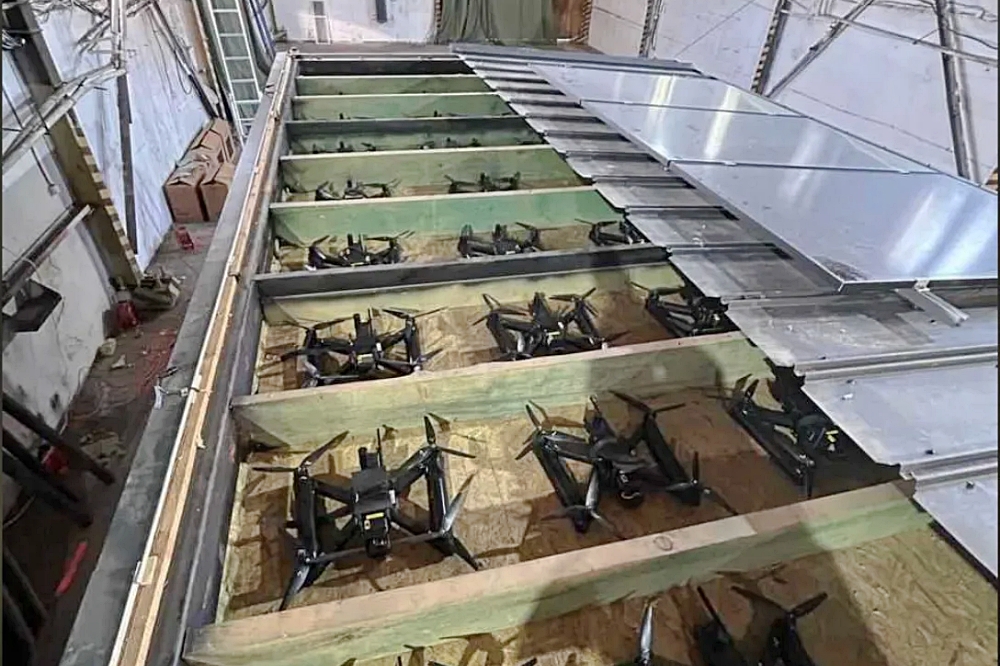
"At the right moment, the roofs of the cabins were opened remotely, and the drones flew to hit Russian bombers."
The source said one of the airfields hit was the Belaya air base in Russia's Irkutsk Oblast, more than 4,000 kilometers from Ukraine. [embed]https://vimeo.com/1089485267[/embed] Olenya air base in Russia's Murmansk Oblast, the Diaghilev airbase in Ryazan Oblast, Ivanovo airbase in Ivanovo Oblast were also targeted.
"SBU drones are practicing on aircraft that bomb Ukrainian cities every night. Currently, more than 40 aircraft are known to have been hit, including the A-50, Tu-95 and Tu-22 M3," the source added.
Unconfirmed videos posted on social media show FPV drones being launched from trucks parked near the airfields.
Irkutsk Oblast Governor Igor Kobzev later confirmed "a drone attack on a military unit in the village of Sredny" and said the "source" of the drones was a "truck." Murmansk Governor Andrey Chibis later confirmed that "enemy drones have attacked the territory of the Murmansk region" but gave no further details.
[embed]https://vimeo.com/1089487573[/embed] The source said that those behind the operation have "been in Ukraine for a long time."
"So, if the Putin regime demonstratively detains someone, it will be another staged performance for the domestic audience," they said. President Volodymyr Zelensky personally oversaw the operation, they added.
President Volodymyr Zelensky said 117 drones were used in the so-called "Spider's Web" operation by the SBU security service, striking "34% of [Russia's] strategic cruise missile carriers" He said that each of the 117 drones launched had its own pilot.
In several posts on social media late on Sunday, Zelensky said he congratulated SBU head Vasyl Maliuk with the "absolutely brilliant result" of the operation.
"The most interesting thing - and we can already say this publicly - is that the 'office' of our operation on Russian territory was located right next to the FSB of Russia in one of their regions," the Ukrainian president said.
The FSB is Russia's powerful state security service.
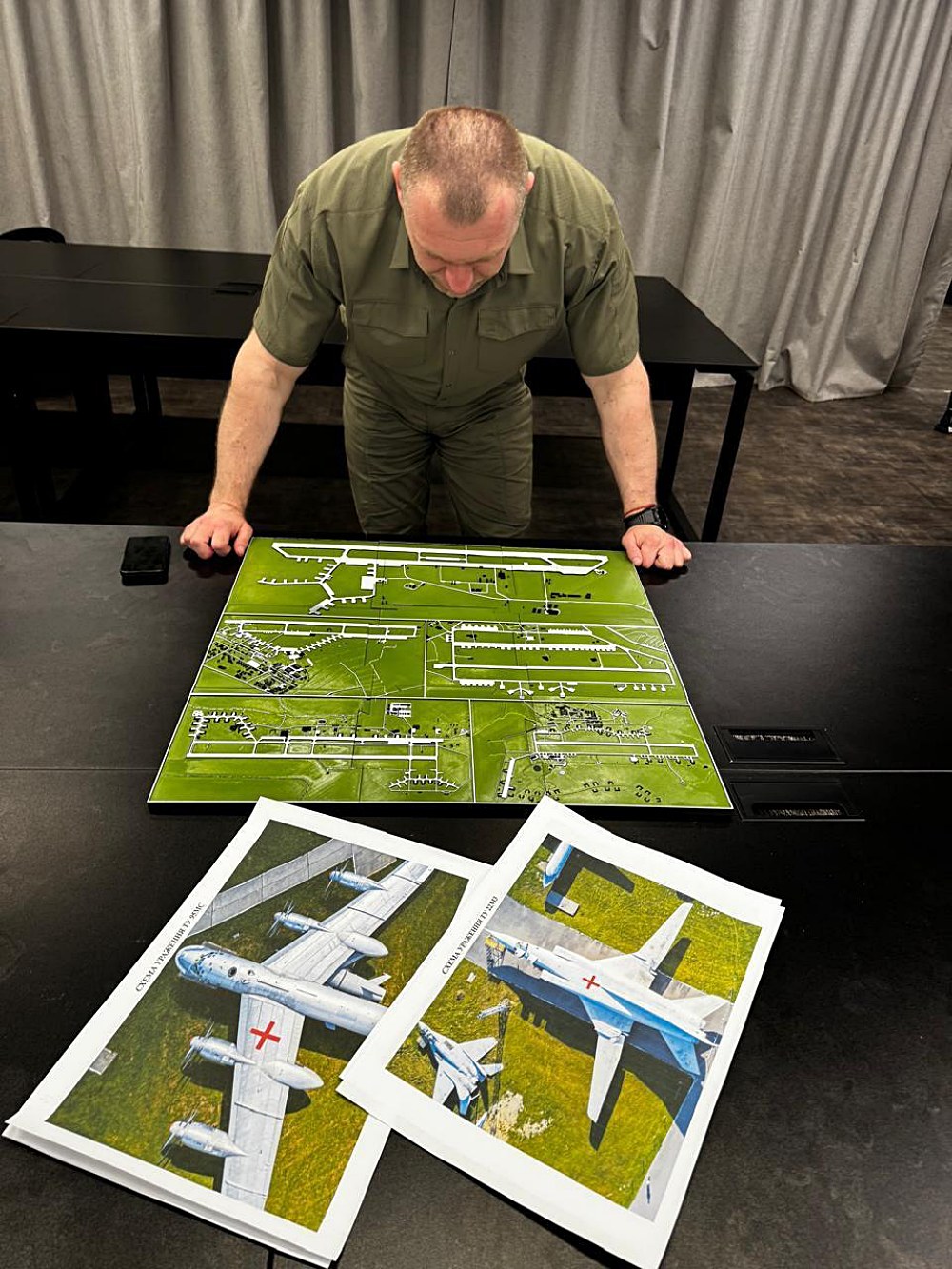
Zelensky also said that all the people involved in the operation had been safely "led away" from Russia before the strikes.
The SBU estimated the damage to Russia's strategic aviation was worth about $7bn (£5bn), promising to unveil more details soon. The Ukrainian claims have not been independently verified.
Sources in the SBU earlier on Sunday told the BBC in a statement that four Russian airbases - two of which are thousands of miles from Ukraine - were hit:
- Belaya in Irkutsk oblast (region) Siberia
- Olenya in Murmansk oblast, Russia's extreme north-west
- Dyagilevo in central Ryazan oblast
- Ivanovo in central Ivanovo oblast
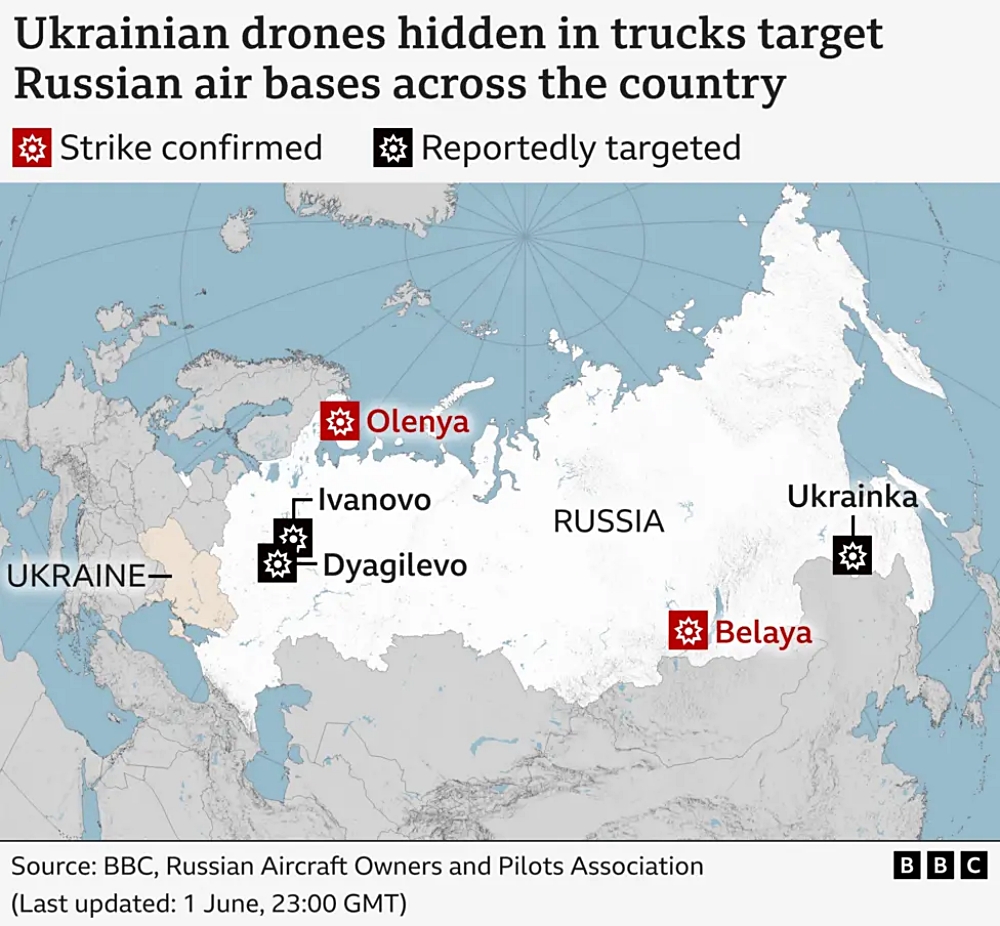
The SBU sources said that among the hit Russian aircraft were strategic nuclear capable bombers called Tu-95 and Tu-22M3, as well as A-50 early warning warplanes.
"No intelligence operation in the world has done anything like this before," defence analyst Serhii Kuzan told Ukrainian TV. "These strategic bombers are capable of launching long-range strikes against us," he said. "There are only 120 of them and we struck 40. That's an incredible figure."
It is hard to assess the damage, but Ukrainian military blogger Oleksandr Kovalenko says that even if the bombers, and command and control aircraft were not destroyed, the impact is enormous.
"The extent of the damage is such that the Russian military-industrial complex, in its current state, is unlikely to be able to restore them in the near future," he wrote on his Telegram channel.
The strategic missile-carrying bombers in question, the Tu-95, Tu-22, and Tu-160 are, he said, no longer in production. Repairing them will be difficult, replacing them impossible.
The loss of the supersonic Tu-160, he said, would be especially keenly felt.
"Today, the Russian Aerospace Forces lost not just two of their rarest aircraft, but truly two unicorns in the herd," he wrote.

Drones Assembled Inside Russia: Chelyabinsk Warehouse Geolocated
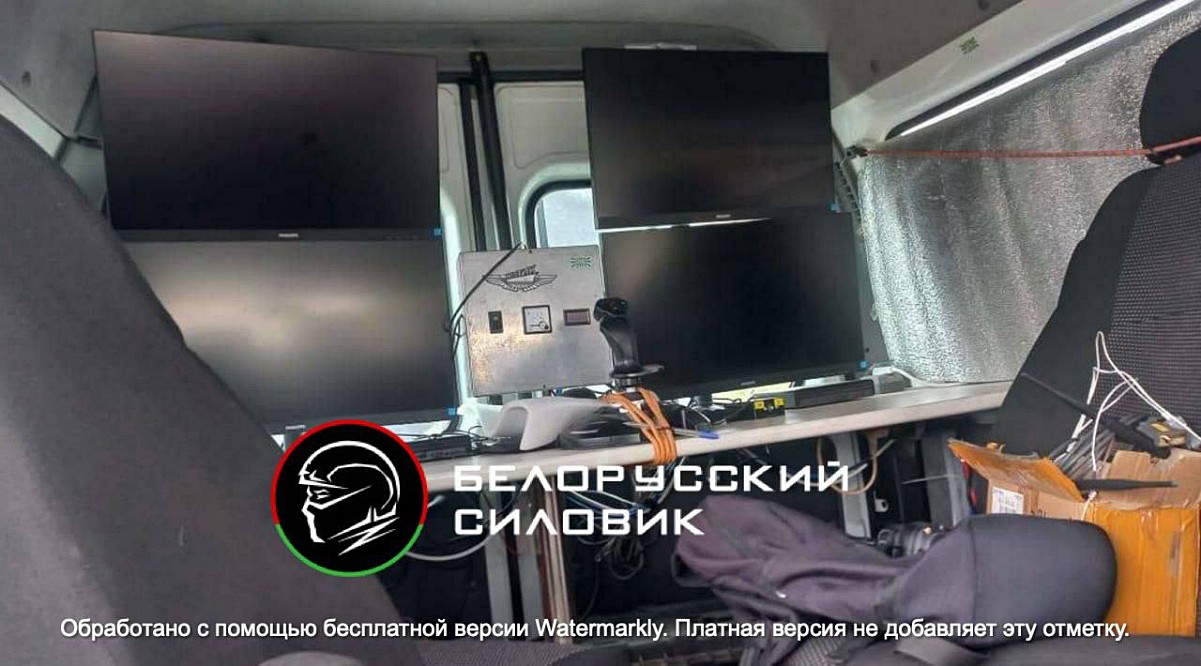
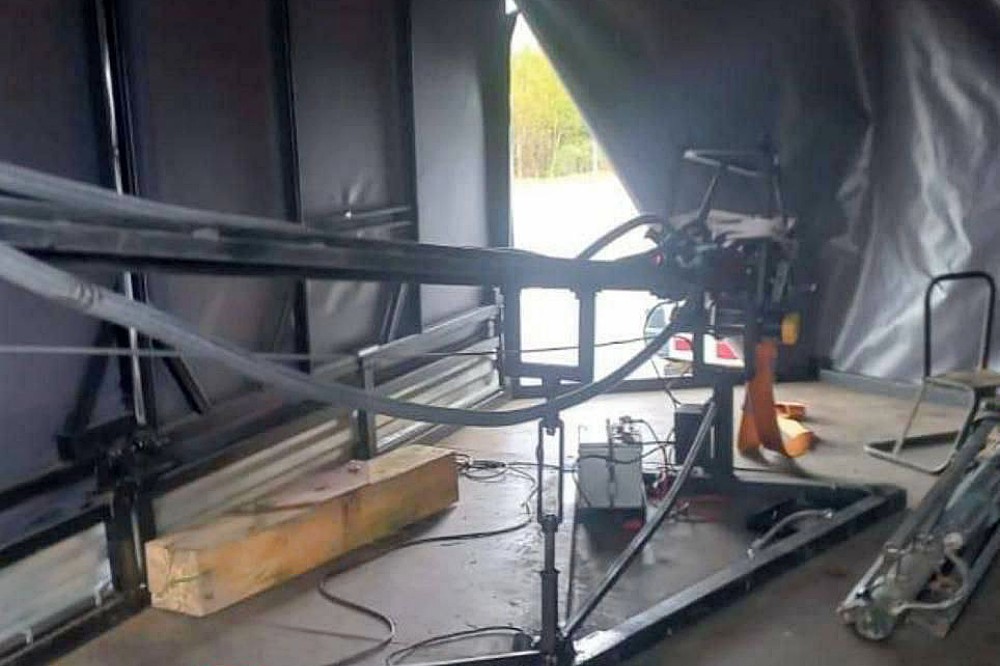
Ukrainian Telegram channels analyzed photos related to the operation that surfaced earlier today — including images showing drone containers — and identified a warehouse facility inside Russia that matched the visuals. The facility was geolocated to a warehouse in Chelyabinsk Oblast, at 28A Sverdlovsky Trakt, reportedly rented by the company Dan-Invest. The facility is located near the Kazakhstan border, which may have served as a supply route for components.
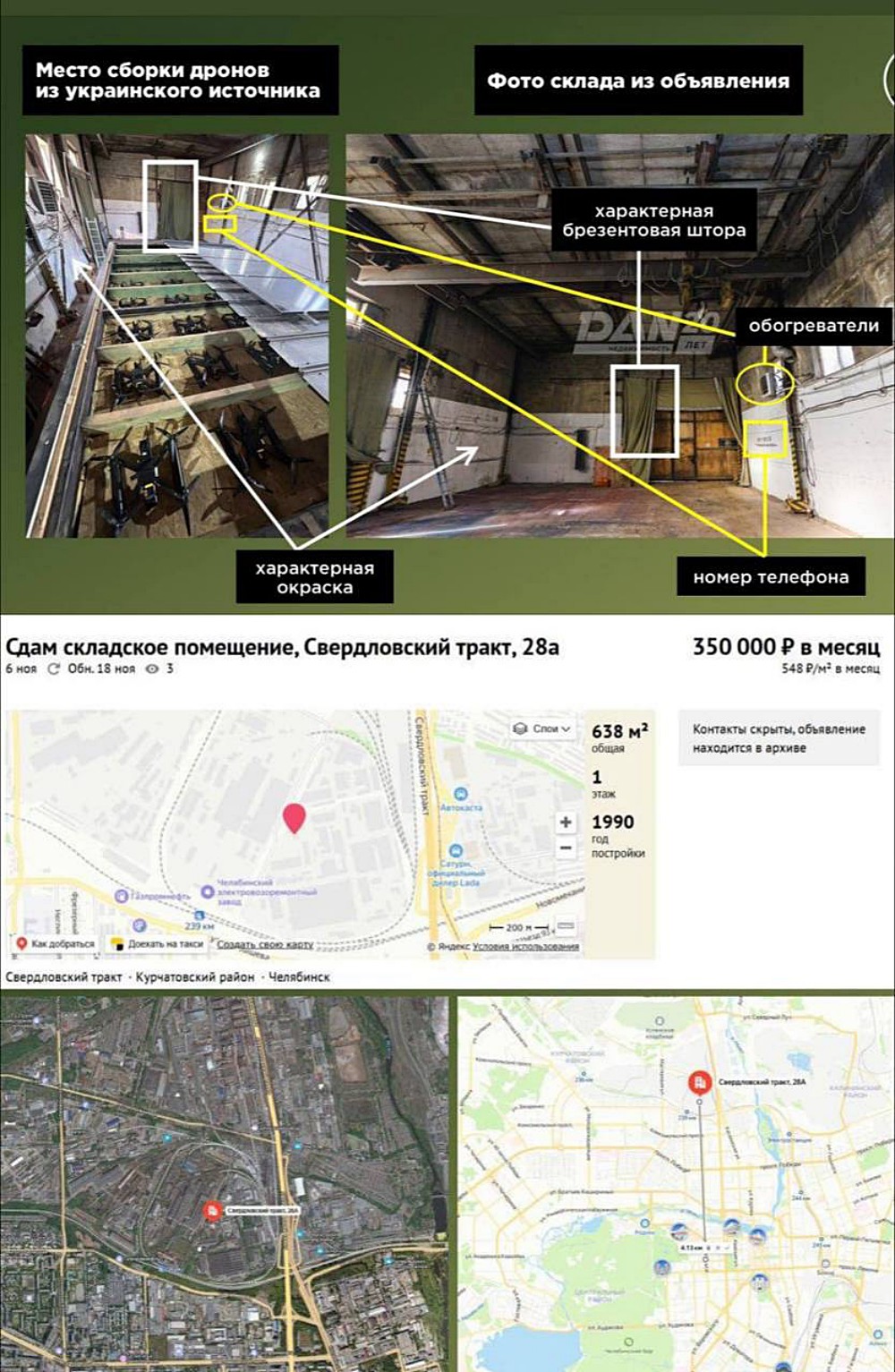
This supports President Zelenskyy’s claim that drones and launchers were assembled on Russian territory.
The Russian Aircraft Hit
The A-50 provides several critical functions for the ongoing war in Ukraine, such as detecting air defense systems, guided missiles, and coordinating targets for Russian fighter jets.
Russia possesses less than ten of these planes. A-50 aircraft have an estimated price tag of around $350 million.
The the Tupolev Tu-95, the Tupolev Tu-22, as well as the Tupolev Tu-160, are all Russian heavy bombers regularly used to launch missiles at Ukrainian cities.
The Tu-95 is the older of the three aircraft, a Soviet-era plane that made its first flight in 1952. It was originally used to carry nuclear bombs but has since evolved to launch cruise missiles.
Each aircraft can carry 16 cruise missiles – either the Kh-55/Kh-555 or the newer Kh-101 and Kh-102 air-launched cruise missiles.
Almost 5,000km from Ukraine, a Ukrainian drone operator takes his time in choosing the perfect point of impact to destroy this Tu-95 strategic bomber
[embed]https://vimeo.com/1089515831[/embed] It features turboprop propellers rather than jet engines, as during the Cold War, their increased efficiency allowed it to fly all the way to the United States without refueling.
The Tu-22 carries the Kh-22 missiles, which pose a particular problem for Ukraine. It is supersonic and travels at around 4,000 kilometers per hour. Currently, it can only be shot down with the U.S.-made Patriot air defense system and potentially the SAMP-T, a joint Italian-French system.
The Tu-160 is Russia's more modern strategic bomber, entering service in 1987. To this day, it remains the largest operational bomber in the world.
It can carry a total of 12 Kh-55 missiles and up to 24 Kh-15s.
Sources: THE KYIV INDEPENDENT; X; BBC; Euromaidan