UK Research on Drones’ Role in Future Construction
A new wave of technology is poised to revolutionize the industry, with flying robots at the forefront. Researchers in the UK are exploring how drones could not only build skyscrapers but also transform how we approach construction, from routine repairs to disaster relief efforts.
Reaching New Heights: the Promise of Aerial Construction
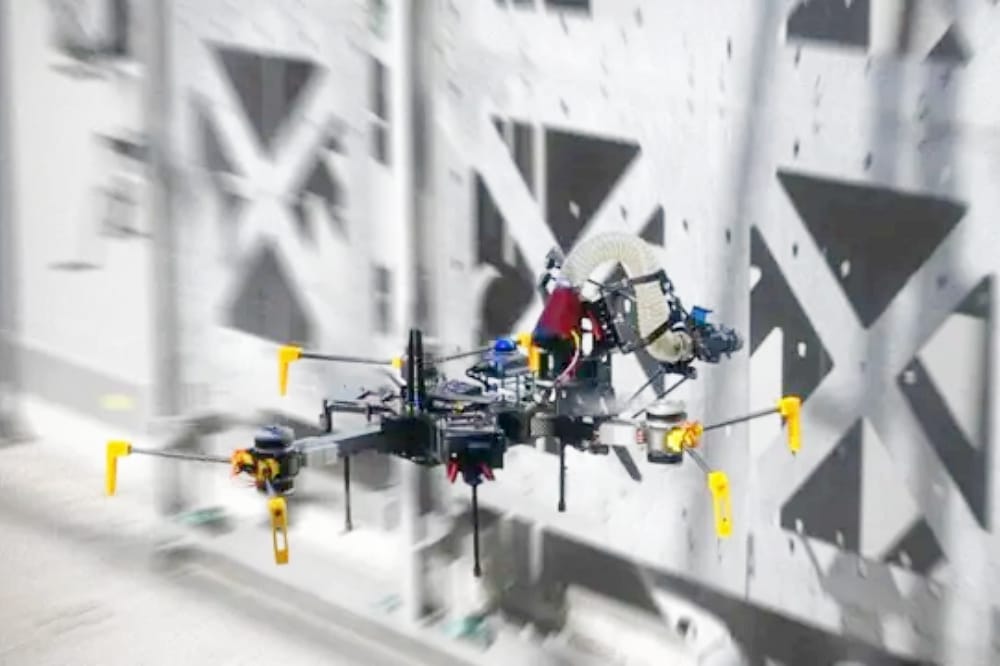
The study*, a collaboration between Imperial College London and the University of Bristol, dives into the potential of aerial robots to perform Aerial Additive Manufacturing (Aerial AM). This process, which involves drones depositing materials mid-air autonomously, is a significant leap forward in construction technology. The advantages are clear: scalability, access to hard-to-reach locations, and the ability to perform rapid on-demand repairs. Imagine drones effortlessly scaling a skyscraper to fix a crack in the facade or constructing an emergency shelter in a disaster zone, all without the need for traditional scaffolding or ground-based systems.
Unlike traditional construction methods, aerial robots offer unparalleled flexibility. They can operate in complex terrains, navigate mountains, rooftops, and even areas inaccessible to conventional equipment. Drones can be deployed in swarms, offering scalability and the ability to adapt to different project needs. This approach also promises to reduce transport distances, lower material consumption, and create safer construction sites. The researchers have developed an autonomy framework tailored for Aerial AM, which tackles the key challenges of flight coordination, precise material deposition, and scaling up for large-scale projects.
Facing the Challenges: Obstacles to Overcome
While the potential is immense, significant hurdles remain. According to the researchers, challenges such as material durability, reliable localization systems for outdoor environments, and coordinating multiple drones must be addressed. Current construction robots often rely on heavy, ground-based systems that lack mobility and flexibility, especially when working at height or on uneven surfaces. The good news is early demonstrations of Aerial AM have showcased the potential of rapid on-demand repairs and modular assembly, paving the way for broader adoption across industries.
The technology is being tested at DroneHub in Switzerland, the first real-world platform for flying construction machines outside a lab. This provides a valuable opportunity to refine the technology and understand its practical applications. One area where aerial robots shine is disaster relief. They can access areas inaccessible to ground vehicles, deliver materials, construct emergency shelters, and perform repairs on high-rise structures without scaffolding.
The Future of Construction: Intelligent and Adaptable Robots
The researchers are developing an autonomy framework with five stages. It ranges from basic route-based flights to full independence, where aerial robots can analyze their environment, detect errors, and adapt designs in real-time. This marks a practical development roadmap. The goal is for aerial robots to understand the materials they are working with and the environment they are in, optimizing the structure during construction.
Lightweight, stable, and workable materials are essential for the technology’s success. Construction designs must also evolve to accommodate the limited precision of aerial robots, ensuring that the structures are both safe and reliable. This approach is not just theoretical; it’s a practical development roadmap that is poised to revolutionize construction.
*The study can be accessed here.
Source: 59Hardware