The Plane With the Most Dangerous Wing in the World
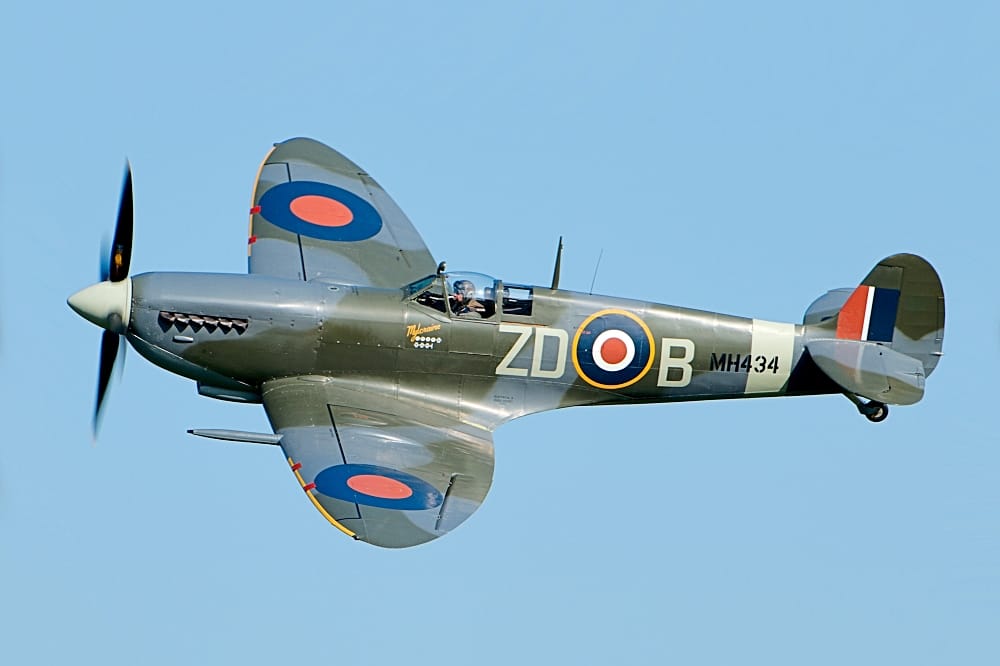
A Spitfire tears over an English village, skimming over the treetops. Below, an old woman drops her basket in shock. Flight Lieutenant "Geoff" Wellum shouts, "Sorry if I frightened you, my love!", grinning widely. Nineteen years old. Barely six hours of solo time. And here he is, gripping the controls of a Supermarine Spitfire Mk I. With a top speed of 370 miles per hour, it feels like flying a wild animal. Geoff grins widely.
Then the radio crackles. German aircraft in the vicinity. Intercept immediately. He slams the throttle. His 1,000 horsepower Merlin Engine screams. Geoff has no idea how green he is. A Messerschmitt Bf 109 gets the drop on him and plunges from the clouds behind him, cannon blazing.
Shells rip past his canopy. Geoff yanks the stick all the way to the right. The Spitfire shudders into a savage turn. Over six Gs of force crush him. The engine overheats. Oil pressure is dropping. Vision tunneling. It’s an impossible turn, but if any aircraft can handle it, it is the Spitfire.
Incredibly, the 109 sticks to him like a shadow. The ground is rushing up at them as they spiral downward, each trying to outturn the other. First one to give in, black out, or break the turn will not see another day.
The Supermarine Spitfire is a British single-seat fighter aircraft that was used by the Royal Air Force and other Allied countries before, during, and after World War II. It was the only British fighter produced continuously throughout the war. The Spitfire remains popular among enthusiasts. Around 70 remain airworthy, and many more are static exhibits in aviation museums throughout the world.
The Spitfire was a short-range, high-performance interceptor aircraft designed by R. J. Mitchell, chief designer at Supermarine Aviation Works, which operated as a subsidiary of Vickers-Armstrong from 1928. Mitchell modified the Spitfire's distinctive elliptical wing (designed by Beverley Shenstone) with innovative sunken rivets to have the thinnest possible cross-section, achieving a potential top speed greater than that of several contemporary fighter aircraft, including the Hawker Hurricane. Mitchell continued to refine the design until his death in 1937, whereupon his colleague Joseph Smith took over as chief designer.
Smith oversaw the Spitfire's development through many variants, from the Mk 1 to the Rolls-Royce Griffon-engined Mk 24, using several wing configurations and guns. The original airframe was designed to be powered by a Rolls-Royce Merlin engine producing 1,030 hp (768 kW). It was strong enough and adaptable enough to use increasingly powerful Merlins, and in later marks, Rolls-Royce Griffon engines producing up to 2,340 hp (1,745 kW). As a result, the Spitfire's performance and capabilities improved over the course of its service life.

During the Battle of Britain (July–October 1940), the more numerous Hurricane flew more sorties resisting the Luftwaffe, but the Spitfire captured the public's imagination, in part because the Spitfire was generally a better fighter aircraft than the Hurricane. Spitfire units had a lower attrition rate and a higher victory-to-loss ratio than Hurricanes, most likely due to the Spitfire's higher performance. During the battle, Spitfires generally engaged Luftwaffe fighters—mainly Messerschmitt Bf 109E–series aircraft, which were a close match for them.
After the Battle of Britain, the Spitfire superseded the Hurricane as the principal aircraft of RAF Fighter Command, and it was used in the European, Mediterranean, Pacific, and South-East Asian theatres.
Much loved by its pilots, the Spitfire operated in several roles, including interceptor, photo-reconnaissance, fighter-bomber, and trainer, and it continued to do so until the 1950s. The Seafire was an aircraft carrier–based adaptation of the Spitfire, used in the Fleet Air Arm from 1942 until the mid-1950s.
Top Photo: Spitfire MH434 at the Shuttleworth Collection Season Premiere Airshow 2018
Sources: Wikipedia; YouTube