The One Thing You Never Wanted to See on a P-51 Mustang
Lieutenant Colonel John C. Meyer’s P-51 Mustang zips down the runway at Y-29 airfield, the first of twelve from the 352nd Fighter Group heading out on patrol. Their noses - painted a very special colour - contrast starkly with the gray Belgian winter.
As Meyer’s wheels begin to lift off the tarmac, a staccato burst of flak erupts at the airfield's edge. Confused, he radios the control tower. But no sooner does Meyer finish sending the message than the shocking reality of the situation reveals itself before his widening eyes: fifty German fighters are swarming toward the base, part of a desperate wide-scale Luftwaffe comeback operation to wipe out Allied aircraft on the ground and turn the tide of World War 2.
Caught off guard and outnumbered four to one, the odds are looking grim. But, Meyer’s landing gear has barely retracted when he pitches up and lets his M2 Brownings rip, sending an incoming Fw 190 into a spin before it crashes into the ground. With no time to wait for tower clearance - or even for each other’s prop wash to disperse - the other P-51s follow Meyer into the skies, all guns blazing. Little did the Luftwaffe know that they had flown straight into the dreaded Blue-Nosed Bastards of Bodney…
America’s Deadliest Squadron With a 100% Kill Rate - Blue-Nosed Bastards of Bodney
The North American Aviation P-51 Mustang is an American long-range, single-seat fighter and fighter-bomber used during World War II and the Korean War, among other conflicts. The Mustang was designed in 1940 by a team headed by James H. Kindelberger of North American Aviation (NAA) in response to a requirement of the British Purchasing Commission.
The commission approached NAA to build Curtiss P-40 fighters under license for the Royal Air Force (RAF). Rather than build an old design from another company, NAA proposed the design and production of a more modern fighter. The prototype NA-73X airframe was completed on 9 September 1940, 102 days after contract signing, achieving its first flight on 26 October.
The Mustang was designed to use the Allison V-1710 engine without an export-sensitive turbo supercharger or a multi-stage supercharger, resulting in limited high-altitude performance. The aircraft was first flown operationally and very successfully by the RAF and as a tactical-reconnaissance aircraft and fighter-bomber (Mustang Mk I). In mid 1942, a development project known as the Rolls-Royce Mustang X, replaced the Allison engine with a Rolls-Royce Merlin 65 two-stage inter-cooled supercharged engine. During testing at Rolls-Royce's airfield at Hucknall in England, it was clear the engine dramatically improved the aircraft's performance at altitudes above 15,000 ft (4,600 m) without sacrificing range.
Following receipt of the test results and after further flights by USAAF pilots, the results were so positive that North American began work on converting several aircraft developing into the P-51B/C (Mustang Mk III) model, which became the first long range fighter to be able to compete with the Luftwaffe's fighters. The definitive version, the P-51D, was powered by the Packard V-1650-7, a license-built version of the two-speed, two-stage-supercharged Merlin 66, and was armed with six .50 caliber (12.7 mm) AN/M2 Browning machine guns.
From late 1943 into 1945, P-51Bs and P-51Cs (supplemented by P-51Ds from mid-1944) were used by the USAAF's Eighth Air Force to escort bombers in raids over Germany, while the RAF's Second Tactical Air Force and the USAAF's Ninth Air Force used the Merlin-powered Mustangs as fighter-bombers, roles in which the Mustang helped ensure Allied air superiority in 1944. The P-51 was also used by Allied air forces in the North African, Mediterranean, Italian, and Pacific theaters. During World War II, Mustang pilots claimed to have destroyed 4,950 enemy aircraft.[
At the start of the Korean War, the Mustang, by then redesignated F-51, was the main fighter of the United States until jet fighters, including North American's F-86 Sabre, took over this role; the Mustang then became a specialized fighter-bomber. Despite the advent of jet fighters, the Mustang remained in service with some air forces until the early 1980s. After the Korean War, Mustangs became popular civilian warbirds and air racing aircraft.
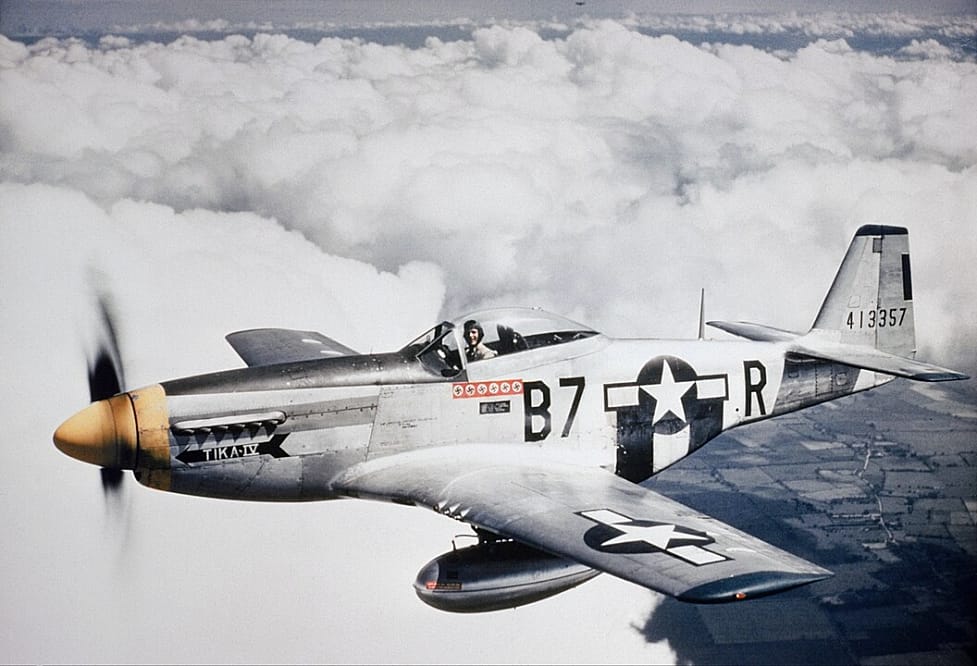
Photo: P-51D-5NA Mustang 44-13357; Lt Vernon Richards, Tika IV 8th AF / 374th FS / 361s t FG. Was later assigned to Lt. Alfred B Cook Jr who renamed it Sailor Girl Shirl - KIA 16 Nov 44 - crashed near Little Walden.
Sources: YouTube; Wikipedia