
Launchers


Launchers
Take-Off & Landing
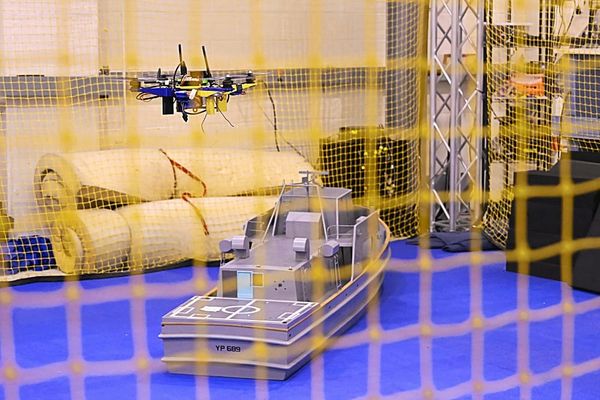
The capability could let U.S. Navy warships recover tactical drones when enemy electronic warfare disrupts satellite navigation or communication links, supporting more resilient reconnaissance, surveillance, and logistics operations.

Military
Admiral Brad Cooper, commander of US Central Command overseeing the Middle East, said: "In just the last few hours, we hit an Iranian drone carrier ship, roughly the size of a World War II aircraft carrier, and as we speak, it's on fire."
Military
General Atomics Aeronautical Systems, Inc. (GA‑ASI), has announced that the U.S. Department of Homeland Security (DHS)/Customs and Border Protection (CBP) has released its newest flight software which fields GA-ASI’s proprietary Automatic Takeoff and Landing Capability (ATLC) system. The ATLC system is designed to increase safety
Commercial
Start-up company SkyFallX unveiled a fully autonomous parachute system for drones last year. The purpose of the system is to reduce danger to people and property on the ground. The company is now seeking strategic partners to help enter mass-production. The SkyFallX parachute system uses on-board sensors
Business
General Atomics Aeronautical Systems, Inc. (GA‑ASI) and GKN Aerospace’s Fokker business unit, a Dutch aircraft systems and components manufacturer, have announced that they will collaborate to produce and support landing gear systems for Predator B/MQ-9 Reaper RPA systems. Fokker is GA-ASI’s Dutch in-country
Research
In an effort to build—and control—ever smaller drones, researchers have been looking at how insects navigate. Insects use a technique called optical flow, based on the apparent speed of objects passing by in their field of vision. In fact, humans use optical flow to give us a sense
Commercial
Senseable, a small danish drone technology developing company announced it has successfully finished the first round of tests of a new drone safety system, designed to guide drones or small aircraft to a safe landing site if technical problems arise during flight. The safety system consists of three parts, an
Testing
Helicopters are incredibly manoeuvrable in the air, but during landing and takeoff their traditional skid- and wheel-based landing gear requires stable, flat surfaces—surfaces that are often unavailable in helicopter-needy environs such as forward operating areas, ships at sea and natural-disaster zones. Having the ability to land
Testing
General Atomics Aeronautical Systems, Inc. announced that its Predator B/MQ-9 Reaper RPA has successfully completed 106 full-stop Automatic Takeoff and Landing Capability (ATLC) landings, a first for the multi-mission aircraft. The milestone was first achieved with four ATLC landings on June 27 at the company’s
Military
This 15-minute video shows an MQ-9 Reaper taking off and landing at Wheeler Sack Army Airfield (WSAAF) at Fort Drum, New York on 05 April 2012. The MQ-9 is from the 174th Fighter Wing which launches and recovers its aircraft at WSAAF. The video was shot by
Take-Off & Landing
Aircraft-carrier crews use a set of standard hand gestures to guide planes on the carrier deck. But as unmanned aircraft are increasingly used for routine air missions, researchers at MIT are working on a system that would enable them to follow the same types of gestures. The problem of