Grid Aero Launches with $6M and Breakthrough Autonomous Cargo Aircraft Built in 6 Months
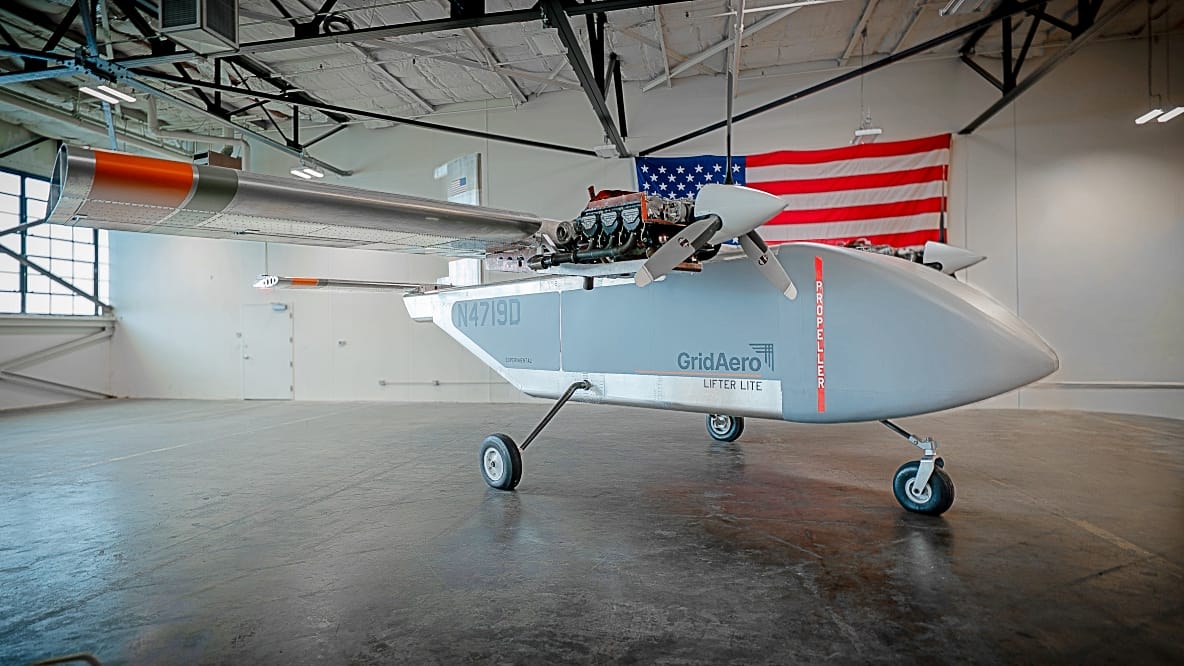
A new startup has a contract with the Air Force’s innovation arm and a prototype to test its new concept: a network of “flying pickup truck” drones to solve the problem of logistics in the vast Pacific.
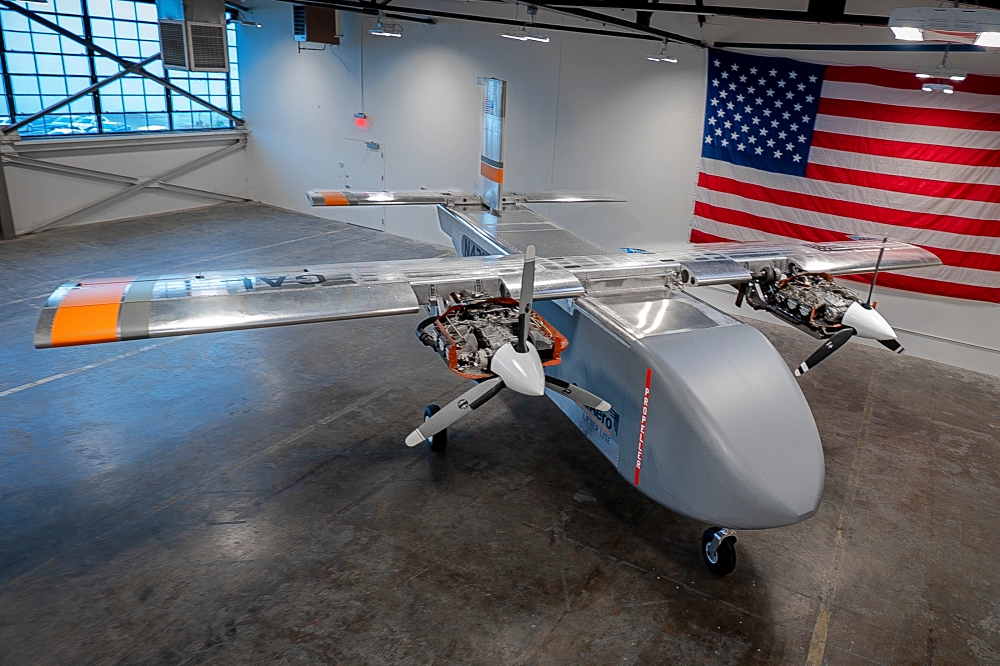
- Grid Aero debuted its “Lifter Lite” drone Aug. 18, as the firm announced $6 million in seed funding co-led by Calibrate Ventures and Ubiquity Ventures, and a small business innovation research Phase II contract with AFWERX.
Lifter Lite is meant to fly “thousands of pounds, thousands of miles,” Grid Aero Chief Executive Officer Arthur Dubois told Air & Space Forces Magazine. The exact capacity and range could vary, but the idea is to be able to carry somewhere between 1,000 and 8,000 pounds over distances “like Guam to Japan,” Dubois said—a trek of some 1,500 miles.
Founded by aerospace veterans from Joby Aviation, Xwing, Northrop Grumman, and the U.S. Air Force, Grid Aero is taking a radically faster and more cost-effective approach to developing large uncrewed aircraft for both military and commercial logistics.
“We’re building the pickup truck of the skies,” said Arthur Dubois, CEO of Grid Aero. “This is a rugged, mission-flexible aircraft that combines autonomy with tough, modular hardware. The shift from massive, expensive platforms to distributed fleets of smart, affordable systems is long overdue—and essential for the future of global logistics.”
Defense Demand: Urgent, Strategic, and Growing
The need is real. Grid Aero has secured a Direct to Phase II SBIR award from AFWERX, the small business innovation arm of the Department of the Air Force (DAF). Innovative, disruptive technologies are needed to address the tactical logistics challenges of distributed operations in a contested environment. The awarded contract reflects the need for affordable, scalable, autonomous cargo solutions that can operate reliably in contested and denied environments where traditional military logistics platforms face significant risks.
“As the former Director for Logistics on the Joint Staff, I’ve seen the operational demands of the Indo-Pacific firsthand,” said Lt Gen (ret.) Leo Kosinski, former Director of Logistics (J4), Joint Chiefs of Staff. “Grid Aero delivers a uniquely scalable and rapidly deployable airborne logistics solution. One that addresses the tyranny of distance with the agility and speed our legacy systems lack. While the People’s Republic of China fields multiple such platforms, Grid Aero remains the only U.S.-based capability that is operationally credible. If the United States is serious about sustaining deterrence and forward readiness in the region, investing in Grid Aero is not optional, it is essential.”
A New Model for Aerospace Innovation
Grid’s approach is built around a distributed network of low-cost, autonomous cargo aircraft, designed to move heavy payloads over long distances, even into unprepared or high-risk locations. This dual-use capability positions the company for commercial growth as well, especially in the underserved short-haul cargo sector where conventional airfreight economics break down.
With early backing from the Department of Defense, rapid development velocity, and a compelling dual-use thesis, Grid Aero represents a new generation of aerospace companies, leaner, faster, and more adaptable to the evolving demands of both national security and global trade.
Dubois is no stranger to the autonomous cargo world; he previously worked as head of engineering for Xwing, which flew an unmanned modified Cessna aircraft in the Air Force’s 2024 Agile Flag exercise, including moving equipment between two airfields some 400 miles apart.
The idea for Lifter Lite sprang from asking military and commercial air cargo stakeholders about their pain points, Dubois said. For the military, that’s executing logistics in areas where U.S. assets could be attacked.
“We decided to then approach that problem with a clean-sheet design of a long-range, low-cost heavy lift autonomous aircraft that really is anchored around this idea of mass-deployed attritable assets in this kind of [agile combat employment] construct,” he said.
Work began on a prototype in January, and final assembly finished in about six months. Ground testing is set to begin in the fall, “and then flight is when you’re ready after that,” Dubois said.
Compared to the C-130’s 35,000-pound maximum capacity, the Lifter Lite is small. But Grid Aero is pitching it as the solution for a challenge Air Force leaders have been talking about for several years: how to handle the logistics of agile combat employment, or having Airmen and aircraft disperse from large central hubs to small, remote, or austere air bases to become harder to hit.
ACE is seen as especially vital in the Pacific, given the growing reach of China’s missiles and the multitude of small islands that could serve as lilypads for military forces. Yet keeping such a distributed force supplied and capable of generating airpower is no small feat—especially in areas with contested airspace.
To meet that challenge, Grid Aero is pitching a vast network of drones.
“It’s really this idea of distributing your cargo assets across many different aircraft, because when you’re in a contested environment, if you lose one aircraft, the mission still has to carry on,” Dubois said.
Coordinating and flying that many aircraft will require autonomous technology. Dubois said his firm is working on software to go along with its drone that will have a “human on the loop,” capable of intervening if necessary.
“We’re building a little bit of the higher-level autonomy functionalities around path planning, obstacle avoidance, threat detection and so on and so forth,”
he added, noting that Grid Aero’s autonomy tech is meant to be compatible with larger networks that do battlespace integration, whether autonomous or controlled by a human.

Given how big the Pacific is and how little infrastructure many of its islands have, Dubois also said his firm is trying to build the Lifter Lite to be cheap and tough—“a flying pickup truck” with a “rugged, simple” cargo bay and landing gear engineered for rough runways.
“We’ve designed enough margin into the structure that it’s not like if you have one little ding you’re going to have to stop and fix it,” Dubois said. “It’s also true for the components where we have enough redundancies that we can take off with parts of the system not operating or destroyed.”
Grid Aero is also suggesting its flying truck could be used for intelligence, surveillance, and reconnaissance, air-to-air refueling, or as a mothership for other drones.
“Our customers will put what they want on it, and it can be used for many, many different things,” he said.
Grid Aero isn’t the only business eyeing smaller aircraft for such missions. Joby Aviation—which acquired Xwing in June 2024—has announced a partnership with L3Harris to develop an autonomous vertical takeoff-and-landing aircraft for defense missions like contested logistics, officials have said. And Reliable Robotics, another autonomy startup, has outfitted Cessnas of its own to carry cargo, too.
Grid Aero’s advisory board includes a trio of retired Air Force officers—Lt. Gen. Leonard Kosinski, former director of logistics for the Joint Chiefs of Staff; Maj. Gen. Lawrence M. Martin Jr., a former mobility wing commander and assistant deputy undersecretary of the Air Force for international affairs; and Col. Steve Marshall, former chief of international affairs at Pacific Air Forces.
Source: Air & Space Forces