Spain Procures Nine SIRTAP Tactical UAS, Designed and Manufactured by Airbus in Spain
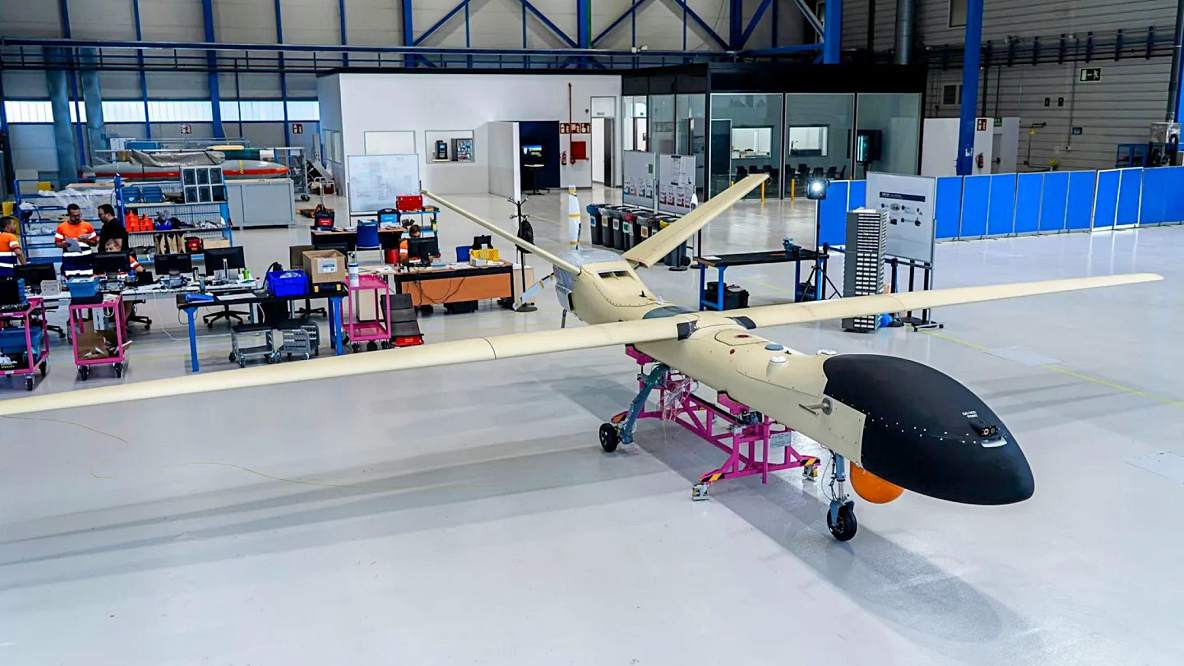
Spain’s first SIRTAP unmanned aerial system prototype is now complete and slated to begin ground testing, in an ambitious schedule lasting a good portion of 2026, before the first delivery by 2027. Airbus Defence and Space, which manufactures the system, released a short video on Sep. 4, 2025, showing the aircraft receiving a paint job at its facility in Getafe in Spain.
This precedes the ground and flight tests at the National Institute of Aerospace Technology’s (INTA) Unmanned Systems Test Centre (CEUS) in Huelva, southwestern Spain. Airbus added in the X post that the next milestone is to ship Aircraft and Ground Control Station prototypes to support the ground trials, expected to last the next few months, followed by flight trials through 2026.
The latest revelation comes after Airbus announced on Jun. 17, 2025, the completion of the first SIRTAP prototype’s assembly, adding that the ground testing would involve “structural evaluations, main systems components and software testing.” The subsequent flight trials would also help secure an airworthiness type certification to “ensure that the aircraft meets the highest safety and performance standards, leading to the delivery of the first system to Spain in 2027,” Airbus added in the press release.
[embed]https://vimeo.com/1117354977?fl=pl&fe=sh[/embed]
Airbus SIRTAP for Spain
The video showed Airbus personnel at Getafe applying the grey paint scheme and the company’s markings with spray paint guns. In the image accompanying the Jun. 17 release, the aircraft is sporting a beige-colored primer, but retaining the grey paint on the tail end housing the propeller engine, and the full-black front nose section.
As per a November 2023 contract between Spain’s Ministry of Defence and Airbus Defence and Space, Madrid is slated to acquire nine SIRTAP systems, each consisting of three aircraft and a ground control station. Its total outlay in the future includes 27 drones and nine ground control stations to “reinforce the tactical capabilities of the Spanish Armed Forces,” Airbus explained.
Additionally, Spanish operators are also slated to receive two training simulators from Airbus. These simulators have passed a Critical Design Review, marking the completion of their functionality and architecture.
The development also comes after Airbus and Spanish state-owned shipbuilder Navantia announced an agreement earlier this year to explore SIRTAP’s integration on the Spanish Navy’s flagship, the Juan Carlos I multipurpose aircraft carrier LHD (Landing Helicopter Dock). As is now evident, the drone displayed on the Juan Carlos I was a full-sized mockup.
The Armada Española’s (Spanish Navy) sole aircraft carrier, which is equipped with a ski-jump to support AV-8B Harrier II’s flight operations, will be tested for command and control, combat system integration and navigation support, with the latter also including take-off and landing operations.
SIRTAP Drone
According to Airbus, SIRTAP lies in the “high-end tactical UAS segment.” The company explains “its defence and security applications will offer a wide range of missions tailored to the operational needs of customers in both the institutional and governmental markets.”
The UAV is primarily an ISR (Intelligence, Surveillance and Reconnaissance) platform that can fly in all-weather conditions and harsh environments, with an endurance of more than 20 hours and an operational altitude of over 20,000 feet. Airbus adds that it will be certified by Spanish military airworthiness authorities to fly in segregated airspace.
Its two primary payloads are an EO/IR (Electro-Optical/Infrared) turret under the chin and a multi-mission maritime surveillance radar. These payloads allow SIRTAP to conduct maritime force protection roles with guided weapons on the four underwing hardpoints, extending the surveillance reach of the fleet while complementing other manned platforms.
Other capabilities include electronic warfare systems like SIGINT, ELINT and COMINT (Signals/Electronic/Communications Intelligence) sensors.
Sources: The Aviationist; X