Schiebel and Nordic Unmanned Conduct World's First Full-Scale Offshore UAV Flight for Equinor
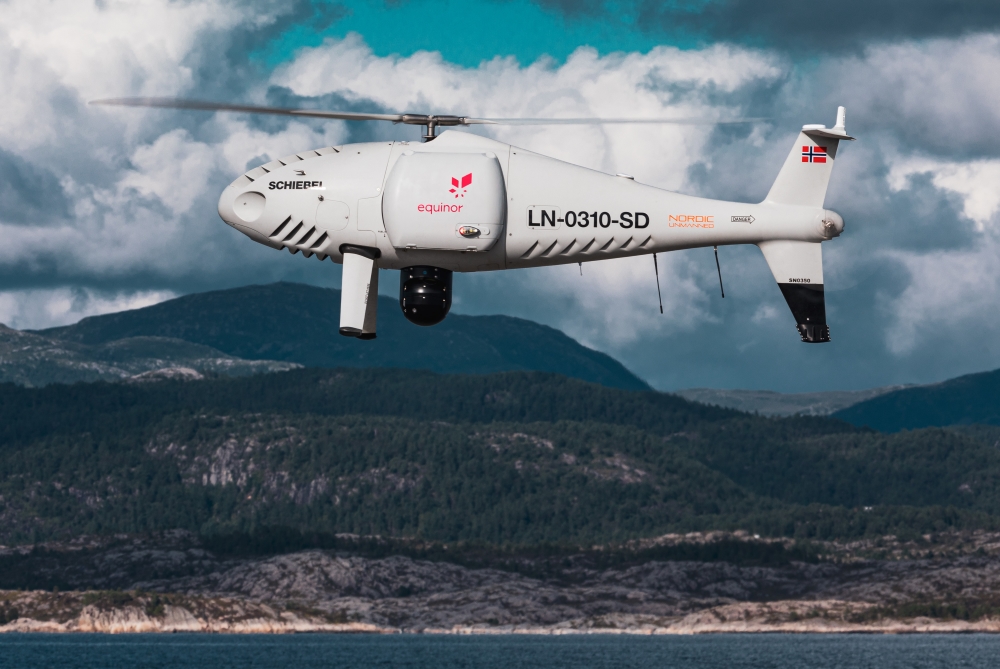
Schiebel, together with partner Nordic Unmanned, successfully demonstrated to Norwegian energy company Equinor the cargo delivery capability of its Unmanned Aerial Vehicle (UAV) CAMCOPTER S-100 to offshore platform Troll A.
This is a world’s first in terms of full-scale offshore UAV delivery from shore to an active oil and gas installation.
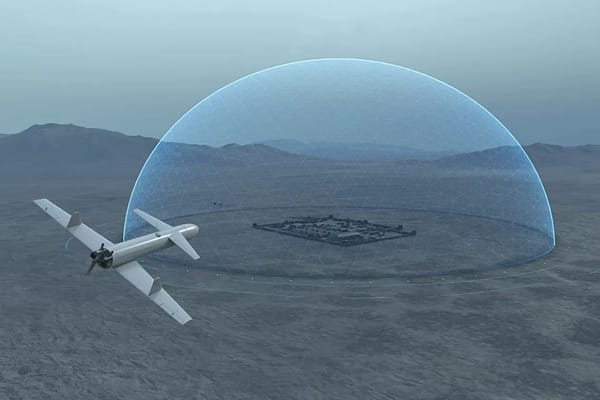
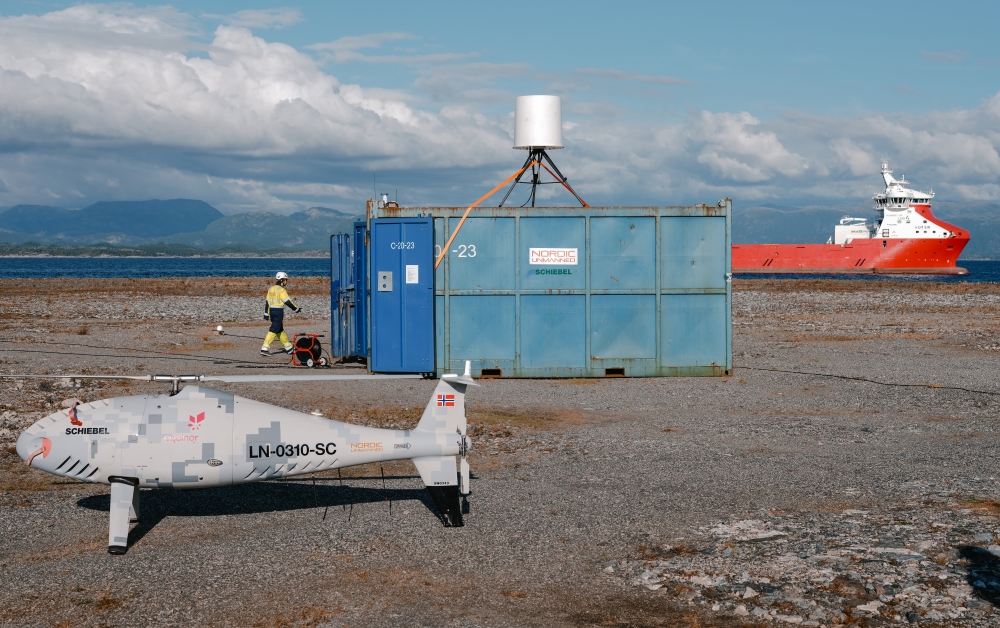
The exercise simulated the scenario of an urgent requirement for specific essential spare parts at the gas production platform Troll A. The CAMCOPTER S-100 successfully carried out the long-range delivery flight from Mongstad, where the spare parts were 3D-printed, to the offshore platform Troll A located in the North Sea. The unmanned delivery distance was 100 km (55 nm). After the UAV supplied the spare parts, it carried out a close inspection around the platform before it headed back to Mongstad.
The flight trials also included a successful Search and Rescue (SAR) mission, where a “man over board” dummy was quickly located by the UAV, transmitting the positioning data and live images using the L3 Harris Wescam real-time Electro-Optical/Infra-Red (EO/IR) camera and an Automatic Identification System (AIS).
Hans Georg Schiebel, Chairman of the Schiebel Group, said:
“This was the perfect trial to show off the exceptional maritime capabilities of the S-100 for the oil and gas industry. We have extensive experience in long-range unmanned flights, especially in the maritime domain and under adverse weather conditions. The S-100 was able to show off its outstanding capabilities and we have proven once again that the S-100 UAV is the superior choice.”
Arne Sigve Nylund
“Drones could reinforce safety, boost production efficiency and contribute to lower CO2 emissions from Norwegian oil and gas. Drones will also play a role as we shape new energy solutions on the Norwegian shelf,” Nylund continues.
The operator of the drone is the Sandnes-based company Nordic Unmanned, a leader in drone services in Europe. Equinor and the drone operator have enjoyed good cooperation with the Civil Aviation Authority, Avinor Air Navigation Services and the Norwegian Communications Authority in completing this ground-breaking transport operation.
“Over the longer term, we expect to see new infrastructure for logistics and support operations, which can reinforce what we already have within vessels and helicopters,”says Alena Korbovà Pedersen, who heads the work on developing logistics solutions in Equinor.
“If we are to develop the logistics solutions of the future on the Norwegian shelf, where drones could play an important role, we must cooperate across all of the industry’s players; operating companies, suppliers, the authorities and the trade union and safety interests,” Pedersen continues.In addition to conducting logistics operations, airborne drones can also be used for inspections and observations of the technical condition of our offshore installations and onshore facilities. They have extremely advanced camera equipment and can be used in search and rescue operations, for example to locate people who have fallen into the sea, or for early detection of pollution on the sea. These abilities were also tested during yesterday’s flight.
Drones will also play a role in new energy solutions on the NCS. Drones can inspect wind turbines, deploy equipment to be used by personnel performing maintenance and repairs, and they can deliver critical parts, fast. Using drones will also enable us to avoid some vessel lifts that can be both more costly and leave a greater environmental footprint.
The fact that we chose a 3D printed part for our first drone transport offshore was a very natural choice. 3D printing is another rapidly growing technology that will transform the way we work. The part we transported was a diesel nozzle holder – a critical component in the lifeboats on Troll A.
The part is no longer manufactured and is difficult to obtain. Therefore, the part was re-designed and modelled in 3D before an advanced metal 3D printer produced a replica in a sturdy, industrial alloy, Inconel 718. The part was manufactured quickly, and was delivered safely and efficiently to Troll A, Norway’s largest gas producer.
Knut Roar Wiig, CEO of Nordic Unmanned highlighted the importance of this operation.
The unmanned industry is evolving rapidly, and the professional part of the industry is starting to adopt the best practice from traditional aviation in terms of safety, regulations, and certifications. By leveraging our experience and highly skilled employees and partners, Nordic Unmanned is continuously working to pursue pioneering projects and untapped potential that moves the industry forward in giant steps. Long-range unmanned logistics is expected to be a large and important market segment as it reduces carbon footprint, risk and cost; Nordic Unmanned is dedicated to continue innovating and improving novel cutting-edge concepts and putting them into action for our bold and visionary clients."
Pål Kristensen, business unit manager, logistics and robotization, for Nordic Unmanned was eager to highlight the teamwork behind such an achievement.
"The operation that we have conducted today is an excellent example of how we in Nordic Unmanned work together with a demanding client to implement the latest in unmanned technology. This marks the beginning of a new chapter within unmanned logistics. The technology is proven and robust enough to implement in large scale, and reduces the risk cost and environmental footprint drastically. The good collaboration with Equinor, Schiebel, Avinor, Norwegian Communication Authority and Norwegian Civil Aviation, has made it possible to take this project from end of feasibility study, to end of operation in less than 4 months. I’m honoured to have led this project for Nordic Unmanned”
Source: Press Releases