Saab 35 Draken – The Mach 2 Beast No One Was Ready For
A total of 651 Drakens were manufactured by Saab. Sweden's fleet of Drakens comprised a total of six different versions, while two additional models of the Draken were offered to prospective export customers
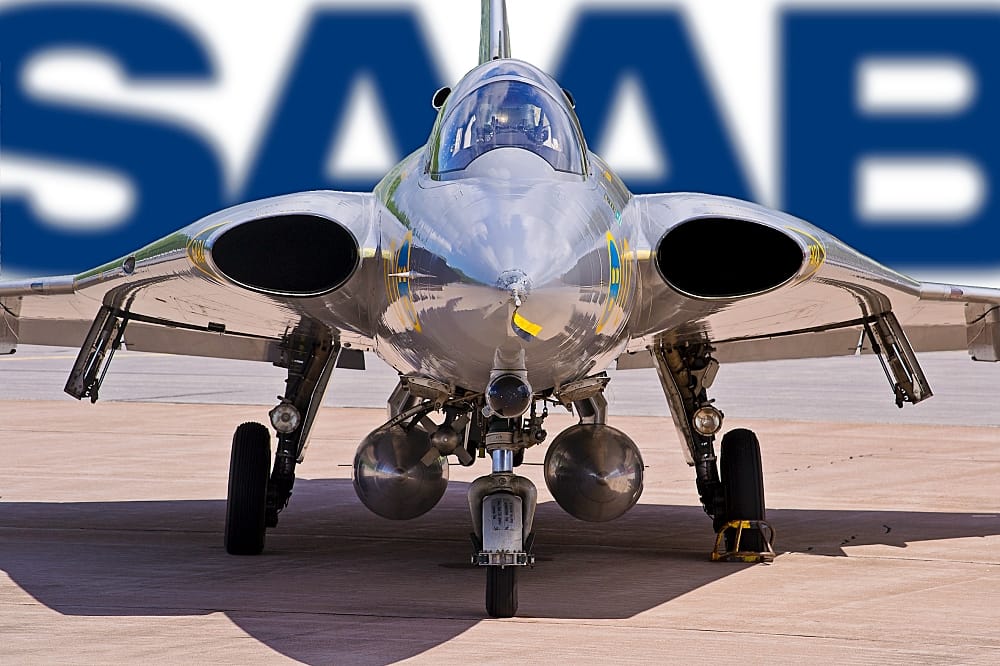
An aggressor squadron screams across the Baltic sky, closing in on the Swedish Saab 35 Draken at Mach 1.7. By all conventional wisdom, the brand new Swedish fighter should have been trapped—outgunned, outmaneuvered, and seconds away from being another Cold War casualty. But this is no ordinary aircraft….
Suddenly, the Draken’s nose pitches up violently, almost perpendicular to its flight path. The fighter seems to hang suspended in midair as its forward momentum evaporates, defying the laws of physics. It was a move that was supposed to be impossible. Any pursuing jet would become a target as the Draken ripped backwards on their tail.
The Swedes called it kort parad—”short parry.” It would later become known worldwide as the mythical Cobra Maneuver, and for now in 1963, it exists nowhere else on Earth.
To pull it off required one of the riskiest and most dangerous designs ever implemented in an aircraft. The Saab 35 Draken would either kill or be killed by the “SUPER STALL.
The Saab 35 Draken (IPA: [drɑːkɛn]; The Kite, ambiguous with The Dragon) is a Swedish fighter-interceptor developed and manufactured by Svenska Aeroplan Aktiebolaget (SAAB) between 1955 and 1974.
Development of the Saab 35 Draken started in 1948 as the Swedish Air Force future replacement for the then also in development Saab 29 Tunnan day fighter and Saab 32B Lansen all-weather fighter. It featured an innovative but unproven double delta wing, leading to the creation of a sub-scale test aircraft, the Saab 210, which was produced and flown to test this previously unexplored aerodynamic feature.
The full-scale production version entered service with frontline squadrons of the Swedish Air Force on 8 March 1960. It was produced in several variants and types, most commonly as a fighter-interceptor.
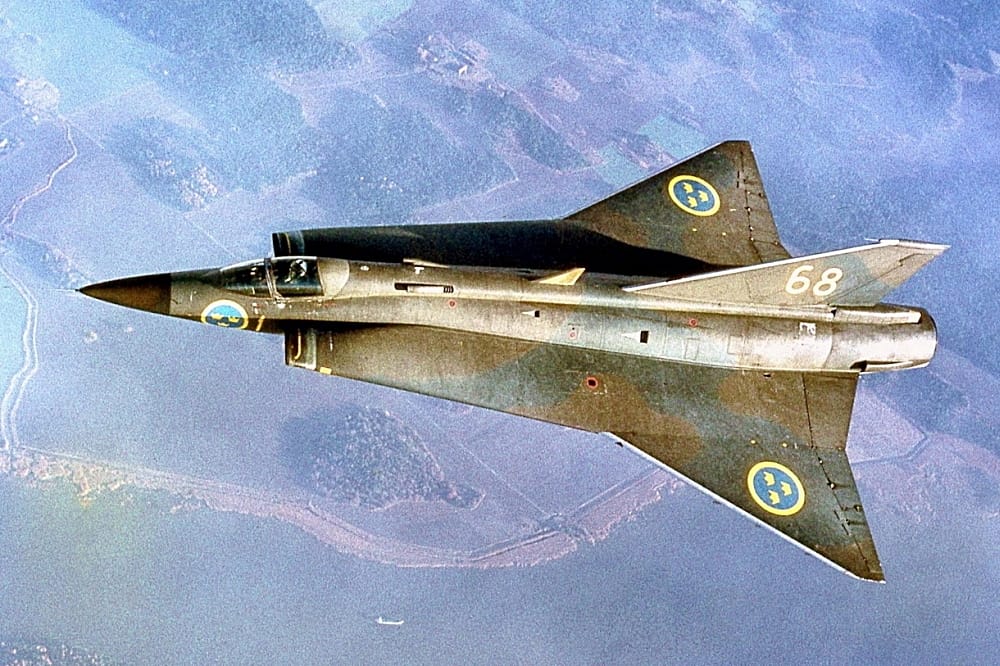
The Draken functioned as an effective supersonic fighter aircraft of the Cold War period, although it was never used in conflict. Even though the type was designed and intended as an interceptor, it was considered to be a very capable dogfighter for the era.
In Swedish service, it underwent several upgrades, the ultimate of these being the J 35J model. By the mid-1980s, the SAF’s Drakens had largely been replaced by the more advanced JA 37 Viggen fighter, while the introduction of the more capable Saab JAS 39 Gripen fighter was expected in service within a decade, although delayed.
As a consequence of cutbacks and high maintenance costs, the SAF opted to retire the Draken during December 1999. The type was also exported to the air forces of Austria, Denmark and Finland. Danish aircraft have been exported, post-service, to the United States where they have seen use as training aircraft for test pilots.
Naming
The Swedish word “Draken” has a double meaning, translating either as “The Dragon” or “The Kite”. It is said that the name was derived from the appearance of the prototype, like a paper kite, when seen from above.
The number “35” comes from the aircraft’s Swedish Air Force-designation: “flygplan 35” (fpl 35), meaning “aeroplane 35”. Depending on the given role, the aircraft received a prefix to indicate its type, the most common being “J 35” to indicate “jaktflygplan” (pursuit-aircraft), the Swedish term for fighter aircraft.
Sources: YouTube; Wikipedia