Russia’s New Truck-Mounted Laser Weapon
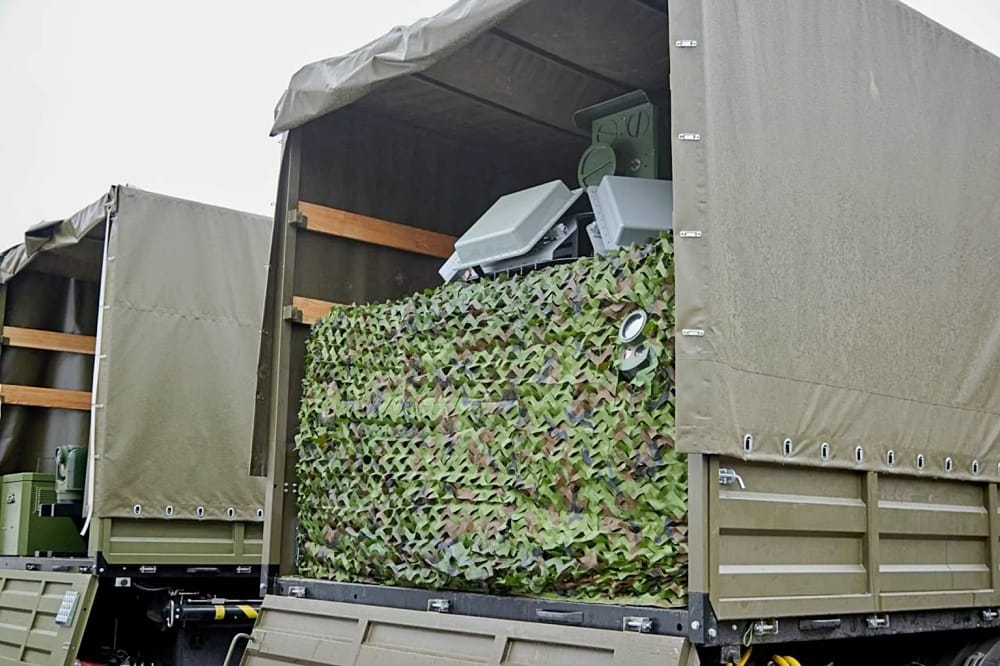
At the Interpolitex 2025 exhibition in Moscow, the Shvabe optoelectronics group, part of the Rostec defense industry corporation, presented for the first time a mobile truck-mounted anti-drone laser system. This event marked a new step in the race to develop directed energy weapons between Russia and Western powers.
The new laser system is designed on an off-road chassis, fully integrated with a command and control station (C2), rechargeable battery power source, and electro-optical sensors to detect, track, and destroy small UAVs such as reconnaissance drones or FPV attack UAVs/drones. According to Shvabe, the system can shoot down multiple targets in less than a minute, depending on weather conditions and target altitude.
The design is unique in that it uses an air-cooled system, which is simpler than liquid cooling, allowing for weight reduction, ease of maintenance, and rapid deployment. All the hardware, from the control station to the laser, fits neatly into a truck bed that can be set up or moved in minutes. Power from rechargeable batteries allows for quiet operation, reducing thermal and acoustic signatures, making it ideal for use in urban or frontline environments.
The system can coordinate with radar, acoustic sensors or radio reconnaissance equipment to receive target data, then the laser performs precise destruction. In a multi-layered air defense structure, the laser acts as the “last shield” - destroying small targets that have penetrated the layers of anti-aircraft guns and missiles.
Technically, the laser beam is powerful enough to damage the drone’s sensors, wiring, or batteries, causing them to lose control and crash. The effective range of such a compact system ranges from a few hundred meters to more than 1 km, depending on weather conditions. The outstanding advantages are extremely low firing costs, no need for ammunition, and quiet operation, suitable for protecting bases, factories, or residential areas from small UAVs.
However, the system is dependent on visibility conditions, as rain, fog, or dust can reduce the beam’s effectiveness. As a result, crews need to be trained to switch to kinetic weapons when the weather is bad or the target is moving too fast for the laser’s range.
Compared to Western programs, the Russian project is more compact in scale. The US is testing a 50kW laser mounted on a Stryker vehicle under the DE M-SHORAD program, the UK is developing the DragonFire system, and Israel is preparing to deploy Iron Beam by 2025. While competitors use complex power and cooling systems, Shvabe has chosen a simple, portable, and economical approach, based on rechargeable batteries, air cooling, and stabilized optics.
Source: MOT THE GIOI