Russia Develops Fiber-Optic Drone Launch Vehicle
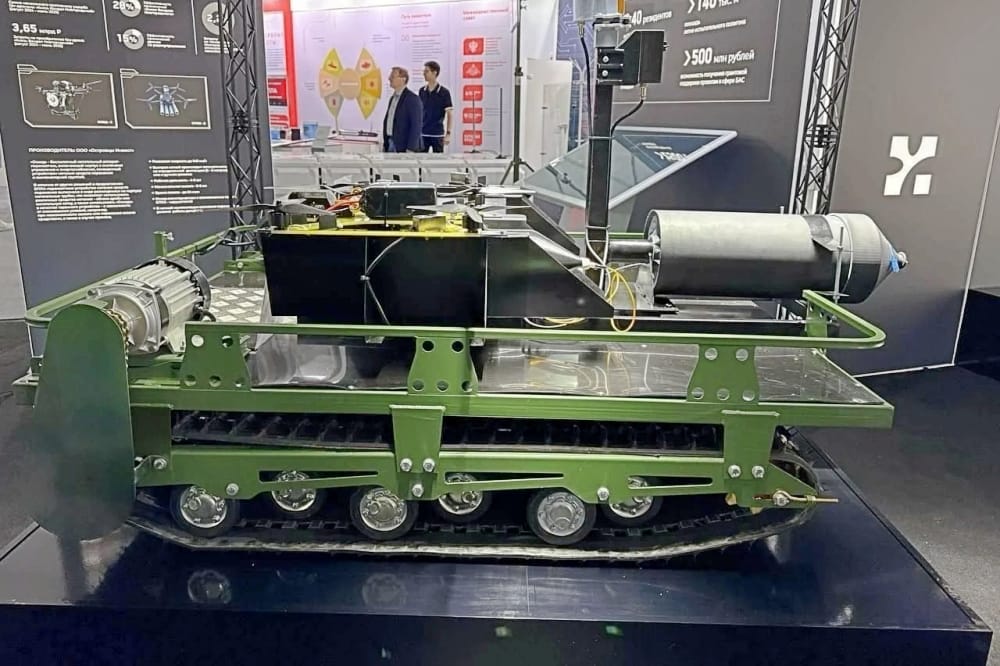
Russian engineers have developed a new unmanned ground platform designed to deliver and launch drones using a fiber-optic control link, according to the Scientific and Technical Center (STC) 'Kornei.'
The system, presented at the 'Unmanned Systems: Technologies of the Future' forum, is intended to expand operational flexibility in contested electronic warfare environments.
The platform, known as the Dronobus, integrates a software and hardware package that allows it to transport and launch unmanned aerial vehicles (UAVs) without relying on traditional radio control. Instead, both the platform and the drones are managed through a fiber-optic cable, reducing susceptibility to jamming.
According to STC 'Kornei', the unmanned vehicle can travel up to 10 kilometers before deploying its drones, which can then operate at ranges of up to 15 kilometers from the launch point.
In addition to UAV deployment, the Dronobus can transport cargo weighing up to 150 kilograms. The platform is built for year-round operation, capable of functioning in temperatures ranging from -20°C to +40°C.
“The robotic hardware and software complex ‘Dronobus’ is designed for the delivery and launch of unmanned aerial vehicles using fiber-optic communication or for the delivery of cargo weighing less than 150 kg,”
the manufacturer’s statement, cited by TASS, said.
The use of fiber-optic tethering in UAV operations is not new, but its integration into a mobile ground launch system could offer advantages in environments saturated with electronic warfare. By maintaining a hardwired control link to both the vehicle and the drones, the system may avoid some of the vulnerabilities that have plagued Russian and Ukrainian UAV operations in the current conflict, where GPS spoofing and radio-frequency jamming have become routine.
Source: Defence Blog