Russia Arms Shahed Drones with Air-to-Air Missiles
Ukraine’s Military Intelligence (HUR) said recently that Russia has begun arming drones with Soviet-era air-to-air missiles to target Ukrainian interceptors.

Ukraine’s Military Intelligence (HUR) said recently that Russia has begun arming drones with Soviet-era air-to-air missiles to target Ukrainian interceptors.
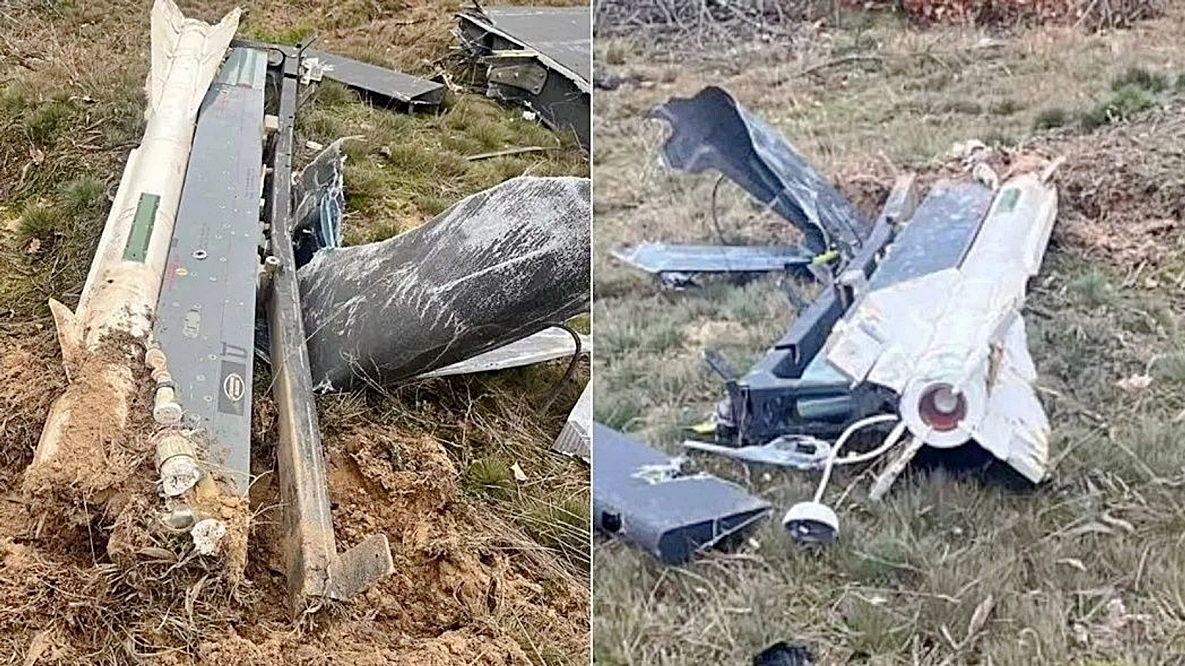
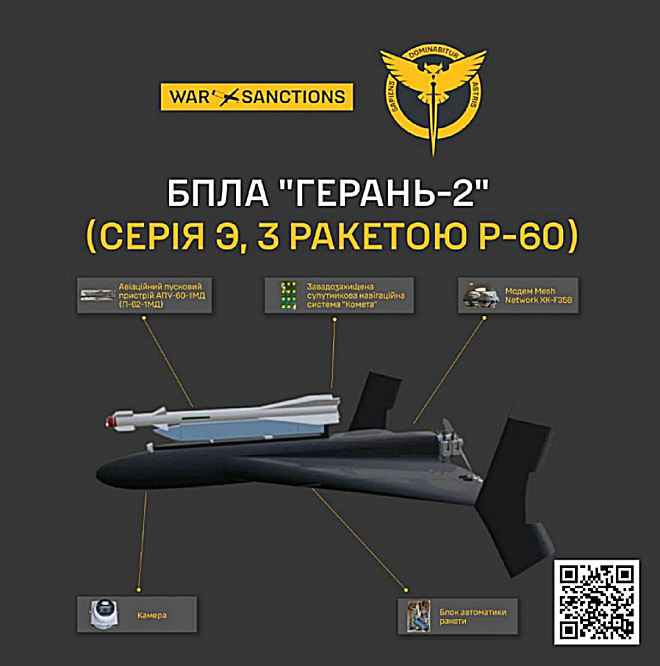
In a report published on its War&Sanctions portal, HUR said Russia has equipped a modified Geran-2 drone with an R-60 air-to-air missile, originally designed for use by combat aircraft.
The statement confirmed earlier reports that downed Russian drones were fitted with R-60 missiles.
According to HUR, the missile is mounted on a dedicated launch rail installed on a special bracket located on the upper forward section of the drone’s fuselage.
The adaptation is intended to threaten Ukrainian military aviation and tactical aircraft involved in intercepting Russian unmanned aerial vehicles, HUR said.
The R-60 missile, a Soviet-designed infrared-guided weapon, is paired with an aviation launch device, the APU-60-1MD. Once launched, the missile’s heat-seeking guidance system autonomously locks onto its target, HUR said.
Ukrainian intelligence reported that the drone is fitted with two network cameras – one in the nose and another positioned behind the missile launcher. Video and control signals are transmitted to the operator via a Chinese-made mesh modem, the Xingkay Tech XK-F358.
HUR said the system likely relies on real-time video feeds to an operator, who can authorize a missile launch if a Ukrainian aircraft enters the engagement zone. An alternative scenario would involve the missile’s seeker acquiring a target before launch and relaying the data for approval.
Despite the new missiles, the drone’s flight controller, navigation, and inertial systems remain the same as those of other Geran variants, HUR said. It operates in heavy electronic warfare environments using a 12-channel anti-jamming satellite navigation module called “Kometa.”
The electronic payload also includes a Raspberry Pi 4 single-board computer, manufactured in the United Kingdom, along with a tracker and two GSM modems used to transmit telemetry data.
HUR added that the countries of origin of the electronic components remain typical for Russian drones of this class, including the United States, China, Switzerland, Taiwan, Japan, Germany, and the United Kingdom.
A full list of components, including serial markings and photographs, has been published on the War&Sanctions portal.
Ukrainian intelligence said the primary objective of the modification is to reduce the effectiveness of Ukraine’s aerial interception of Russian drones by introducing a direct threat to aircraft conducting air defense missions.
“This development gives Russia’s multipurpose version of the Iranian Shahed-136 an additional role,”
HUR said, adding that operational experience with the system is likely to be shared with Iran.
Russia’s Sanction-Evasion Efforts
In recent months, Ukrainian intelligence has released technical profiles and supplier lists for missiles, cruise systems and drone families – steps Kyiv says are crucial for helping partners close loopholes and stop the flow of dual-use goods.
The War&Sanctions platform, created and maintained by HUR, documents supply chains, tracks sanctioned entities, and lists foreign components found on Russian weapons.
The War & Sanctions portal currently contains:
- more than 5,200 foreign-made components identified in 181 types of Russian weapons;
12 interactive diagrams of Russian and Iranian weapon systems; - over 280 companies involved in their production.
HUR said coordinated pressure by Western allies remains essential. “Weapons Russia is using against Ukraine today may be used tomorrow against other states,” the agency warned, calling for “synchronized action, stronger sanctions, and sustained support for Ukraine to stop the aggressor.”
Russia has begun deploying the recently operational Shahed-107 against the frontline regions of Ukraine, according to HUR.
A report on HUR’s War&Sanctions portal outlines the Shahed-107’s construction, components, and foreign electronics. The drone was first unveiled by Iran’s Islamic Revolutionary Guard Corps (IRGC) in June as tensions with Israel rose.
Source: Kyiv Post