Rheinmetall Presents Drone Armed with Loitering Munitions and Air-to-Air Missile
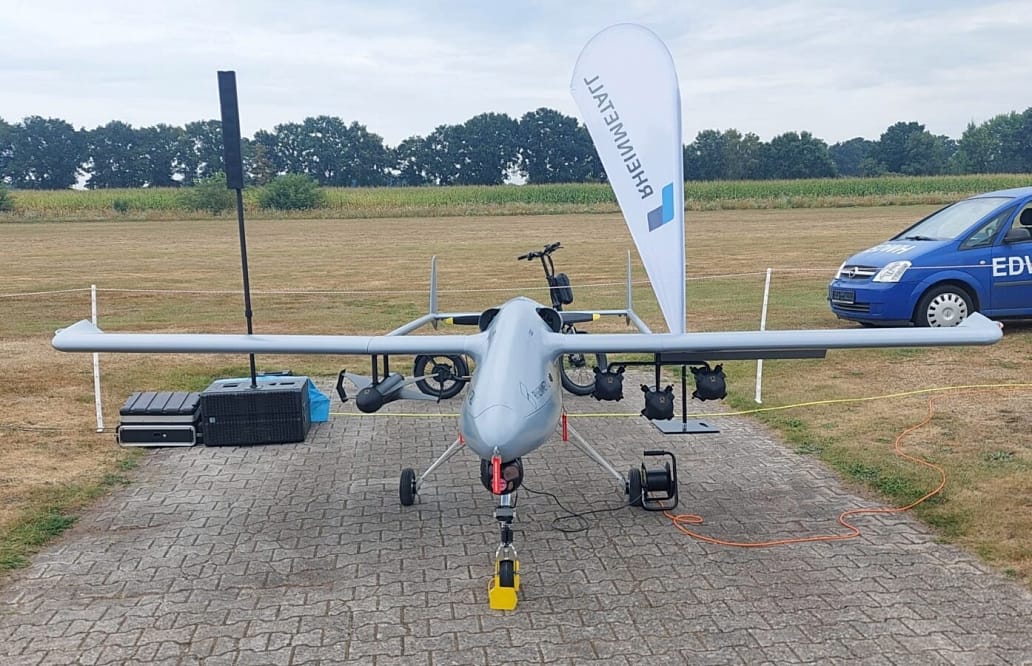
The Düsseldorf-based defense company Rheinmetall is currently working on a drone equipped with an air-to-air missile for self-defense and three loitering munitions. The company exhibited a model of the system at the Drone Days 2025 exhibition, held by b.r.m. IT & Aerospace GmbH from August 27 to 29 at Oldenburg-Hatten Airfield.
A Primoco One 150 drone from the Czech manufacturer of the same name was displayed as the platform for the missiles. The unmanned aircraft, which the manufacturer primarily intends for ISR missions, can, according to Rheinmetall, carry a maximum payload of 30 kilograms, which in the version shown consists of an optical sensor from the manufacturer Octopus on the nose and four missiles. According to the manufacturer, the One 150 has a range of approximately 1,800 kilometers and flies for approximately six to eight hours with a 30 kilogram payload.
For self-protection, a model of an air-to-air missile currently under development at Rheinmetall was attached to the right wing. According to the manufacturer, the missile, with a flight endurance of 5 minutes and a speed of 600 km/h, is primarily intended for combating other drones and helicopters.
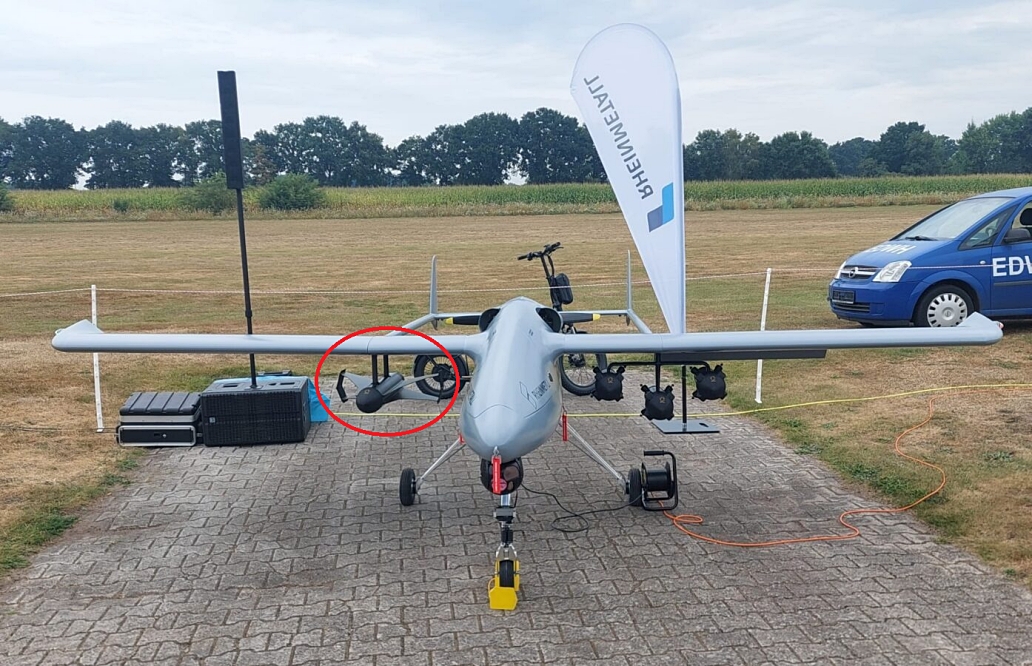
According to Rheinmetall, the missile, which carries a payload of four kilograms, has a technical readiness level (TRL) of 3. Flight tests could possibly begin this year.
Three HERO R-20 loitering munitions, reportedly manufactured by the Berlin-based start-up Bär Technology, are mounted on the left wing of the Primoco drone. According to Rheinmetall, the HERO version shown operates fully autonomously with its own seeker, making the solution comparatively expensive. Target designation via a laser on the parent drone is planned for the future to reduce costs.
The loitering munition is dropped and then, after a certain flight time above the ground, begins its own flight. According to Rheinmetall, the munition, powered by four propellers, can stay airborne for around 20 minutes and has a range of less than five kilometers. The 500-gram warhead is currently still under development. According to Rheinmetall, the TRL of the loitering munitions will soon reach levels 8 and 9, enabling delivery of the weapons to a customer soon.
The fact that a Primoco drone is being used for the concept presented here, rather than the company's own Luna NG, is due, according to Rheinmetall, to two main reasons:
- A catapult launch with a force of several Gs would place considerable stress on the missiles, while the Primoco drone takes off and lands like a normal aircraft.
- Furthermore, the Luna NG has limited space for ordnance under its wings.
Should the concept attract customer interest, Rheinmetall could reportedly take over the assembly of its partner Primoco's drone itself, subject to sufficient demand, and integrate the systems.
Source: hartpunkt; (translation - Google)