Republic XF-84H Thunderscreech - So Loud it Made Ground Crews Sick
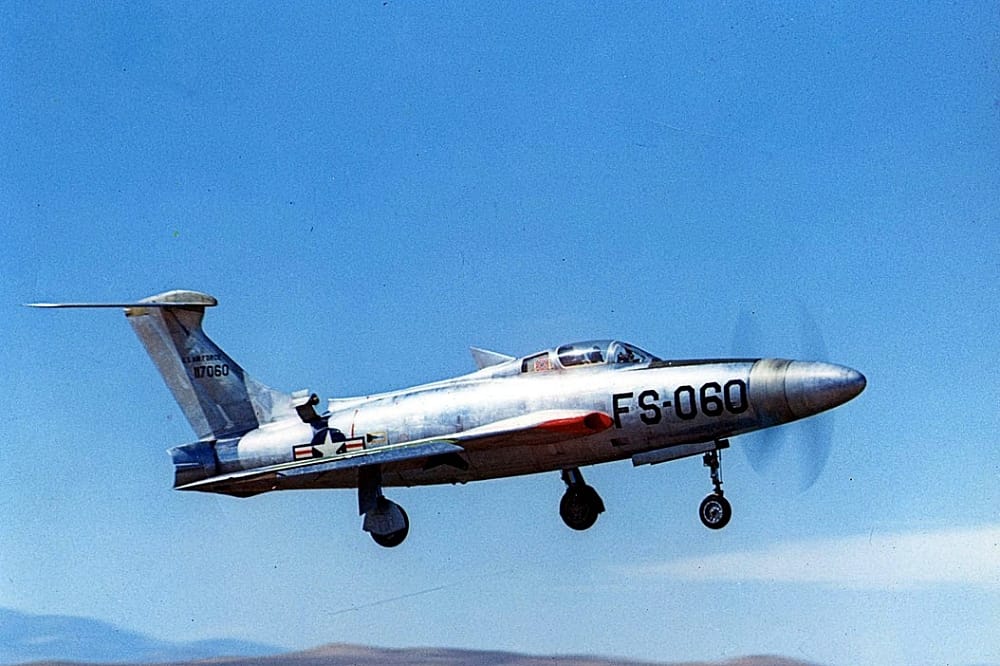
The Thunderscreech was an experimental American turboprop plane created to as an experimental variant of the the F-84 Thunderstreak fighter jet. Development began after the Navy issued a requirement seeking a carrier fighter that could take off without a catapult – a problem still facing jet powered aircraft at the time. Even though the Navy would cancel its order, the US Air Force would absorb the project for testing.
The US Air Force hoped to create a plane capable of breaking the unofficial record for the fastest propeller-driven aircraft. The Thunderscreech’s turbine engine was ideally suited for a supersonic propeller. At first, they promised that the aircraft would reach over 1,000 miles per hour. However, this hope was dashed soon after aerodynamic deficiencies and engine reliability issues doomed the program. Not to mention that the propeller was so loud, it reportedly made crews on the ground physically sick…
The Republic XF-84H "Thunderscreech" is an American experimental turboprop aircraft derived from the F-84F Thunderstreak. Powered by a turbine engine that was mated to a supersonic propeller, the XF-84H had the potential of setting the unofficial air speed record for propeller-driven aircraft, but was unable to overcome aerodynamic deficiencies and engine reliability problems, resulting in the program's cancellation.
Its name, Thunderscreech, is a reference to its extremely loud supersonic propeller.
Design and Development
Although the USAF Wright Air Development Center was the key sponsor of the Republic Project 3347 turboprop fighter, the initial inception came from a U.S. Navy requirement for a carrier fighter not requiring catapult assistance. Originally known as XF-106 (a designation later reused for the Convair F-106), the project and its resultant prototype aircraft were redesignated XF-84H, closely identifying the program as an F-84 variant, rather than an entirely new type.
With a projected contract for three prototypes, when the US Navy canceled its order, ultimately, the remaining XF-84H prototypes became pure research aircraft built for the Air Force's Propeller Laboratory at Wright-Patterson AFB to test supersonic propellers in exploring the combination of propeller responsiveness at jet speeds.
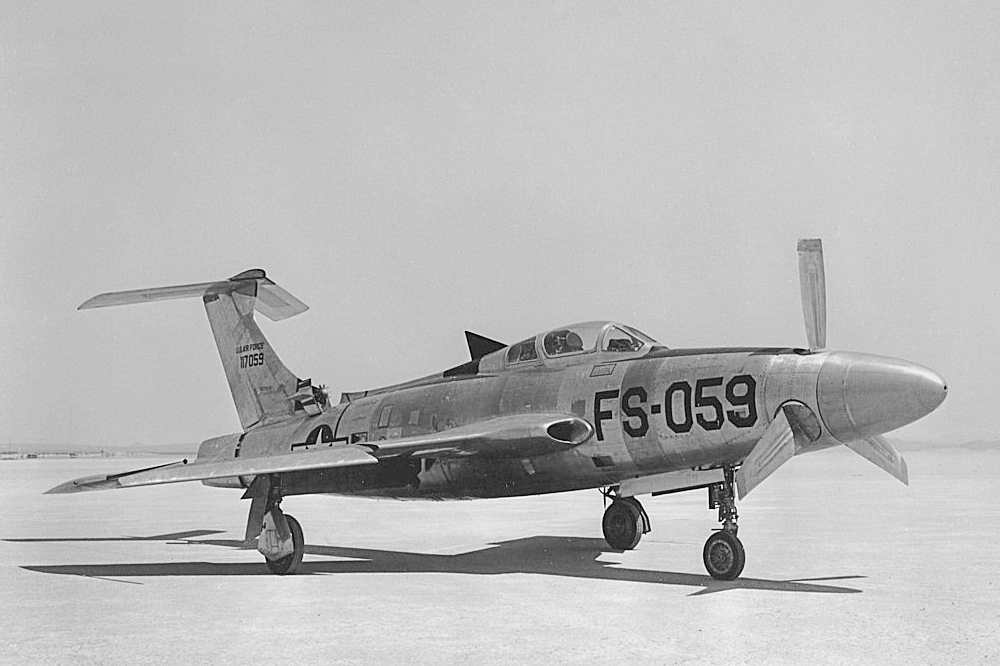
The XF-84H was created by modifying a F-84F Thunderstreak airframe, installing a 5,850 hp (4,360 kW) XT40-A-1 turboprop engine in a centrally located housing behind the cockpit with a long extension shaft to the nose-mounted propeller. The turbine engine also provided thrust through its exhaust; an afterburner which could further increase power to 7,230 hp (5,390 kW) was installed but never used. Thrust was adjusted by changing the blade pitch of the 12 ft (3.7 m) diameter Aeroproducts propeller, consisting of three steel, square-tipped blades turning at a constant speed, with the tips traveling at approximately Mach 1.18 (1,446 km/h).
To counter the propeller's torque and "P-factor", the XF-84H was fitted with a fixed dorsal yaw vane. The tail was changed to a T-tail to avoid turbulent airflow over the horizontal stabilizer/elevator surfaces from propeller wash.
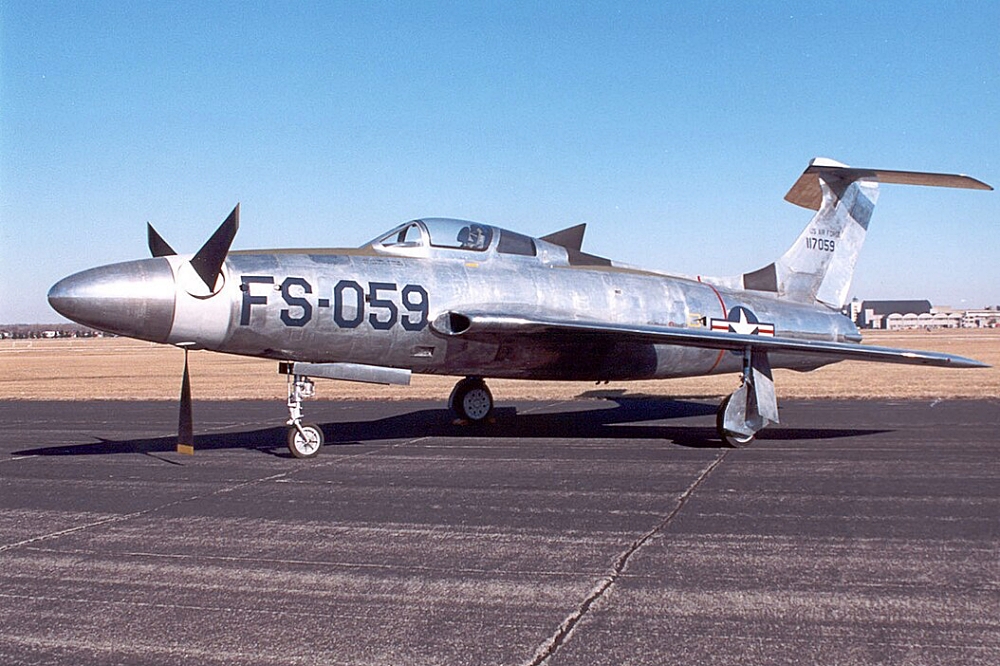
The XF-84H was destabilized by the powerful torque from the propeller, as well as inherent problems with supersonic propeller blades. A number of exotic blade configurations were tested before settling on a final design. Various design features were intended to counteract the massive torque, including mounting the left leading edge intake 12 in (30 cm) further forward than the right, and providing left and right flaps with differential operation.
The two prototypes were equally plagued with engine-related problems affecting other aircraft fitted with T40 engines, such as the Douglas A2D Skyshark and North American XA2J Super Savage attack aircraft. A notable feature of the design was that the XF-84H was the first aircraft to carry a retractable/extendable ram air turbine. In the event of engine failure, it would automatically swing out into the airstream to provide hydraulic and electrical power. Due to frequent engine problems, as a precaution, the unit was often deployed in flight.
Top Photo: The experimental Republic XF-84H (s/n 51-17060) in flight in 1955/56. Two F-84Fs were converted into experimental aircraft. Each was fitted with a Allison XT40-A-1 turboprop engine of 5,850 shaft horsepower (4,365 kW) driving a supersonic propeller
Sources: YouTube; Wikipedia