Quantum Systems Transforms Reliant UAS into Advanced Mothership for the US
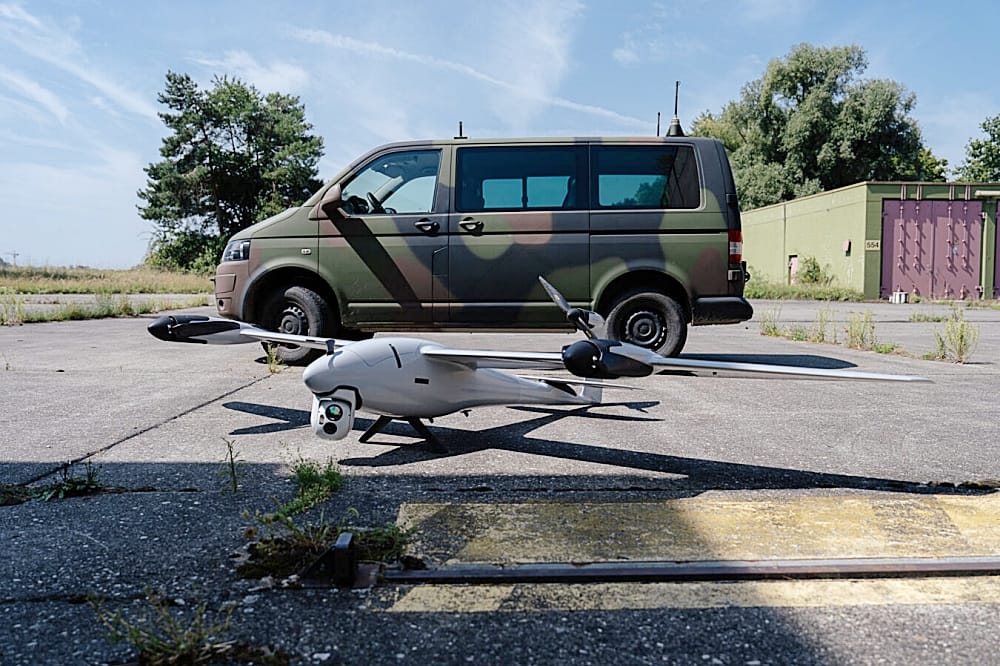
Originally developed by the German drone manufacturer Quantum Systems as a long-range reconnaissance drone, the Reliant is apparently being developed into a drone carrier. This is at least suggested by an exhibit from Quantum Systems (QS) at the AUSA trade fair currently taking place in Washington.
In addition to the QS reconnaissance drones Reliant, Vector, and Twister, the FPV drone Archer from the US manufacturer Neros is also on display there. An information panel is attached below the Archer, explaining that the FPV drone can be carried using the attachment points attached to the Reliant's wings, thus expanding the Reliant's range of applications with an organic component. According to a LinkedIn post by the US managing director of Quantum Systems, the Reliant will have one attachment point per wing. This means that the company has unveiled a second "drone carrier project" within just a few months. Just a few months ago, the Sparta, a mothership drone, was publicly unveiled, which is expected to reach series production by the end of the year, hartpunkt reported. Unlike the Reliant, however, the Sparta is not a VTOL drone capable of vertical takeoff and landing, and it is also about 10 kg lighter.
When asked by hartpunkt, the company confirmed this development intention, which is apparently limited to the US market at this time.
"The integration of mounting points into the intended European market is not currently planned," the QS spokesperson told hartpunkt. "However, if successful and there is sufficient interest, we would also consider equipping European Reliants with such mounting points."
The company declined to provide further details on the matter. The reasons for the focus on the US market could be due to the respective requirements of the armed forces. While US armed forces may require reconnaissance and combat capability in a single system, the current requirements of European armed forces for such systems appear to be limited to pure reconnaissance capability.
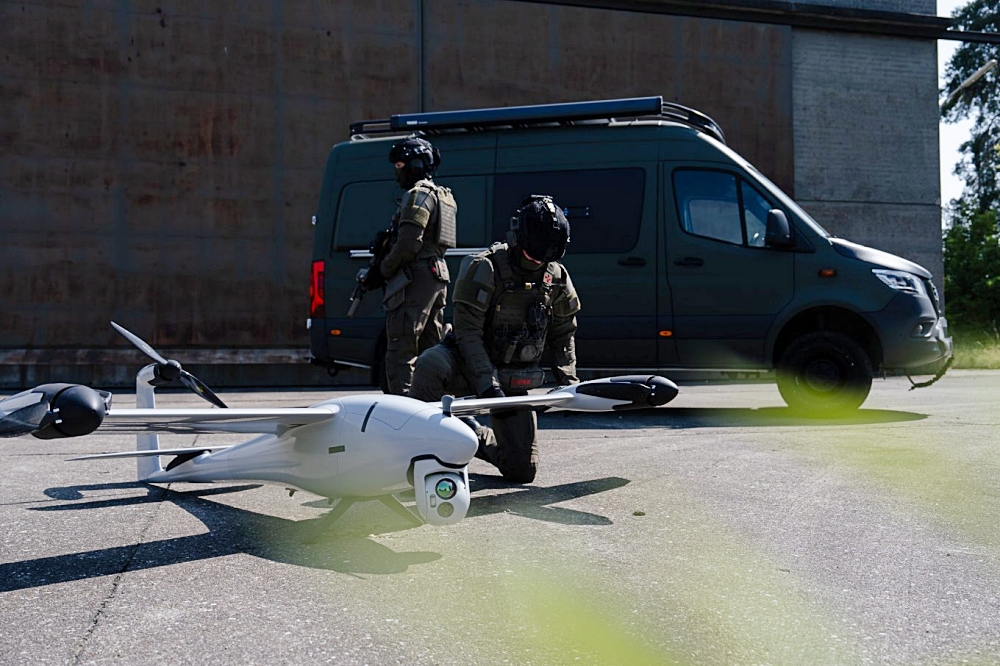
From a purely tactical perspective, the ability to carry combat assets offers both advantages and disadvantages. For example, the additional weight and drag of the drones carried on board have a negative impact on the flight characteristics of the reconnaissance drone, which is likely to reduce both its flight speed and its flight duration, which, however, is comparatively generous for the Reliant at over 10 hours.
The tactical advantages of drone carrier capabilities are obvious. Such a reconnaissance drone could not only report on detected point targets but also engage them directly. However, the combat capability of the carried combat drones would be limited to individual vehicles or personnel. Nevertheless, time-critical targets, in particular, can be engaged much more effectively.
Since the Reliant is equipped with a laser pointer in addition to its reconnaissance optronics, even "dumb" and comparatively simple drones could be guided precisely to their targets, even without any AI capabilities.
In the future, it would certainly be conceivable to carry small interceptor drones, which could protect the long-range reconnaissance drone from enemy interceptor drones until the reconnaissance Reliant can leave the danger zone. However, such considerations are currently purely theoretical. Such a scenario has not yet been documented in action.
Reliant
According to QS, the Reliant is a fixed-wing drone capable of vertical takeoff and landing (VTOL) and offers an endurance of over 10 hours. The system can be transported in two cases and can be deployed in less than 10 minutes without the need for tools. A second payload bay allows the integration of additional sensors – such as radar, SIGINT equipment, CRPA antennas, or jamming systems – thus contributing to the drone's greater mission versatility. The drone was first publicly demonstrated at the US Special Forces Exhibition (SOFIC) in May 2024.
According to the manufacturer, the 4.3 m wide and 2.38 m long Reliant is capable of autonomous flight at a maximum operating altitude of 4,500 m. Depending on the power supply, the flight time is seven hours (Li-Po battery) or over 10 hours (hybrid electric drive with combustion engine). Using a so-called long-range tracking antenna, the drone can receive and transmit signals (control and video) over distances of more than 160 km. The maximum takeoff weight is specified as 25 to 33 kg, including a 3 kg payload.
According to the report, the Reliant QS uses a Trillium HD55-MVS-LD electro-optic system as its primary sensor. The optronics weigh approximately 2.7 kg and feature three cameras (daylight, MWIR, and SWIR), as well as a laser rangefinder and laser pointer. The secondary sensor is a NextVision Raptor electro-optic system with 40x optical and 2x digital zoom.
Source: hartpunkt