Putin’s Helicopter Supposedly Survives Ukrainian Drone Attack
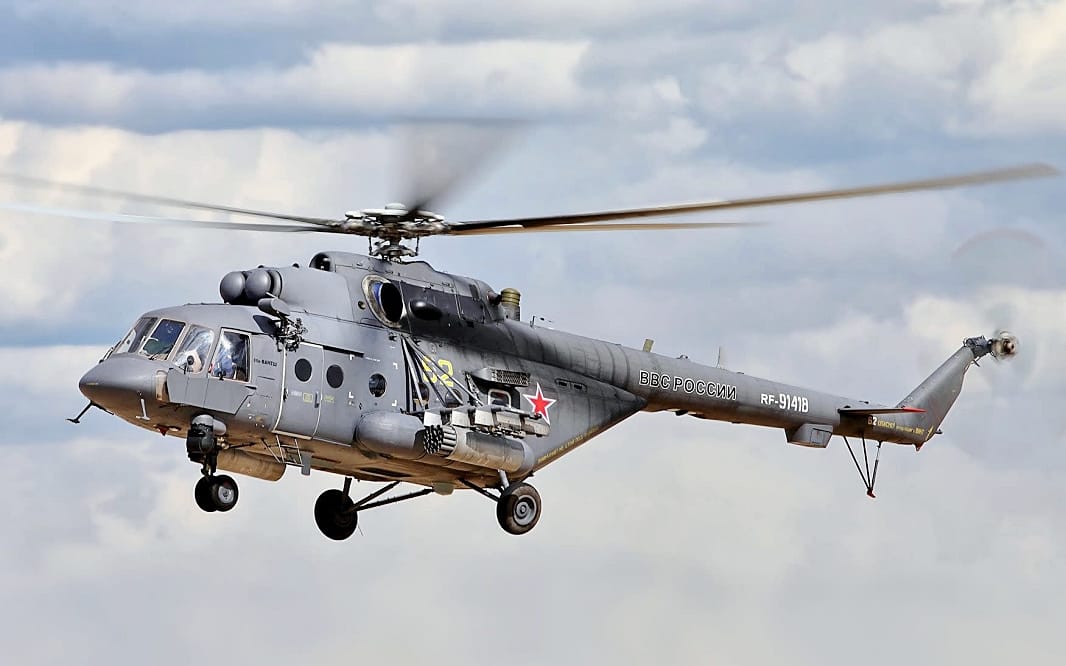
Vladimir Putin’s helicopter was forced to shoot down drones while he was aboard, a Moscow official said on Sunday. The Russian president’s aircraft was involved in an “air defence battle” after an “unprecedented Ukrainian drone assault”, Maj Gen Yuri Dashkin, an air defence commander, told state television.
The incident was said to have happened last week when the Russian leader was on a tour of Kursk, part of which Ukraine previously occupied.
“During the period when the president was working in the Kursk region, the enemy launched an unprecedented attack with unmanned aerial vehicles,”
Maj Gen Dashkin said in an interview with Rossiya-24 television.
He added:
“We simultaneously conducted an air defence battle and ensured the safety of the presidential helicopter’s flight in the air.”
No official statements from the Kremlin, Russian Ministry of Defense, or Ukrainian authorities have confirmed the report, leaving its authenticity in question. The lack of detailed evidence and the reliance on unverified sources underscore the challenges of navigating information in a war marked by competing narratives.
The reported event unfolded in Kursk, a Russian region bordering Ukraine that has been a hotspot of military activity since the conflict began in February 2022. The Kremlin confirmed Putin visited Kursk on May 20, 2025, his first trip to the region since Russian forces, with support from North Korean troops, claimed to have expelled Ukrainian forces from the area in late April.
During the visit, Putin met with interim governor Alexander Khinshtein and inspected the Kursk-II nuclear power plant under construction, according to Russian state media. The region has faced repeated Ukrainian drone strikes and a significant ground incursion by Ukrainian forces in August 2024, which briefly seized parts of Kursk before Russian counteroffensives regained control.

Sprinter Observer’s post, amplified by other X users, claimed the helicopter was caught in the “epicenter” of a drone attack, a term suggesting either intense defensive action or proximity to the president’s aircraft.
Yuri Dashkin, identified as an air defense commander, reportedly stated that Russian forces neutralized the threat, ensuring Putin’s safety. However, no public record verifies Dashkin’s role, and the lack of specifics—such as the number of drones, their type, or the precise location—raises questions about the claim’s credibility.
Other X posts, including one from @serge_063, hinted at internal leaks or confusion, with cryptic remarks about “looking for the snitch,” while @qwest__treated the report with apparent skepticism, adding laughing emojis. Ukrainian officials, who often claim responsibility for high-profile strikes, have remained silent, and Russian state media has not addressed the incident, a departure from its usual practice of highlighting Ukrainian aggression.
This silence, combined with the absence of visual evidence like drone wreckage or damaged infrastructure, fuels doubts about whether the incident occurred as described or was exaggerated for effect.
The Mi-17 helicopter, commonly used for VIP transport, is equipped with flare dispensers and radar warning receivers, enhancing its survivability in contested airspace. The helicopter itself, likely a Mil Mi-17, is a workhorse of Russian VIP and military transport. An evolution of the Soviet-era Mi-8, the Mi-17 measures 82 feet in length and can carry up to 30 passengers or 4 tons of cargo.
Powered by two Klimov VK-2500 turboshaft engines, it achieves a cruising speed of 150 miles per hour and a range of 360 miles. Its defensive suite includes infrared jammers, flare dispensers, and armored plating around critical components, designed to counter heat-seeking missiles and small-arms fire.
Its robust design and defensive systems would make it a challenging target for drones, particularly if escorted by air defense units, as would be standard for a presidential flight. However, a swarm of FPV drones, especially if launched unexpectedly, could exploit gaps in radar coverage or overwhelm escorts with sheer numbers.
The lack of official confirmation raises the possibility that the incident was exaggerated or fabricated as part of the information war. Russia has used unverified claims to portray Ukraine as reckless, while Kyiv has accused Moscow of staging incidents to justify escalation.
The timing of the report, days after Ukraine’s drone strikes on Moscow and a power substation in Kursk, suggests it could be an attempt to amplify Russian resilience or deflect attention from Ukraine’s battlefield gains.
Top Photo: Russian President in an Mi-17 helicopter flying over the Kursk region formerly occupied by Ukraine - Vitaly V Kuzmin
Sources: yahoo!news; Bulgarian Military