Polish and Lithuanian SIM Cards Found in Downed Russian Drones in July

Russia has long been using 4G modems with SIM cards to transmit intelligence information from their drones, and Polish SIM cards were spotted on Russian UAVs shot down in Ukraine in early July, which Warsaw was warned about.
The targeted Russian attack on Polish territory with long-range drones on the night of September 10, which the Polish government called an "unprecedented violation of airspace" and a "large-scale provocation," is far from the first episode of the Kremlin's gradual escalation. Moreover, everything indicates that this and other similar attacks have been in preparation for quite some time.
In particular, at the beginning of July, information was published in Poland itself that 4G modems with SIM cards of Polish operators were found among the wreckage of Russian drones shot down in Ukraine.
Information about this was published by Polish journalist Marek Budzysh with a reference to a report received on July 2 (without indicating the authorship) with quite detailed information, including where exactly the Russian drones were shot down.
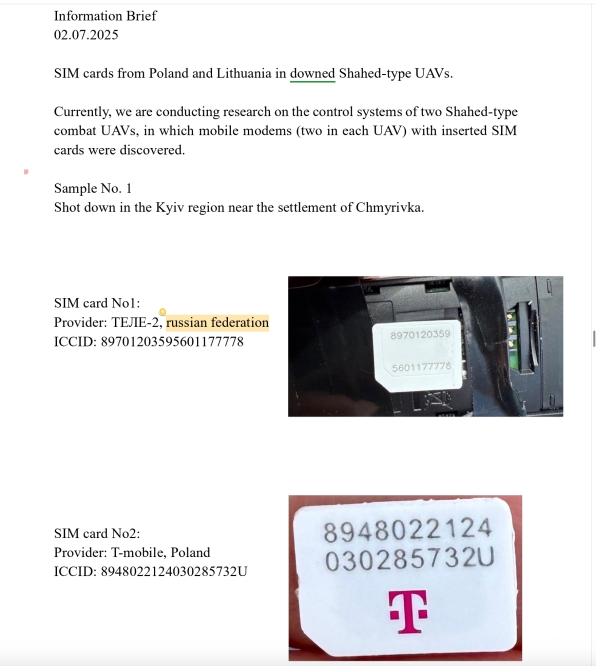
In addition to the Polish SIM cards, a SIM card from a Lithuanian operator was also found in one of the drones. The report stated that this directly indicates that the Russian Federation is preparing to fly drones over the territory of these countries and test connections to mobile networks.
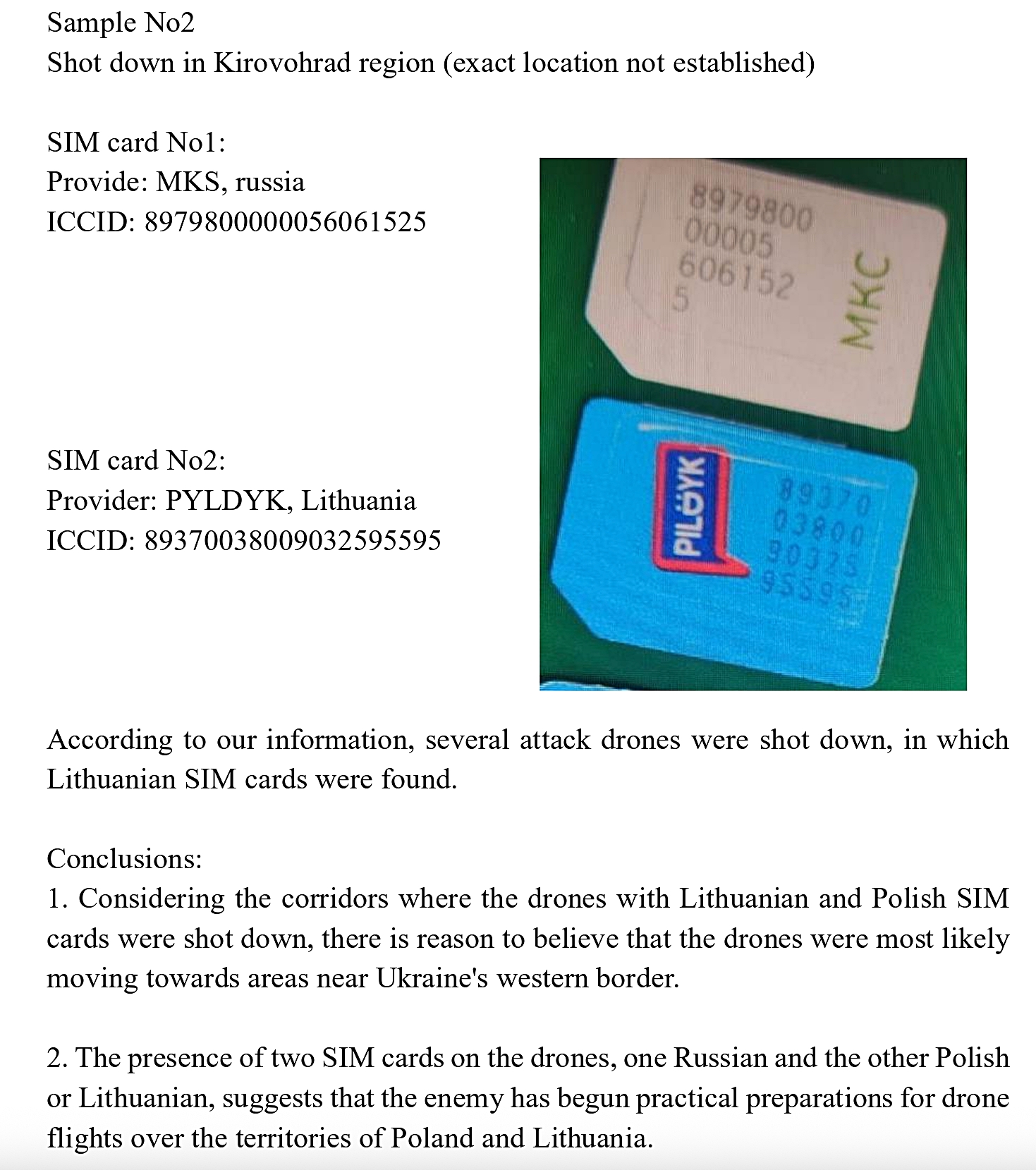
The report, whose authorship is unknown, but apparently of a fairly high level, also directly states: "we consider it necessary to inform partners in Poland and Lithuania about the discovery of SIM cards of Polish and Lithuanian providers in Russian long-range strike drones." Which was apparently done in the end, because a week later it was already at the disposal of a Polish publicist.
At the same time, this information caused almost no resonance in Poland, despite the fact that back in the summer, Russian drones began to fly into its airspace on a regular basis. And some of them even exploded on the ground, as happened on August 20 near the village of Osiny in the Lublin Voivodeship , which is 40 km from the air base where NATO air patrols are located .
At the same time, mobile Internet on Russian drones is necessary for transmitting information from the UAV itself and adjusting its flight. Depending on the additional equipment installed on the drones, the Russian Federation can receive information about the operation of air defense and electronic warfare systems, as well as transmit visual information from the camera. All this has long been and consistently used by racists against Ukraine.
It is currently unknown whether the Russian drones that attacked Poland had such means. At the same time, the assumption that one of the tasks of this Russian attack was precisely reconnaissance of the Polish air defense system is quite reasonable.
Source: Defence Express