Pentagon Funds $13.6M Project to Make Drones Twice as Fuel-Efficient
The U.S. Air Force has awarded Minco Technologies of Cookeville, Tennessee, a contract valued at up to $13.6 million to develop a next-generation unmanned aircraft engine designed to dramatically reduce fuel consumption and improve operational flexibility.
The project aims to create a modular, fuel-flexible propulsion system that could cut the logistical fuel supply chain by as much as 50 percent — a potentially transformative capability for future drone operations.
According to the Department of War, the contract will fund the “Modular Operationally Resilient Fuel-Flexible Extreme-Efficiency UAS-Engine System,” a technology development and demonstration program focused on advancing powerplant efficiency and adaptability for unmanned aerial systems (UAS).
Work will be conducted in Cookeville, Tennessee, with an expected completion date of August 30, 2028.
The award was the result of a competitive acquisition process, with one proposal received. The Air Force Research Laboratory (AFRL), Wright Site, based at Wright-Patterson Air Force Base in Ohio, is overseeing the program under contract number FA2394-25-C-B056.
The Pentagon has increasingly emphasized the need to make logistics more resilient in contested environments, where fuel convoys and forward supply lines are vulnerable to disruption. By enabling UAS platforms to operate on a wider range of fuel types and consume less of it, the new engine system could play a key role in reducing these vulnerabilities.
The Air Force envisions unmanned systems operating farther from established bases and sustaining operations longer without the same level of fuel resupply. A propulsion system that cuts the logistical footprint in half would not only lower operational risk but also enhance the flexibility of how and where UAS platforms can be deployed.
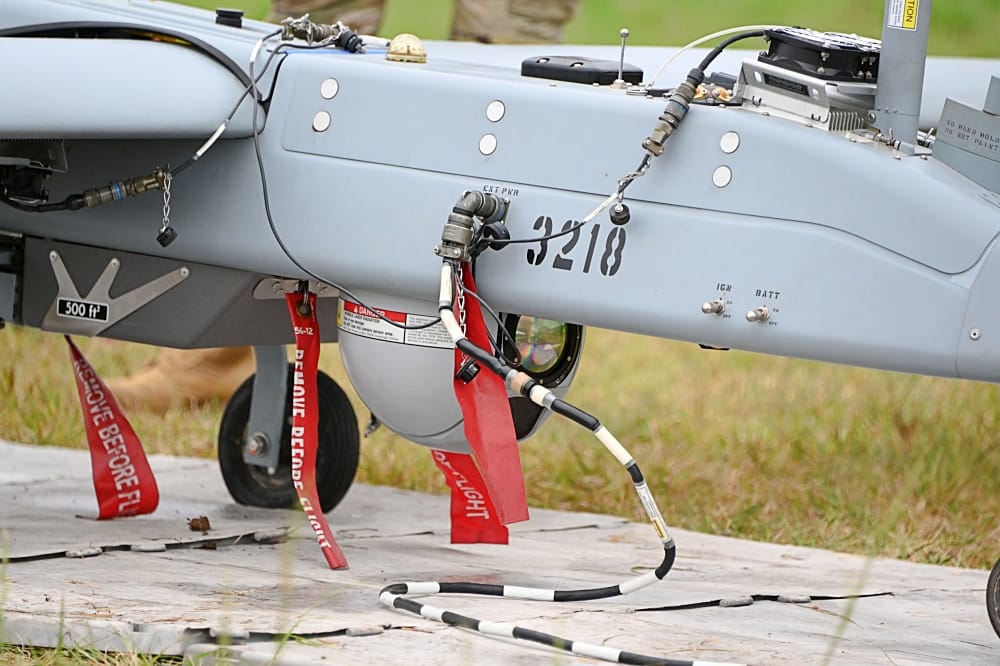
Photo: Shadow -Fort Dix [TSC] Training Support Center)
Source: Defence Blog