Operation Spiderweb: Analysis of Ukraine’s Deep-Strike Drone Offensive
The success of OPERATION SPIDERWEB highly likely indicates a porous Russian front line and also that Ukraine has integrated basic artificial intelligence (AI) targeting metrics into autonomous UAS platforms, enhancing precision and responsiveness.
Ukrainian swarm capabilities are likely limited to light Class I systems. These are optimised for striking vulnerable and lightly protected assets such as parked aircraft and exposed communications infrastructure.
In turn, Russian responses are likely to be swift and aggressive, as Moscow is almost certainly grappling with the emerging threat of Ukrainian-deployed systems operating within its own territory.
Key Judgements
KJ-1. The success of OPERATION SPIDERWEB is highly likely indicative of a porous front line.
- The movement of seven (based on visual analysis) truck-borne UAS launch platforms into Russia indicates ground lines of communication (GLOC) are not well defended and can be exploited for the movement of combat support equipment. [source]
- The use of ground movement across the broader battlespace is highly likely indicative of significant electronic interference. This includes jamming and/or spoofing. This tactic was likely employed to negate Russian air defences by exploiting a comparatively weaker ground-based defensive posture. [source]
KJ-2. It is likely that Ukraine has developed and integrated basic Artificial Intelligence (AI) targeting metrics into its autonomous Unmanned Aerial Systems (UAS) platforms.
- Following the attack, the Security Service of Ukraine (SBU) announced that the UAS were launched remotely, operated autonomously, and employed artificial intelligence to identify key weaknesses within the targeted systems. [source]
- Visual analysis of the three-dimensional movement exhibited by one of the attack systems taken during its tertiary guidance phase is highly likely indicative of onboard AI-based decision-making processes. Patterns in the system’s longitudinal and latitudinal manoeuvring align with characteristics typical of machine decision-making, rather than human-in-the-loop control. [source]
- The drones employed in the attack appear to be of a similar model or configuration to the DJI Mavic series. Given the drones’ limited range, the target areas’ electromagnetic complexity, and the highly likely absence of forward-deployed operators, it is highly likely that Ukraine did not manually control the drones on-site. This strongly suggests the use of pre-programmed flight paths or onboard autonomous guidance systems to execute the attack. [source]
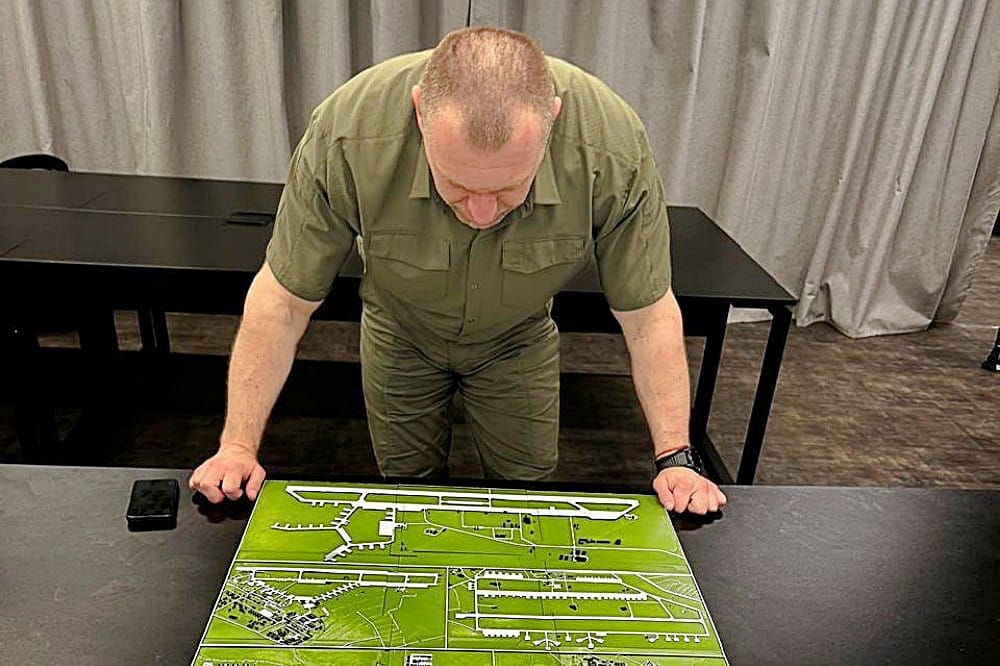
- Photos showing SBU Head General Vasyl Malyuk observing what appears to be current satellite imagery of the intended targets remain unconfirmed as proof that Ukraine has access to high-definition satellite imagery of key Russian positions. It is possible that Ukrainian intelligence may have repurposed pre-existing images to illustrate the optimal Joint Point of Impact (JPOI) for targeting a specific airframe. This corresponds with the placement of target markers observed on the aircraft. Specifically on the wing root of the TU-95 BEAR and the central fuselage of the TU-22 BLACKJACK. Both points represent the optimum JPOI for a light, non-penetrative explosive device, maximising structural disruption with minimal payload. These locations are highly likely to have formed a critical decision point within the AI modelling used in the attack. [source]
KJ-3. Ukrainian UAS swarm capabilities are likely limited to light Class I systems, primarily suited for targeting vulnerable and lightly protected assets such as parked aircraft and exposed communications infrastructure.
- Decision-making delays observed in the visual analysis of footage from one of the UAS involved in Operation Spiderweb suggest low onboard AI processing speeds. These latency indicators likely necessitate the use of a hover function to provide the system with sufficient time to complete targeting or navigation calculations. As a result, such AI-driven guidance appears limited to rotor-borne UAS platforms capable of maintaining a stable hover. [source]
- Ukraine has announced the development of the GOGOL-M autonomous launch system platform. While the system presents some tactical value, it is highly likely constrained by several key design limitations. These include its vulnerability to surface-to-air threats in a dense and contested air defence environment. This also includes documented attrition rates associated with rotor-borne systems when deployed from fixed-wing launch platforms. These factors will likely limit the system’s survivability and also its operational effectiveness in high-intensity conflict zones. [source]
- Targeting considerations and limitations drawn from OPERATION SPIDERWEB were likely to remain constrained to lightly armoured or vulnerable assets. This likely results from a combination of slow onboard decision-making speeds and the inherently limited penetrative effect of a low-speed Class I UAS acting as an unshaped kinetic delivery platform. As such, it is highly unlikely that this capability, in its current form, poses a significant threat to heavily armoured vehicles or hardened infrastructure. [source]
KJ-4. Russian responses are highly likely to be swift and aggressive. Moscow is almost certainly reeling as it confronts the potential spread of Ukrainian-deployed threat systems within its territory.
- Russian internal media and messaging channels have launched information campaigns aimed at diverting attention from, denying, or downplaying the effects of Operation SPIDERWEB. [source]
- This attack possibly represents the first in a series of strikes launched from prepositioned, covert UAS launch platforms. Defensive activity in the vicinity of key Russian strategic assets, including air bases, logistics hubs, and communications nodes, is likely to increase significantly over the next 24 to 96 hours. This will almost certainly include broad search efforts to identify other possible launch vehicles.
- Based on historical precedent, Russia’s external reaction is highly likely to include a large-scale, aggressive strike against Kyiv. This will almost certainly involve massed waves of one-way attack UAVs and cruise missiles targeting Ukraine’s critical infrastructure and life-support systems. The strike will likely coincide with a messaging campaign by President Putin. This campaign will be aimed at saving face and mitigating the reputational damage caused by OPERATION SPIDERWEB.
Summary of Analysis
Confidence in assessments surrounding the capability wielded in this attack is high, supported by extensive image and video analysis. This aligns with Ukrainian claims of operational success. Russian reporting also confirms that the strikes occurred, though often framed in downplayed or limited terms. Contradicting this, assessments made regarding the scale of effect of the attack possess substantially less confidence.
Broad misinformation campaigns are likely underway, aimed at distorting perceptions of the scale and impact of the attacks. This includes their effect on the broader Russian war effort and the effectiveness of Russian responses. These responses include the reported arrests of suspects and the performance of defensive measures.
Ongoing messaging from both Russia and Ukraine is likely to become increasingly unreliable. This is because information warfare campaigns intensify, and propaganda is generated and disseminated by both sides. This growing information contest will further complicate independent assessments of operational outcomes and strategic effects.
Source: Grey Dynamics
Grey Dynamics is an Intelligence firm based out of London with a network of analysts, researchers, and investigators worldwide.