NUSTL Publishes Assessment Report on Blue UAS for First Responders in an Urban Environment
The National Urban Security Technology Laboratory (NUSTL) is a federal laboratory within the U.S. Department of Homeland Security (DHS) Science and Technology Directorate.
Located in New York City, NUSTL is the only national laboratory focused exclusively on supporting the capabilities of federal, state, local, tribal, and territorial responders to address the homeland security mission.
Executive Summary
Over the past decade, first responders have begun integrating small, unmanned aircraft systems (UAS) as a resource for a variety of operational needs. UAS provide first responders with an aerial view of their environment and can be outfitted with various sensors tailored to address different applications. UAS, often referred to as “drones,” are used by first responders in support of public safety activities such as search and rescue, firefighting, and post-incident reconstruction.
From November 18 through 21, 2024, the Systems Assessment and Validation for Emergency Responders (SAVER) program conducted an operational assessment of Blue Unmanned Aircraft Systems. The assessment took place at Bayfront Park and LoanDepot Park in Miami, Florida.
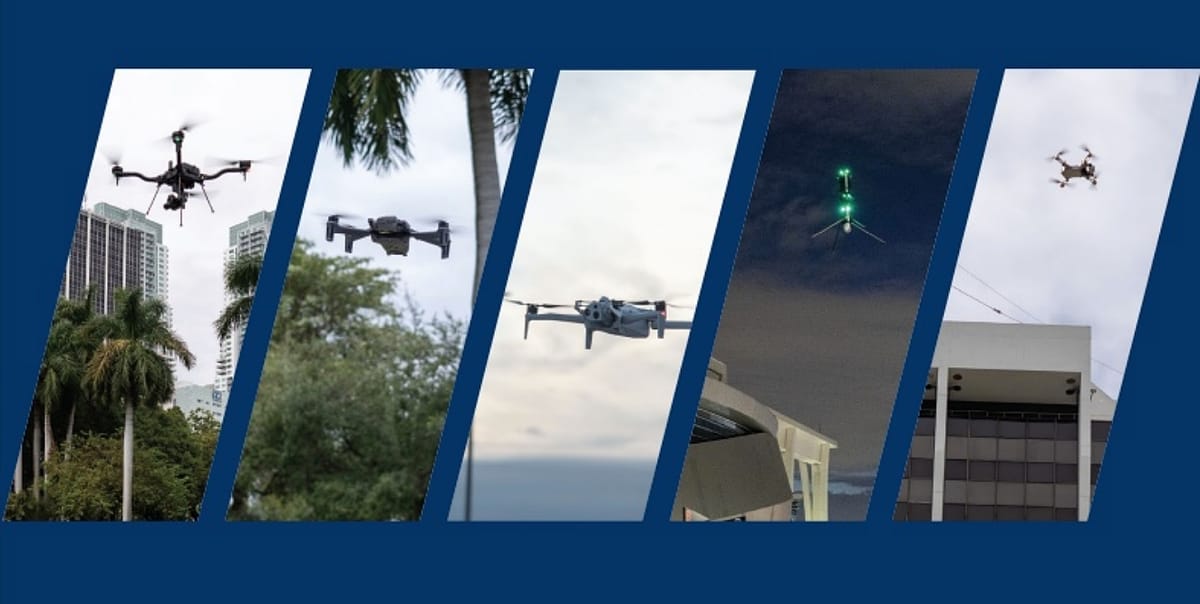
Eight first responders (all experienced remote pilots) from various jurisdictions served as evaluators for this assessment. Evaluators assessed five products: the Ascent AeroSystems Spirit, Freefly Systems Astro, Parrot Drones ANAFI USA GOV, Skydio X10D, and Teal Drones Teal 2. During three operational scenarios, these products were assessed against 15 evaluation criteria on a scale from 1 to 5, where 1 means the product met none of their expectations and 5 means it exceeded expectations.
Evaluators concluded that one of the products met all of their expectations, the Skydio X10D which scored the highest with a 4.0. The below table presents the overall scores as well as the category scores for each product, listed in order from highest to lowest overall score.
The purpose of this assessment report is to provide emergency responders with information that will guide their agencies in making operational and procurement decisions. Emergency responder agencies should consider overall capabilities, technical specifications, and limitations of Blue UAS in relation to their agency’s operational needs when making equipment selections. Agencies should also consider impacts associated with integrating equipment into their information technology infrastructure, data management, concept of operations, and maintenance requirements.
The full 54-page report can be accessed here.
Source: NUSTL