Northrop Grumman Lumberjack Jet-Powered One-Way Attack Munition
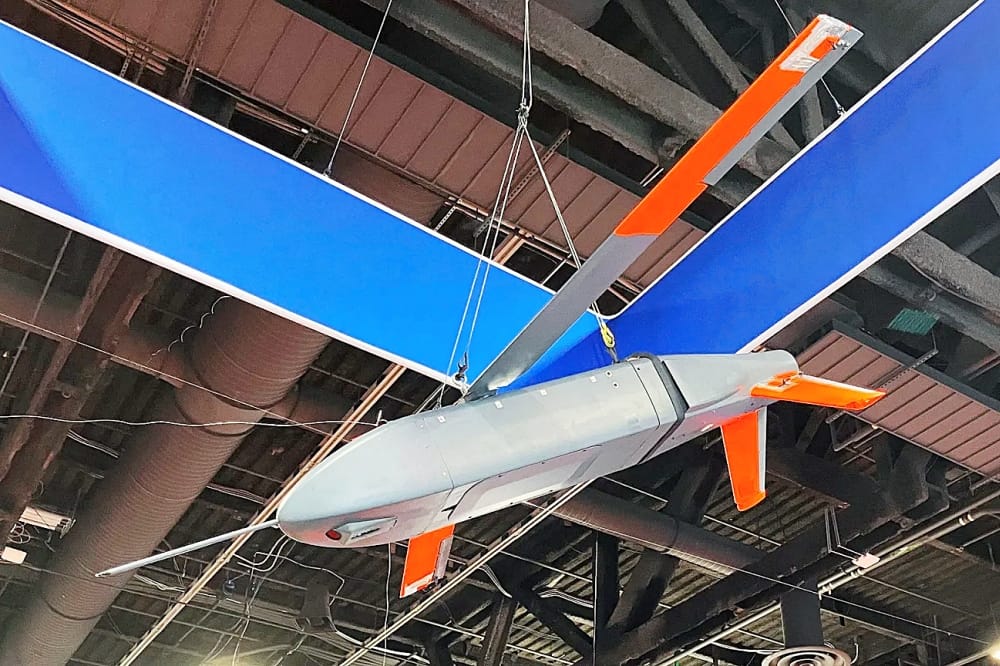
- Northrop Grumman has just unveiled its new Lumberjack loitering one-way attack drone at the Modern Day Marine conference in Washington, D.C.. TWZ talked to Michael Bastin, director of technology for the firm, on the show floor to get the low-down on Lumberjack and what it brings to the table.
The jet-propelled weapon falls into the U.S. military’s Group 3 uncrewed aerial systems (UAS) category, defined as designs weighing between 55 and 1,320 pounds, able to fly at between 3,500 and 18,000 feet, and having top speeds of between 100 and 250 knots. Lumberjack can be launched from the surface or the air. It carries a payload size similar to that of a 250-pound class Small Diameter Bomb (SDB). It can be configured for kinetic strike, including dropping submunitions of its own, or other roles, such as acting as an electronic warfare platform or reconnaissance. This flexibility comes via a modular center base compartment.
“Because it is air-launched and/or ground-launched, and it has a several hundred-mile range, you can basically put in kinetic effects from a forward-deployed ground base — very modular — it’s a two-man lift. So you can have an ability to sort of reach out and defend surface and land capabilities, as well as air deploy, and have non-kinetic electronic warfare protection for your main forces,” Bastin told us.
It can also trade its range for loitering endurance, staying in the air over an area for “a couple hours.”
In terms of launch options, Bastin said
“we’ve demonstrated two different launchers. One is an electric rail system developed for … the Navy, intended actually to launch off of ships. So you could actually launch this off of surface vessels. We’ve also launched it using a pneumatic technique, which is field-deployable. It’s very similar to what’s being employed currently in Europe … If the ground forces want it, it’s basically a large, effectively a potato gun. Very cheap, very easy to build. You can build it in, you know, local components.”
Cost-wise, Lumberjack is aiming to come in at around “$75 to $100K,” per weapon, according to Bastin. This would be a comparatively attractive price, especially for a modular kamikaze drone that is jet-powered and can fly at least a few hundred miles. This would equate to roughly half the cost of a Hellfire missile. Alternately, a single 227mm M31 GMLRS guided artillery rocket, which has a range of around 50 miles, costs around $150K.
Lumberjack would not strike as fast as the M31, but it would cover a much larger area and do so more flexibly from a single position than current GMLRS offerings, and even the forthcoming GMLRS-ER, which has nearly double its progenitor’s range.
With this in mind, from a single ground position, Lumberjack would allow a very small team to take on targets anywhere in a circle ranging at least 200 miles (possibly significantly further) in any direction, and do so relatively rapidly thanks to the Lumberjack’s jet speed. Once again, this is a capability far beyond the range of traditional and guided rocket artillery systems, and one that can be employed without the need to put airpower overhead. That is a huge amount of territory that can be put at risk very cheaply.
The ability for a single Lumberjack to attack multiple small targets geographically separated using submunitions on its one-and-only sortie it will fly is also a major plus, both in terms of value and flexibility.
Lumberjack’s potential use as a ship-based weapon is also attractive, especially due to its cost, range, and smaller size. Its loitering ability could come in use for many roles, from electronic warfare to reconnaissance, but especially for setting up force protection pickets between the ship and potential small surface threats.
Source: The War Zone