Northrop F-20 Tigershark - the Beast the US Navy Built but Never Used
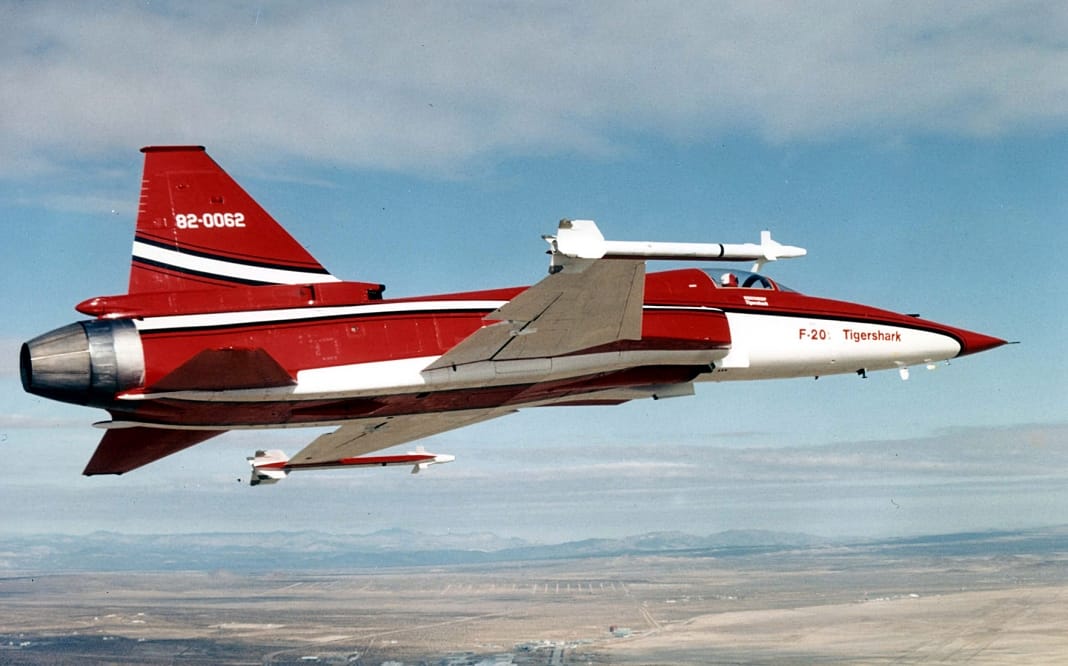
They heard it would be the aircraft that would finally bring frontline American technology within their reach. It’s 1983, and a group of South Korean defense procurement officials excitedly enters a meeting room to get a glimpse of the Northrop F-20 Tigershark, the United States’ latest jet fighter. Their eyes widen. On the screen, the soaring aluminum hero comes bursting through the clouds at Mach 2.
They listen intently as the film’s narrator lays out the fighter’s impressive features and capabilities. Excellent thrust-to-weight ratio. High maneuverability. Solid reliability and ease of maintenance. As fast as an F-16 at half the cost—exactly what they’ve been looking for. Just as it couldn’t get any better: legendary American war hero and sound-barrier-breaking test pilot Chuck Yeager. His ringing endorsement is all they need to hear.
The Tigershark is all set to revolutionize the air forces of the USA’s allies across the globe. Yet when they need it most, it is nowhere to be found…
The Northrop F-20 Tigershark (initially F-5G) is a prototype light fighter, designed and built by Northrop. Its development began in 1975 as a further evolution of Northrop's F-5E Tiger II, featuring a new engine that greatly improved overall performance, and a modern avionics suite including a powerful and flexible radar. Compared with the F-5E, the F-20 was much faster, gained beyond-visual-range air-to-air capability, and had a full suite of air-to-ground modes capable of utilizing most U.S. weapons.
With these improved capabilities, the F-20 became competitive with contemporary fighter designs such as the General Dynamics F-16 Fighting Falcon, but was much less expensive to purchase and operate.
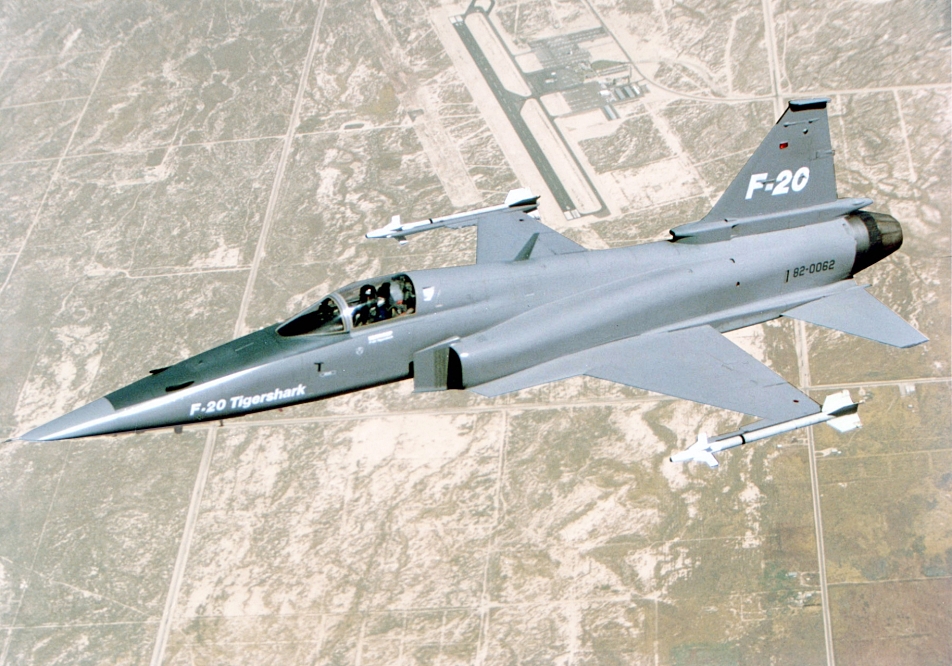
Much of the F-20's development was carried out under a US Department of Defense (DoD) project called "FX". FX sought to develop fighters that would be capable in combat with the latest Soviet aircraft, but excluding sensitive front-line technologies used by the United States Air Force's own aircraft. FX was a product of the Carter administration's military export policies, which aimed to provide foreign nations with high quality equipment without the risk of US front-line technology falling into Soviet hands.
Northrop had high hopes for the F-20 in the international market, but policy changes following Ronald Reagan's election meant the F-20 had to compete for sales against aircraft like the F-16, the USAF's latest fighter design. The development program was abandoned in 1986 after three prototypes had been built and a fourth partially completed.
Top Photo: The first F-20 in Northrop colours
Sources: YouTube; Wikipedia