Noise, Vibration Considerations in eVTOL Aircraft
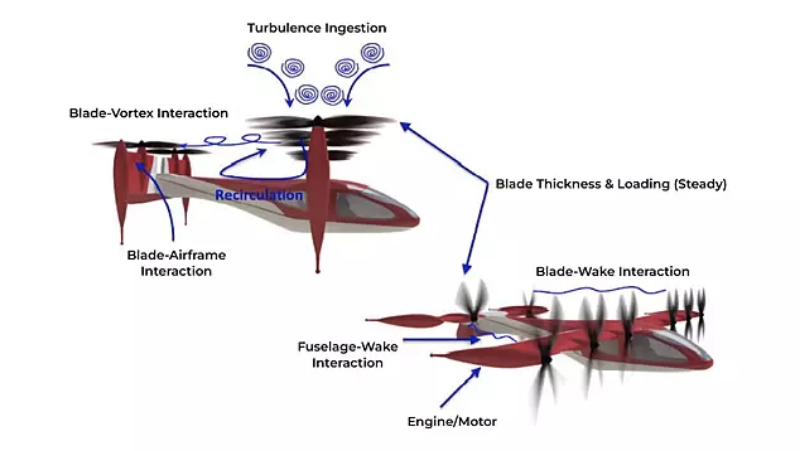
Dr Arunkumar M Sampath, a Principal Consultant in Tata Consultancy Services (TCS) in Chennai, recently published a study into the implications of the increase in the production and operation of eVTOL aircraft and UAVs within populated civilian areas at relatively low altitudes which creates noise annoyance issues that impact human health and well-being.
Extract:
Advanced Air Mobility (AAM) comprising Unmanned Aerial Vehicles (UAVs) and Urban Air Mobility (UAM) with less than 100 nautical miles (nm) flying range is an emerging quick mode of transport in large cities with heavy traffic jams, where the possibility of using helicopters is ruled out due to dense population and annoying noise levels of these rotorcraft.
With significant advances in battery technology and electric propulsion, electric vertical takeoff and landing (eVTOL) aircraft form a critical role in UAM to offer sustainable transport of passengers and cargo loads in densely populated large cities around the world. An increase in the production and operation of eVTOL aircraft and UAVs within populated civilian areas at relatively low altitudes creates noise annoyance issues that impact human health and well-being.
Additionally, as eVTOL aircraft designs evolve, researchers are still assessing the types of noise and vibration sources and the means to control them for the comfort of the pilot and passengers on board.
The Federal Aviation Administration (FAA) in the USA and European Union Aviation Safety Agency (EASA) in the EU have formed working groups on Noise Vibration Harshness (NVH) to formulate strict noise regulations on UAM aircraft and ensure compliance by different eVTOL and UAM manufacturers on acceptable community noise levels (exterior noise) and pilot and passenger comfort levels during air travel (interior noise).
Different research facilities under the aegis of the National Aeronautics Space Administration (NASA) at Langley Research Centre in Hampton Virginia and Glenn Research Centre in Cleveland Ohio, have been assisting FAA in developing eVTOL aircraft concept designs, developing generic codes for predicting the performance and noise signatures of these aircraft, and analysing and characterising the noise generated by these vehicles.
Owing to multiple sources of noise in an eVTOL aircraft generating tonal, narrowband, and broadband noises under different flight modes of operation, efforts are being made to optimise the design for noise reduction at source, improve the lightweight fuselage design for better aerodynamics, range, and NVH, and explore active noise and vibration control technologies for improved interior noise and pilot and passenger comfort.
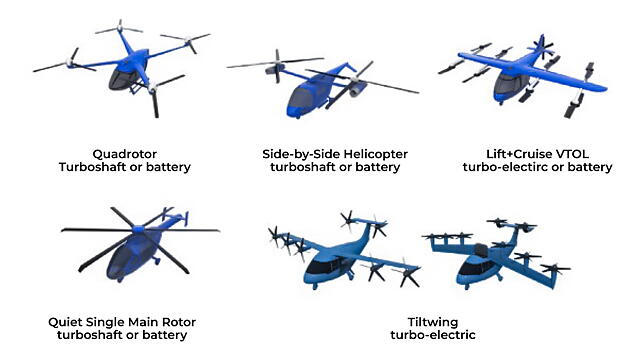
A few concepts of UEM (eVTOL aircraft) designs have been proposed by NASA [Ref 1,], some of which are shown in Figure 1 [Ref 1] that comprise a quadrotor aircraft, with turboshaft and electric propulsion; side-by-side aircraft, with turboshaft and electric propulsion; lift + cruise aircraft with electric and turbo-electric propulsion; a quiet single-main rotor helicopter with turboshaft and electric propulsion; and a tilt-wing aircraft with turbo-electric propulsion.
Future Work
For UAM to be successful in densely populated urban areas, ultra-quiet aircraft operations are a must that could be achieved using a strong multidisciplinary research effort combining research in aerodynamics, acoustics, numerical methods, active controls, advanced materials, low-noise flight operations, and autonomous flying capabilities, to name a few.
It is observed that unsteady loading will dominate the noise of these aircraft. Depending on the design configuration of an eVTOL aircraft (rotors, fixed vs tilt wing, etc.), strong aerodynamic interactions between the lifting and propulsion components and the airframe occur, resulting in annoying noise signatures.
Only recently, aero-acousticians have started understanding the complex interactions between rotors or propellers and turbulent wakes generated by upstream aerodynamic components in eVTOL aircraft, while enough research has been carried out over many decades on blade-vortex interaction noise, blade-wake interaction noise, and rotor-airframe interaction noise for propeller aircraft and rotorcraft such as helicopters.
A multidisciplinary approach is required to accurately build UAM noise source models using computational aeroacoustics by building on the prior research regarding helicopter BWI and propeller turbulence ingestion noise. A hybrid noise standard for UAM that includes the timber element of sound and that incorporates the noise standards from the automotive industry may be required to address the noises experienced by urban residents from both on-road vehicles and low-flying eVTOL aircraft. Further research needs to be carried out on active control technologies for cost-effective and scalable solutions to address NVH issues in eVTOL aircraft.
The full study is available here.
About the Author: Dr Arunkumar M Sampath works as a Principal Consultant in Tata Consultancy Services (TCS) in Chennai. His interests include Hybrid and Electric Vehicles, Connected and Autonomous Vehicles, 5G/6G, Cybersecurity, Functional Safety, Advanced Air Mobility (AAM), AI, ML, Data Analytics, and Data Monetization Strategies.
Source: Mobility Outlook