New Technology to Wirelessly Power Drones in Flight
A research group led by Takayuki Matsumuro, a researcher at the Wave Engineering Laboratory of the Advanced Telecommunications Research Institute International (ATR) in Japan, has developed a new technology for wirelessly transmitting power to drones in flight.
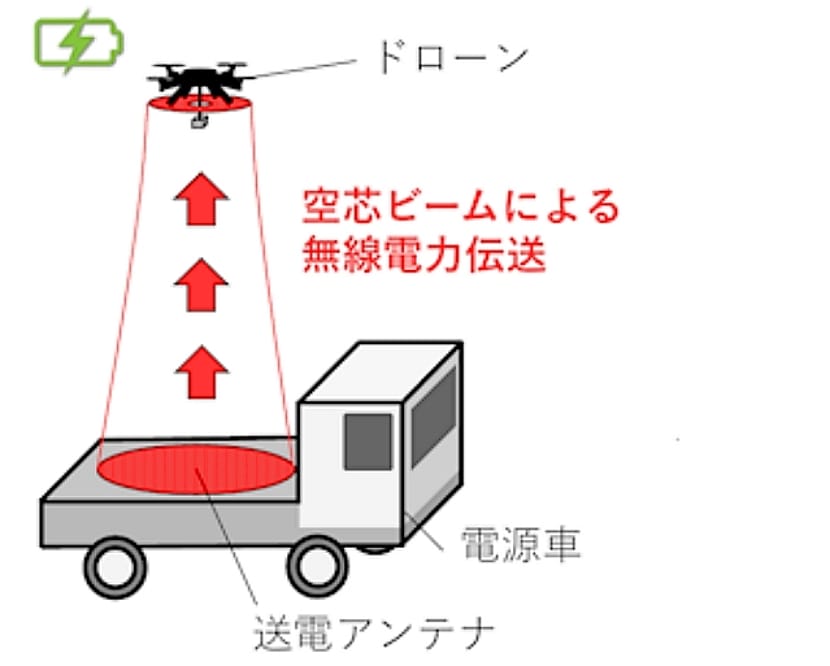
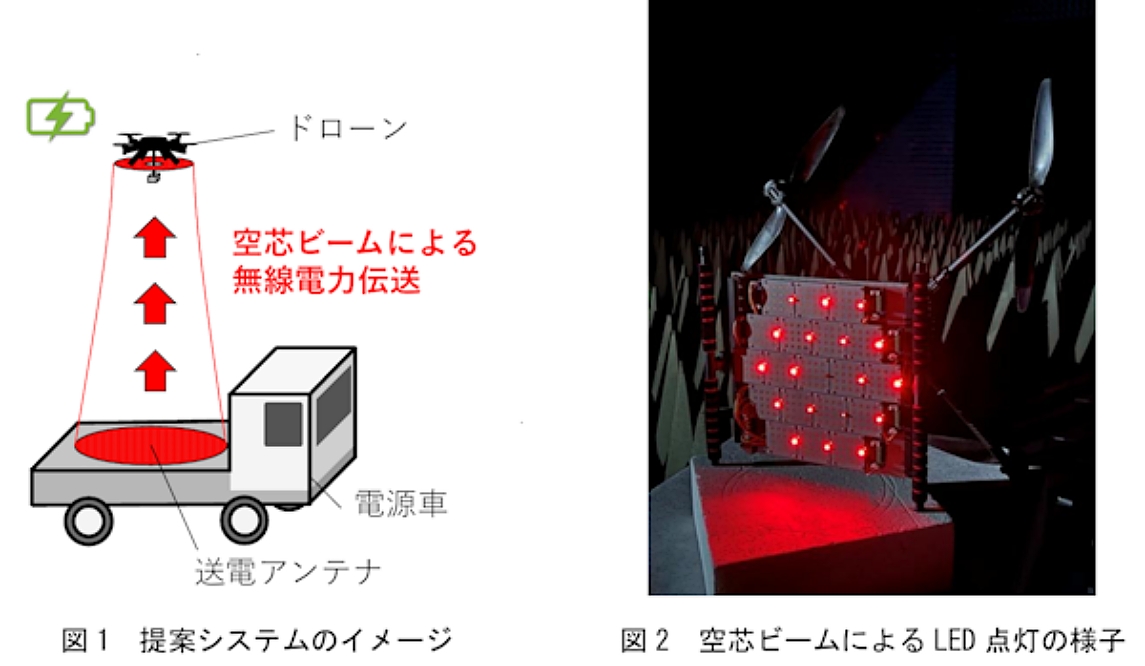
This technology forms a special beam called an "air-core beam" *1 ), which can supply power to drones without affecting their cameras and other equipment (Figure 1).
In an experiment, the power transmitted using the air-core beam was converted to direct current, and the group succeeded in lighting only LEDs located away from the center of the drone (Figure 2). The fact that the central LED was not lit confirmed that interference had been avoided.
This technology will be the foundation for supplying power to drones in flight while they carry out various missions, and it is expected that wireless power transmission will be put to practical use and applied to a variety of fields in the future.
The results of this research will be exhibited at Wireless Japan x Wireless Technology Park (WTP) 2025, which will be held at Tokyo Big Sight from May 28, 2025.
Research Background
As drones are increasingly being implemented in society, they are expected to be used in a variety of fields, including watching sports, logistics, agriculture, and even collecting information and restoring communications during disasters. However, drones have a limited battery capacity and a short continuous flight time (approximately 30 minutes to 1 hour).
To solve this problem, this study proposes a wireless power transmission system using microwaves. However, to transmit power wirelessly, a "rectenna" *2 must be installed at the bottom of the drone to receive the power. This causes problems such as radio and physical interference with the drone's mission equipment, such as cameras.
Solution Method
In this study, we developed a wireless power transfer system that uses a special beam called an "air-core beam" to solve the interference problem during power transfer.
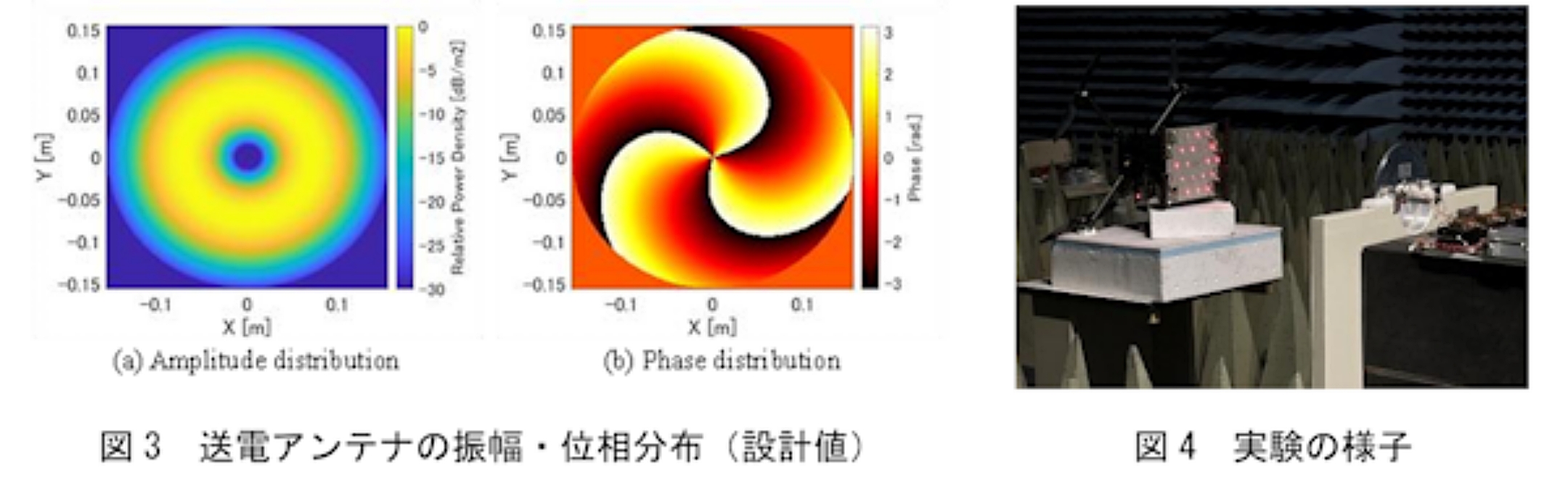
First, we designed the amplitude and phase distribution required to form an air-core beam based on the transmission distance and the size of the transmitting and receiving antennas. An air-core beam has the characteristic that the phase of the radio waves emitted from the antenna is rotated in a spiral shape, causing the radio waves to cancel each other on the propagation axis, resulting in zero power at the center (Figure 3).
Based on this design, we developed a transmitting antenna with a diameter of 30 cm that can generate an air-core beam in the 24 GHz band. In addition, we developed a lightweight rectenna with a size of 5 cm square as the receiving side, and placed 19 of them in a flat shape on the bottom of the drone. Each rectenna was equipped with an LED so that the location where power was transferred could be confirmed by light.
To evaluate the performance of this system, we installed a rectenna panel 1 m away from the transmitting antenna and conducted an experiment (Figure 4). As a result, we confirmed that the LEDs around the center of the drone were lit up without affecting the center of the drone (Figure 2 above). In the future, it is expected that the development of even larger transmission antennas will enable wireless power transmission over longer distances and with greater power.
Future Outlook
The results of this research showed that it is possible to create an area in the center of the beam where interference can be avoided in a wireless power transmission system. This technology will fundamentally solve the problem of interference between the power transmission and the camera and various mission equipment mounted on the drone.
This technology is an important step towards realizing drones that can fly for long periods of time and perform various missions by transmitting power from the ground. It is also expected to be applied to various fields, including long-distance wireless power transmission.
Terminology
*1) Air-core beam: A special beam in which the intensity at the center where the radio waves are transmitted is zero. It has a swirling phase distribution and is also called the orbital angular momentum (OAM) mode or Laguerre-Gaussian mode. *2) Rectenna: A device that receives microwaves and converts them into DC power. A portmanteau of "rectifying" and "antenna," it is used as the power receiving side of wireless power transmission systems.
Source: Advanced Telecommunications Research Institute International