NATO Publishes New Sense-and-Avoid Standard for UAS in Unsegregated Airspace
The NATO standard “Sense and Avoid for Unmanned Aircraft Systems” has been promulgated and is effective after being ratified by NATO nations. This is the first Sense/Detect and Avoid standard to be implemented on both sides of the Atlantic.
The standard transitioned from recommended practice to an implemented standard after validation by military and civil authorities, industry, and technical experts. NATO is continuing to operationalize Sense and Avoid across the Alliance through developing NATO-wide means to demonstrate compliance to the standard and validating NATO-wide operational approval processes, using the UK Protector as a demonstration platform.
The standards—AEP-107 Edition B and AEP-107.1 Edition A—and the NATO agreement STANAG 4811 Edition 3 can be downloaded for free here. (click “Covered Standards” for AEP-107 and AEP-107.1).
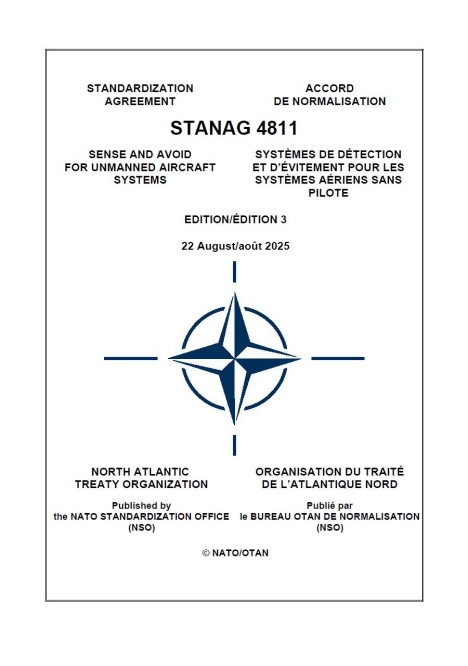
The stated NATO interoperability requirements (from the STANAG) are:
To standardize the minimum functional and performance requirements for Unmanned Aircraft System (UAS) Sense and Avoid (SAA) systems in order to ensure interoperability:
a. Compatibility: to ensure the safety of civil and military operations through acceptable interactions of equipment, operations, procedures, and humans; and
b. Interchangeability: to support recognition and commonality of materiel solutions and industry standards; and
c. Commonality: to enable routine operations by standardizing operational procedures, functionality, performance, and approval processes.
AEP-107 provides minimum functional and performance requirements to ensure the safety and interoperability of SAA systems for UAS operations in non-segregated airspace. AEP-107 defines tailorable acceptable means of compliance for each requirement.
This STANAG is considered implemented when the standardized requirements in AEP-107 are used or are specified to be used in the future (e.g., through policy, regulation, order, or instruction as appropriate) by the appropriate authorities:
a. within SAA acquisition programs; or
b. within certification, airworthiness, or certification processes; or
c. to facilitate cross-border approvals of SAA equipped UAS; or
d. to facilitate the recognition or approval of industry SAA standards.
Source: LinkedIn