MSU Researchers Developing Long-Range Identification Technology for US Intelligence Community
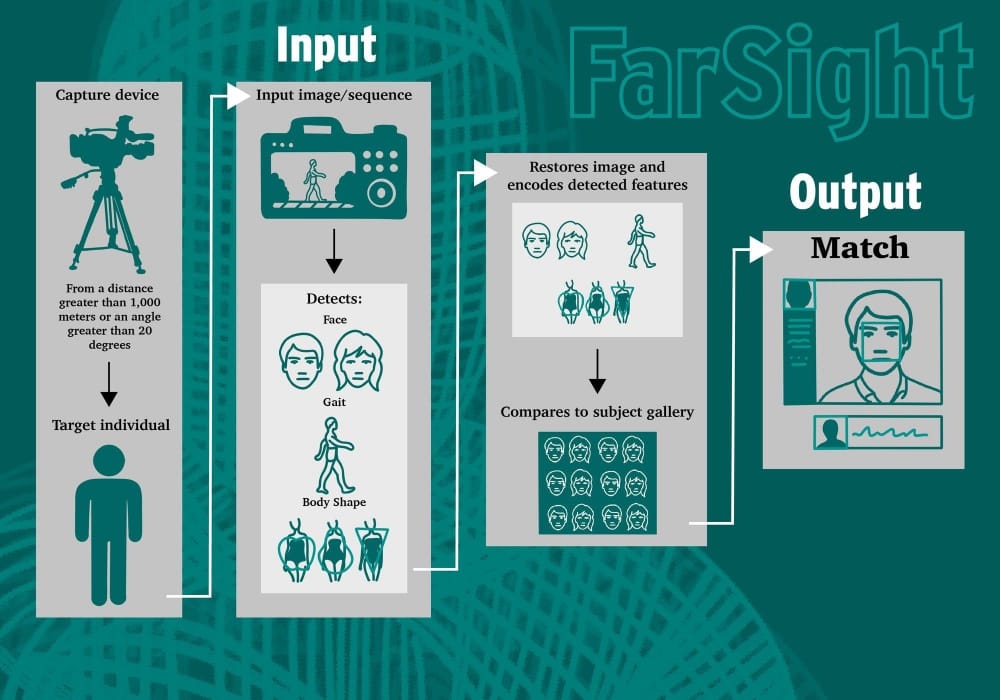
Since Nov. 2021, researchers at Michigan State University have been working to develop a computer vision system capable of identifying individuals from 1,000 meters away. The technology, called FarSight, is the culmination of 18 months of research in cooperation with the Intelligence Advanced Research Projects Activity, or IARPA, a federal organization that works to develop solutions for technological problems faced by U.S. intelligence agencies.
In Sept., MSU’s research team received a $12 million, four-year grant from IARPA to continue development on FarSight under the agency’s Biometric Recognition and Identification at Altitude and Range, or BRIAR, program.
BRIAR Program Manager Lars Ericson said the impetus for the program’s creation was that some sensors used by the intelligence community were often not well-suited for performing facial recognition. Ericson pointed out that additional challenges, such as low resolution and severe viewing angles, necessitated the development of new surveillance technology.
systemsIn order to successfully identify individuals from long distances, as would be necessary from a surveillance drone, for example, FarSight uses a person’s face, gait and body shape for biometric identification. This whole-body approach to identification is meant to address the challenges posed by low-image quality, individual similarities and severe viewing angles.
FarSight Project Lead and MSU Research Foundation Professor Xiaoming Liu said the software also helps combat a phenomenon called atmospheric turbulence, which occurs when light is distorted over long distances due to conditions in the atmosphere such as temperature.
turbulenceAccording to the BRIAR program’s website, the software that ultimately arises out of this research is intended to be used for counterterrorism, military force protection and border security. As a research agency, however, IARPA does not determine the exact applications of its technology and instead works to “facilitate the transition of research results” to the U.S. intelligence community.
weigh in on.”University of Tampa Associate Professor Abigail Hall, who studies U.S. foreign policy and militarism, said it's not uncommon for technologies originally meant for military purposes to ultimately be deployed domestically. She added that although domestic use of surveillance equipment, such as drones being used for agricultural purposes, is not inherently negative, law enforcement applications of surveillance technology can be difficult to regulate.
those applications.”Hall explained that because the work of the U.S. intelligence community is secretive by nature, it can be incredibly difficult for civilians and elected officials alike to access the information needed to effectively monitor the uses of technology such as FarSight.
usedAlthough Liu said he is instructed by the project sponsors to not articulate potential applications of FarSight, he provided his own perspective as a scientist and researcher.
possibilitiesSource: State News