Merops - the Cheap US Interceptor Drone Making Russia’s $35K Shaheds Obsolete
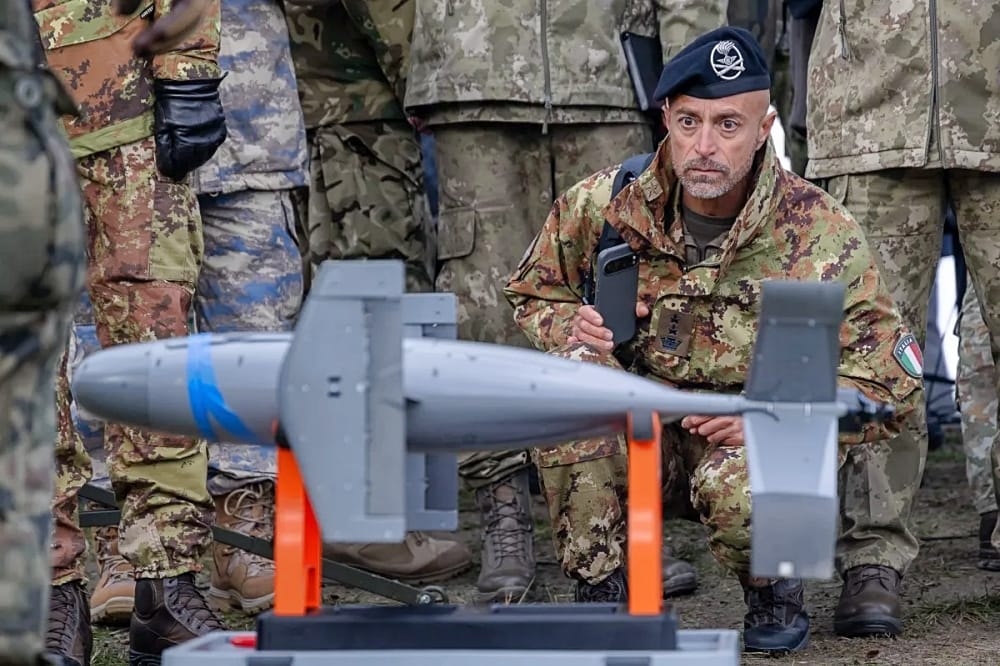
With plans to establish a drone wall to combat a surge in Russian UAV incursions, multiple states in NATO’s Eastern Flank are now adopting Merops, the battle-tested ‘Shahed-killer’ counter-drone system. Merops has been fast-tracked to countries like Poland and Romania, both of which are witnessing mounting drone incursions from Russia. It is reportedly also being purchased by Denmark, which has seen an uptick in unidentified drone activity.
Poland and Romania received their first Merops systems this month and began training alongside US soldiers at one of Poland’s largest military training areas.
On November 18, Polish soldiers launched the sleek interceptor drone from the flatbed of a pickup truck on a windswept training site just 100 kilometers from Ukraine.
[embed]https://vimeo.com/1139797413?fl=pl&fe=sh[/embed]
Recent drone incursions in airspace over the Eastern Flank not only exposed NATO’s vulnerability against these threats but also drew attention to the fact that the alliance does not have cost-effective assets to neutralize these cheap, expendable drones.
While a Russian Shahed drone costs around $25,000 to $35,000, the interceptor missiles used by NATO cost millions of dollars per unit.
This is where the Merops system comes in. Merops interceptor drones can autonomously chase and ram hostile drones at high speed. They cost about $15,000, almost half the price of the Shahed UAV. This system has been battle-tested in Ukraine, where it has been credited with destroying 40% of Russia’s Shahed kamikaze drones.
Merops To Defend NATO
In the war that is fast approaching the four-year mark, Ukraine has successfully deployed cost-effective interceptor drones to neutralize Russian UAVs targeting strategic assets in the country.
In fact, Merops, along with other interceptor drones, is part of Ukraine’s multilayered air defense architecture, which relies mostly on traditional systems such as anti-aircraft guns, MANPADS, and electronic warfare to handle the high volume of Shaheds.
Merops drone is a compact, AI-powered counter-unmanned aerial system (C-UAS) designed to detect, track, and neutralize hostile drones, particularly low-cost, slow-moving threats such as the Shahed. It presents a shift toward affordable, mobile drone-on-drone interception, emphasizing kinetic effects over expensive missiles or electronic warfare.
It is named after the bee-eater bird genus (Merops) known for agile aerial hunting. It was created as part of the US-led Project Eagle.
“This is one of the most effective Shahed killers on the planet right now,”
U.S. Brig. General Curtis King, head of the 10th Army Air and Missile Defense Command, told reporters at the Polish base where the training was taking place.
”We conservatively estimate that it has been responsible for 40% of all Shahed destruction in Ukraine.”
The Merops system consists of launchers, the interceptor UAVs, and a ground control station. During training in Poland, the UAVs are launched straight from regular pickup trucks. Therefore, Merops can be used to hunt down enemy reconnaissance or strike drones close to the frontline as well as to combat long-range UAVs.
Typically, drones used for interception can be controlled remotely or autonomously. They have sensors for detecting targets and carry a small warhead, but it is enough to destroy drones of the Shahed-class. They reach speeds of more than 175 mph (280 km/h).
The Merops system uses Artificial Intelligence (AI) machine vision (optical/IR) for terminal homing, which is resistant to GPS/EW jamming. The system avoids reliance on vulnerable satellite links, using onboard AI to filter noise, identify targets, and execute intercepts even in jammed environments.
Merops entered classified service with Ukraine in mid-2024 and was integrated into air defense units repelling nightly Shahed barrages. Ukrainian operators praise its mobility, and reports suggest that it has achieved over 1,000 confirmed intercepts of Russian Shahed drones.
The system was rushed into production and deployment starting in 2024 to address gaps exposed by Russian drone attacks on Ukraine. According to reports, Anduril’s broader C-UAS portfolio, including tools such as Lattice AI software, integrates seamlessly with Merops for sensor fusion and autonomous decision-making.
“It’s very lethal, very effective, but the key piece here is that it’s cost-effective,”
said Brig. Gen. Curtis King, Brig. Gen. King highlighted its lethality in contested airspace, noting it fills gaps left by pricier systems like Patriots.
“This is one of many capabilities that NATO nations are going to have to look to employ to defeat the drones,”
King stated, noting that the conflict in Ukraine highlights the need for weapons research to keep up with the rapid evolution of modern warfare.
Source: The Eurasian Times