Lumberjack Jet-Powered Modular Missile is Possible Armament for XQ-58 Valkyrie Drones
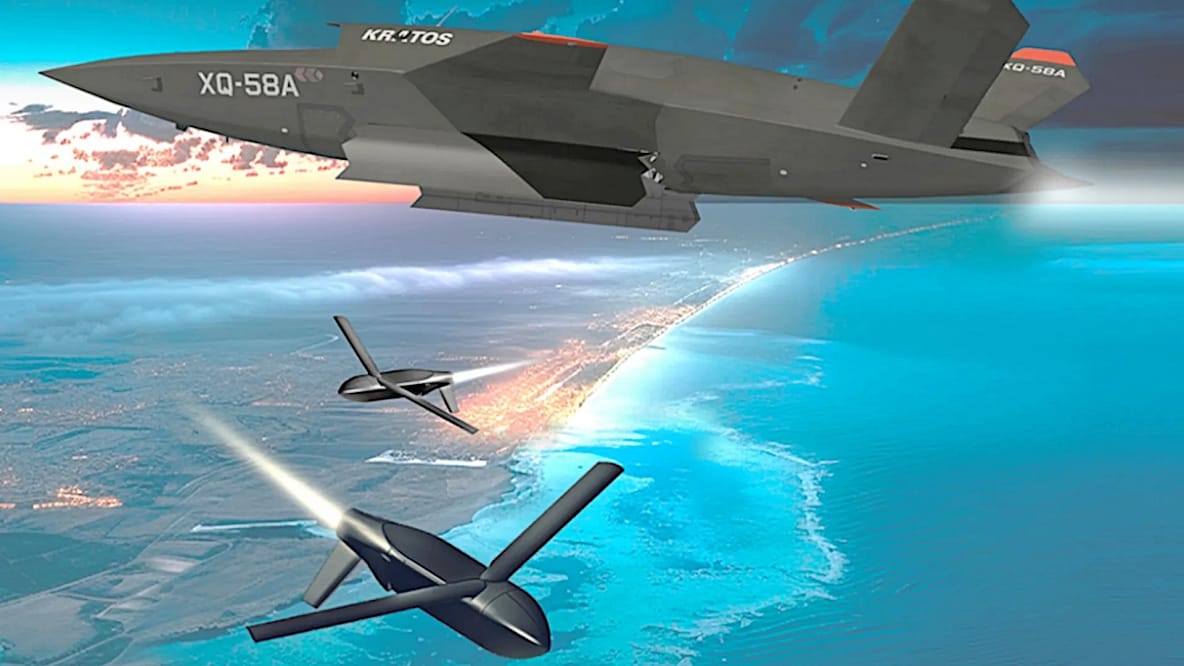
- Northrop Grumman has been doing detailed design work that lays a path to air-launching its Lumberjack loitering one-way attack drone from Kratos’ stealthy XQ-58 Valkyrie uncrewed aircraft. Multiple manned and unmanned aircraft are being eyed as potential platforms for employing Lumberjack, which is already being tested in surface-launched modes and will have the ability to drop its own smaller precision munitions.
In a statement to TWZ, Northrop Grumman confirmed that “Valkyrie is one of the multiple platforms we’re doing detailed design work for to ensure compatibility with Lumberjack” and that “Valkyrie is a good representation of a possible use case.” The XQ-58 is prominently featured in the Lumberjack product card available on Northrop Grumman’s website at the time of writing.
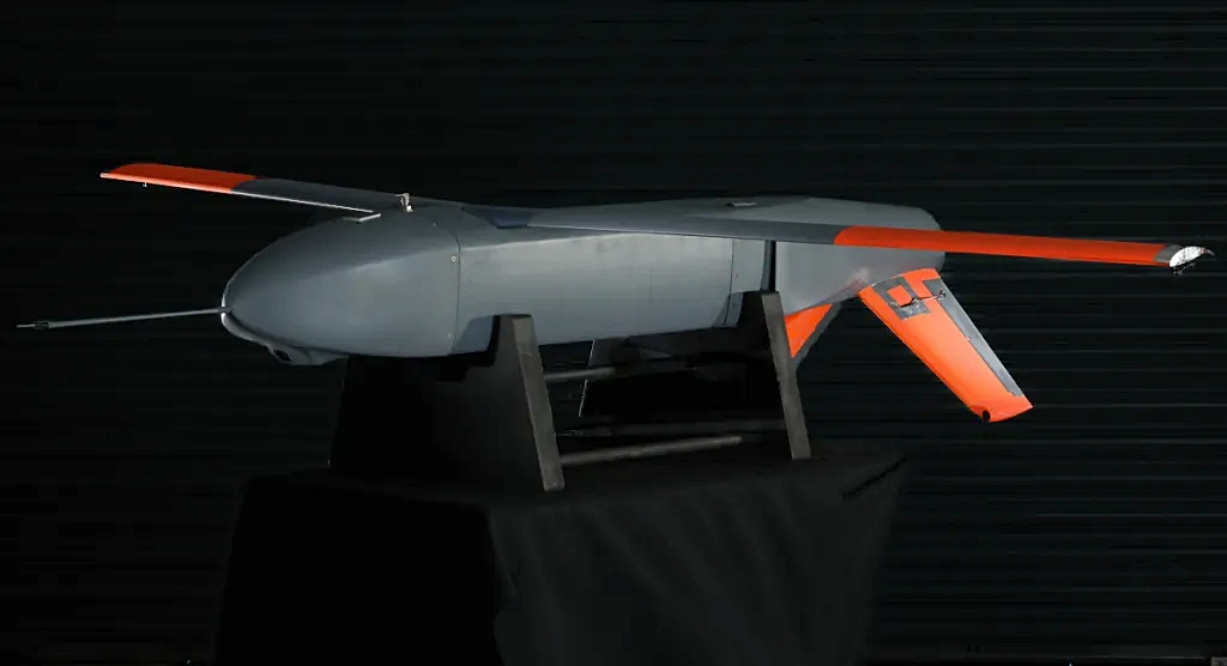
Since being first unveiled in April at this year’s Modern Day Marine conference, Lumberjack has
“participated in both of the T-REX events this year. So, those are the technology, readiness, and experimentation events hosted by OUSD(R&E) [the Office of the Undersecretary of Defense for Research and Engineering, also now referred to as the Office of the Undersecretary of War for Research and Engineering],”
Michael Bastin, Northrop Grumman’s director of programs for Lumberjack said.
“Those are really valuable for us. We got a chance to get operators to look and engage with the system, [and] actually do an end-to-end simulated mission in a relevant type of environment with a lot of capabilities that people were looking for.”

At the T-REX events, Northrop Grumman also demonstrated Lumberjack’s
“ability to launch from two different styles of [ground-based] launchers, the electric rail launcher and the pneumatic launcher,” both provided by other companies, he added. “We are launcher agnostic. So we don’t really develop the launchers ourselves. We just show up to the ride.”
When it comes to current plans for air-launched applications,
“We’re designing that [Lumberjack] for multiple BRUs. So, a couple different BRU installations are compatible against that sort of Small Diameter Bomb length,” he continued, using the U.S. military-standard abbreviation for Bomb Rack Unit. “We are working with two different customer communities right now, working through large plans and experimentation for next year. So that’s part of our flight test plan that we’re developing for next year.”
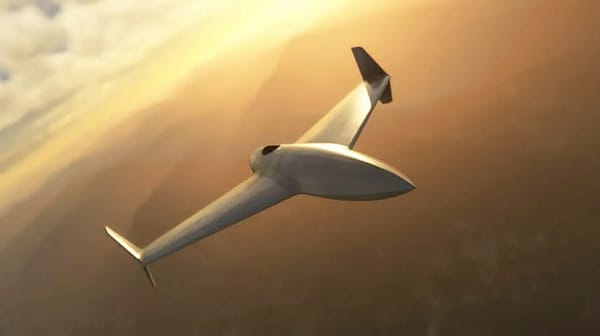
The GBU-39/B Small Diameter Bomb (SDB) is a 250-pound-class precision-guided glide bomb that is just under six feet (1.8 meters) long. Northrop Grumman’s website says Lumberjack has a very similar form factor, but has a maximum gross weight of around 290 pounds.
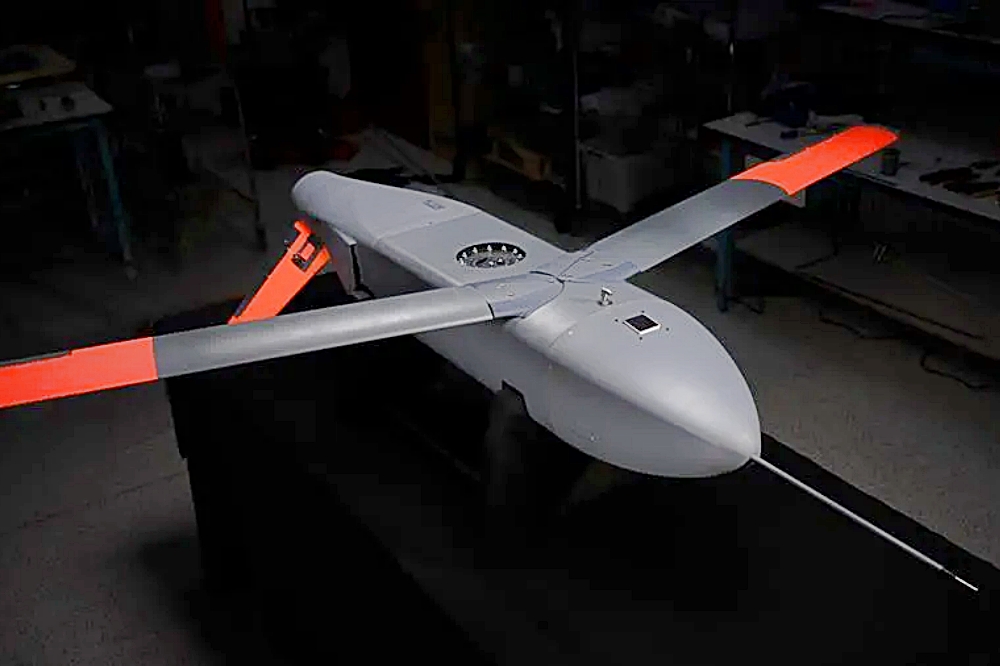
Lumberjack’s weight is payload-dependent, which Northrop Grumman’s website says could include a “combination of kinetic and non-kinetic sub-munitions, or ISR [intelligence, surveillance, and reconnaissance] sensors.” Without any payload or fuel for its small jet engine, the core system, with its composite material structure, only tips the scales at around 79 pounds, according to the product card.
How heavy a Lumberjack might be would also impact its range in both air and surface-launched modes. So far, Northrop Grumman has only said that the system is expected to be able to fly “several hundred” nautical miles. The company has also said that it will be able to cruise at around Mach 0.3 (some 230 knots) at an altitude of 20,000 feet.
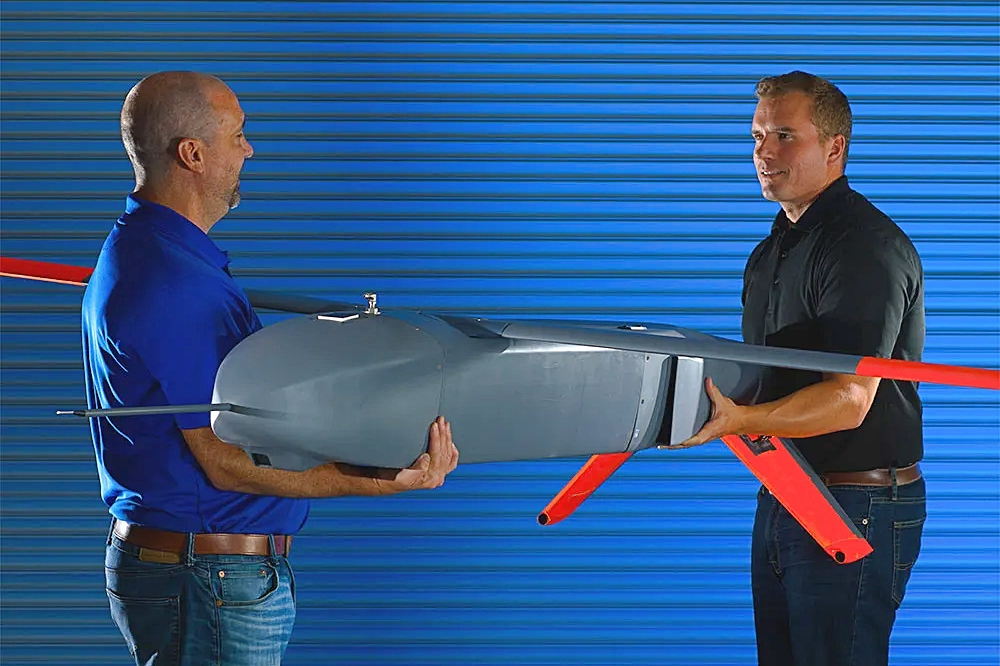
“We have done testing with both kinetic and non-kinetic [payloads],” Bastin said. “Hatchet is certainly a candidate. It’s not the only type of kind of sub-munition that we’d be interested in being able to deploy. So, as I said, if customers come with whatever kinetic effect they want, as long as it fits on the center bay, we’re capable of integrating it.”
In any configuration, Lumberjack already offers the ability to reach target areas at standoff distances. Its ability to launch unpowered gliding payloads like Hatchet, or even potentially small powered ones, only extended its operational reach. This would all be further magnified by pairing it with an aerial launch platform like the XQ-58. The Valkyrie has its own internal payload bay, said to be able to carry at least two SDB-sized stores, and can also carry payloads under its wings. Lumberjack’s range would also help keep the launching platform further away from threats. A full operational scenario might see a Valkyrie or similar launch platform use its own survivability to get close to an especially high-threat part of the battlespace before launching a Lumberjack, which then delivers munitions into the highest risk area. This could even involve taking out hostile air defense assets that threaten the launching aircraft.
Lumberjack can also make use of its range for other purposes, including launching kinetic or non-kinetic attacks on geographically separated targets during a single sortie, as well as just loitering in a particular area. Equipped with a stand-in jamming capability and/or sensor packages, the drones could be used to form temporary force protection picket lines, and do so rapidly.
There is also a cost factor, with Lumberjack’s design being focused on a low unit cost and producibility, with a heavy emphasis on commercial and modified commercial components
“For every pallet that I would ship a fixed number of Small Diameter Bombs on, we can ship the same number of lumberjacks on, but each lumberjack performs multiple effects, multiple missions, and can go on multiple vehicles,” Bastin explained. “So it helps drive down that cost, as I said, within a Lumberjack, because we designed it with open architecture and a very modular center bay.”
Northrop Grumman previously told TWZ that it is targeting between a “cost per effect” of $75,000 to $100,000 for Lumberjack, somewhat nebulous figures that factor in things beyond basic unit price. It is also worth noting here that while Lumberjack is intended to be a one-way system when used operationally, work is being done to improve its recoverability when used in training. Being able to reuse the drones for training, as well as test and evaluation activities, would also offer cost advantages.
If Northrop Grumman keeps to its current test schedule, we may get actual looks at Lumberjacks launched from XQ-58s and/or other aircraft in the coming year.
Source: The War Zone