Lockheed XF-90 - the Nuclear-Proof Jet America Ditched
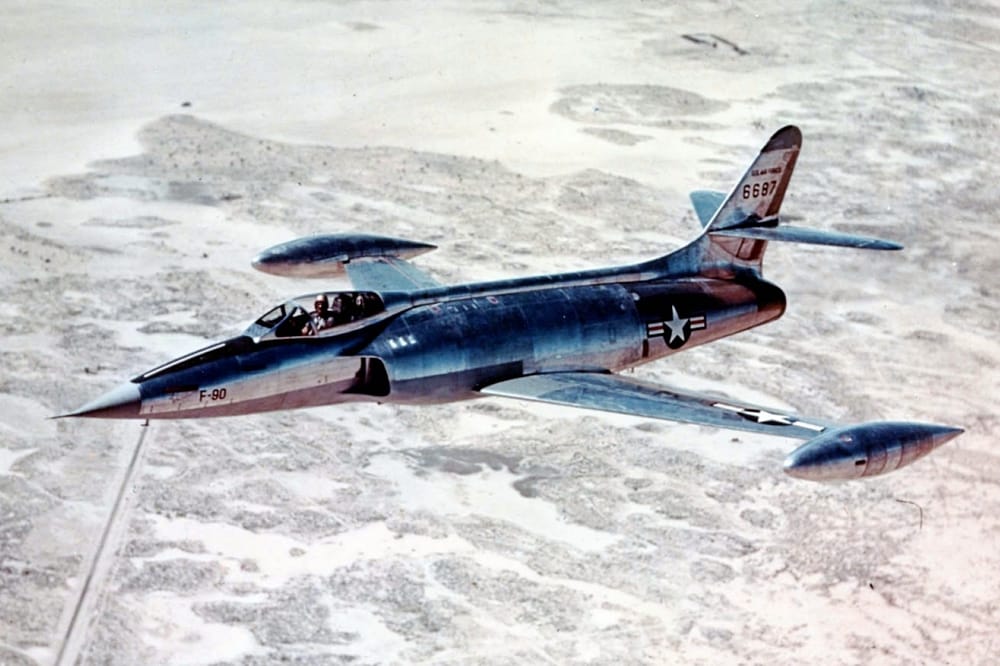
The XF-90 was built like no fighter before… or since. At a time when no one knew what supersonic flight would do to metal, Skunk Works chose brute force over guesswork. They forged the strongest airframe on Earth: 75S aluminum over a steel spine, the fuselage braced until it was closer to armour than aircraft.
It was forged to be at least 50 percent stronger than any warplane in the entire world.
It was meant to ride with the giant B-36 Peacemaker, to dive beyond the speed of sound and deliver nuclear fire across the globe.
Then, in 1952, a blinding flash lit up its aluminum skin. The tail quivered, and the landing gear trembled like Jell-O as a shockwave equal to thousands of tons of TNT smashed into its airframe, followed by a mushroom cloud rising into the sky.
It was time to see if the strongest plane in the world could take a nuclear blast.
The Lockheed XF-90 was built in response to a United States Air Force requirement for a long-range penetration fighter and bomber escort. The same requirement produced the McDonnell XF-88 Voodoo. Lockheed received a contract for two prototype XP-90s (redesignated XF-90 in 1948). The design was developed by Willis Hawkins and the Skunk Works team under Kelly Johnson. Two prototypes were built (s/n 46-687 and -688).
Developmental and political difficulties delayed the first flight until 3 June 1949, with Chief Test Pilot Tony LeVier at the controls.
Embodying the experience gained in developing the P-80 Shooting Star, the XF-90 shared some design traits with the older Lockheed fighter, albeit with swept-wings; however, this latter design choice could not sufficiently make up for the project’s underpowered engines, and the XF-90 never entered production.
Design and Development
In response to a 1945 Army request for an advanced jet fighter, Lockheed proposed a jet powered initially by a Lockheed L-1000 axial flow turbojet, and then the General Electric J35. Further design refinements included using two Westinghouse J34 engines with afterburners. After data showed that a delta planform would not be suitable, the Lockheed Model 90 was built in 1947 as a mock-up.
The final design embodied much of the experience and shared the intake and low-wing layout of the previous P-80 Shooting Star, but with 35° swept-back wings, a sharply-pointed nose, and two Westinghouse J34-WE-11 axial-flow turbojet engines, providing a total thrust of 6,200 lbf (27.6 kN), mounted side-by-side in the rear fuselage and fed by side-mounted air intakes.
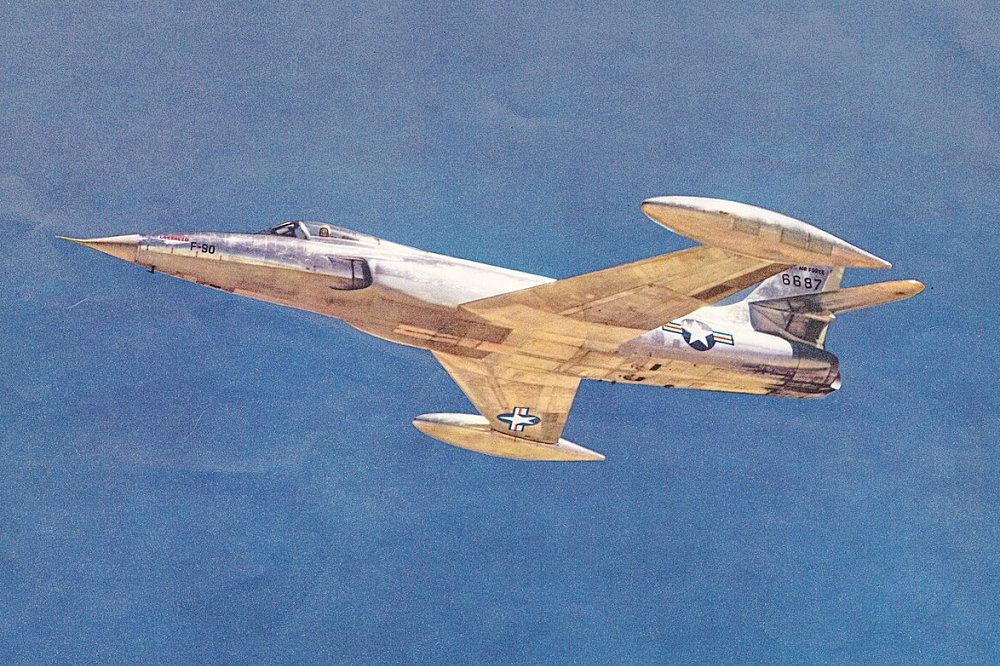
The wings had leading edge slats, Fowler flaps, and ailerons on the trailing edge. The pressurized cockpit was fitted with an ejection seat and a bubble canopy. Proposed armament was six 20 mm (.8 in) cannons. The internal fuel was supplemented by tip tanks, bringing total fuel capacity to 1,665 gal (6,308 L). The use of 75ST aluminum rather than the then-standard 24ST aluminum alloy, along with heavy forgings and machined parts, resulted in a well-constructed, sturdy airframe. These innovations resulted in an aircraft with an empty weight more than 50% heavier than its competitors.
The first XF-90 used non-afterburning J34s, but these lacked the thrust for takeoff as rocket-assisted RATO were required for most of the first flights unless it carried a very low fuel load. The second (XF-90A) had afterburners installed which had been tested on an F-80 testbed. Even so, the aircraft remained underpowered.
Top Photo: The first U.S. Air Force Lockheed XF-90 prototype (s/n 46-687) in flight.
Sources: YouTube; Wikipedia