Lockheed P-80 Shooting Star - America’s Strangest Plane Destroys an Entire Army
June 27, 1950. Seoul has fallen. At Suwon Airfield, American civilians are trapped as North Korean fighters strafe the runway, destroying transports one by one. Enemy armor is twenty miles away and closing. North Korean radar picks up five unidentified contacts approaching from the sea.
The flight leader squints through his La-7 canopy. Whatever these Americans are flying doesn't match any aircraft silhouette he's been trained to recognize. The shape is wrong, grotesquely wrong. Two of something merged into one. Double where there should be single.
A North Korean squadron that hasn't lost an engagement in three days is converging on Suwon Airfield, where 1,527 lives now depend on these bizarre American contraptions.
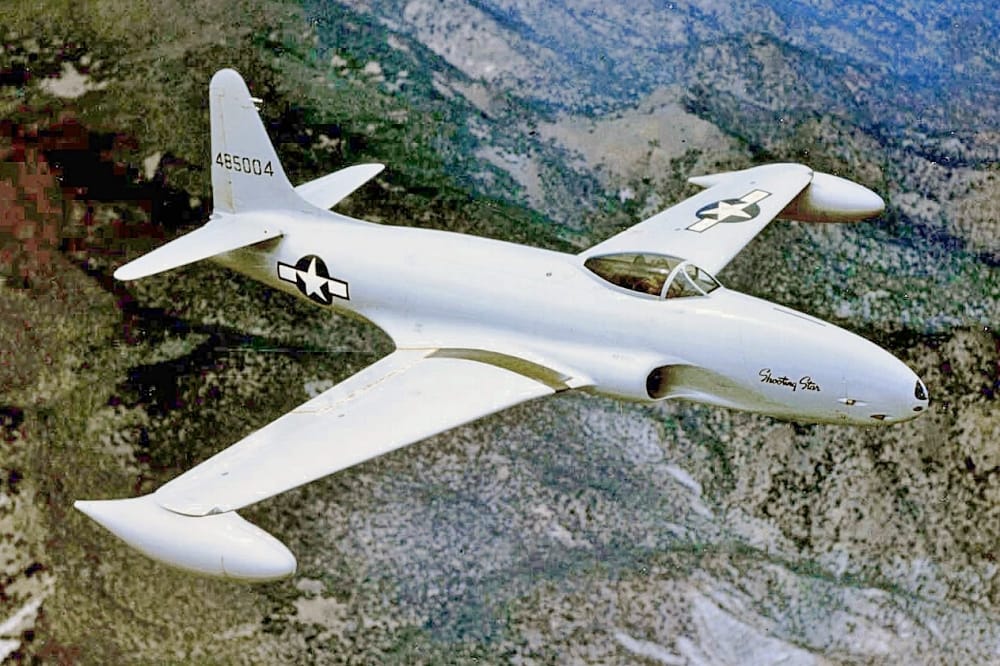
The Lockheed P-80 Shooting Star is the first jet fighter used operationally by the United States Army Air Forces (USAAF) during World War II. Designed and built by Lockheed in 1943 and delivered just 143 days from the start of design, two pre-production models saw limited service in Italy just before the end of World War II but no combat. Designed with straight wings, the type saw extensive combat in Korea with the United States Air Force (USAF) as the F-80.
America's first successful turbojet-powered combat aircraft, it was soon outclassed with the appearance of the swept-wing transonic MiG-15 and was quickly replaced in the air superiority role by the transonic F-86 Sabre. The F-94 Starfire, an all-weather interceptor using the same airframe, also saw Korean War service. The closely related T-33 Shooting Star trainer remained in service with the U.S. Air Force and Navy well into the 1980s, with the last NT-33 variant not retired until April 1997.
Design and Development
The XP-80 had a conventional all-metal airframe, with a slim low wing and tricycle landing gear. Like most early jets designed during World War II—and before the Allies captured German research data that confirmed the speed advantages of swept-wings—the XP-80 had straight wings, similar to previous propeller-driven fighters.
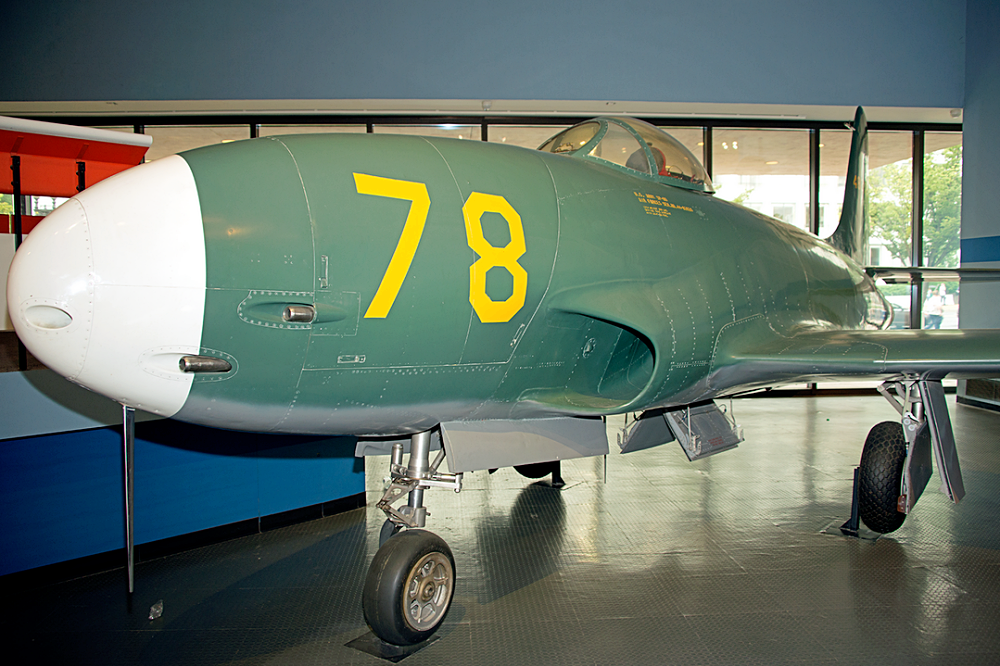
It was the first operational jet fighter to have its engine buried in the fuselage, a format previously used in the pioneering German Heinkel He 178 V1 of 1939, and the later British Gloster E.28/39 demonstrator of 1941. Other early jets generally had two engines because of their limited power, these being mounted in external nacelles for easier maintenance. With the advent of more powerful British jet engines, a single fuselage-mounted engine was more effective, and this configuration was used by nearly all subsequent fighter aircraft.
Lockheed was the first American aircraft company to start work on a jet-powered aircraft, beginning work on the L-133 in 1939. The L-133 eventually developed into an extremely advanced design, including futuristic features such as canard forewings and a blended wing body, but when Lockheed presented the design to the Army Air Force, it was rejected as being technologically unfeasible. Instead the USAAF concentrated development around the much less radical Bell P-59 Airacomet, which first flew in October 1942.
It quickly became obvious, however, that the P-59's performance was only marginally superior to current piston engined fighters. Bell performed preliminary work revising the P-59 with a low wing and a single fuselage-mounted engine, to be designated XP-59B, but by this time the Bell factory was swamped with other work so the USAAF transferred the project to Lockheed.
The impetus for development of the P-80 was the discovery by Allied intelligence of the Me 262 in spring 1943, which had made only test flights of its own first quartet (the V1 through V4 airframes) of design prototypes at that time, all fitted with retracting tailwheel landing gear. After receiving documents and blueprints comprising years of British jet aircraft research, the commanding General of the Army Air Force, Henry H. Arnold, believed an airframe developed to accept the British-made Halford H-1 B "Goblin" jet engine could provide the superior performance to match the new German jets, and the Materiel Command's Wright Field research and development division tasked Lockheed to design the aircraft based on their experience with the L-133.
Concept work began on the XP-80 in May 1943. Since the British turbojet was not yet delivered, Lockheed obtained its blueprint dimensions from Bell as ordered by the USAAF. Lockheed's team, consisting of 28 engineers, was led by Clarence L. "Kelly" Johnson in the same manner as the P-38 Lightning, in the same remote building with high security and greater autonomy, a continuation of Lockheed's Skunk Works style of research and development.
Top Photo: A U.S. Air Force Lockheed P-80A-1-LO Shooting Star (s/n 44-85004) in flight. This aircraft was later upgraded to an F-80C-11-LO
Sources: Youtube; Wikipedia