Lockheed P-38 Lightning - the Plane that Could Warp Metal
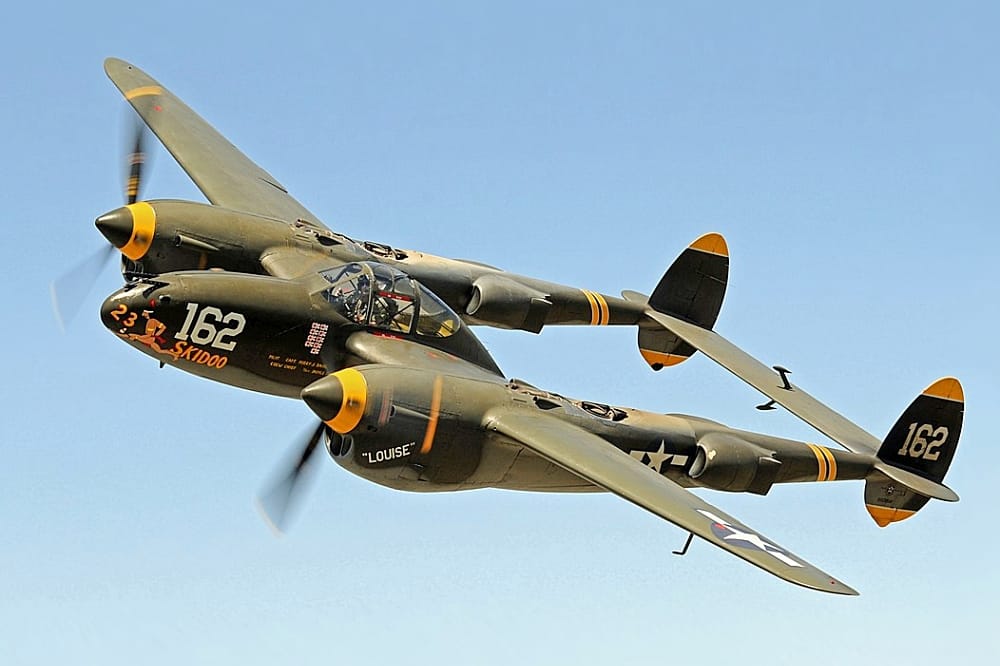
Flak bloomed around him. Tracers lanced past like electric needles. Captain Robin Olds didn’t flinch; he was already lining up his next target. Scat II, his silver P-38 Lightning, screamed across the sky, twin engines snarling as it tore through Messerschmitts. Then, he saw movement below. A lone Mustang, twisting hard, two Bf 109s welded to its tail. No time to think. Olds flipped Scat II over and dropped like a sword from the clouds. Engines howled. Guns ready. But his controls were not working.
Compressibility.
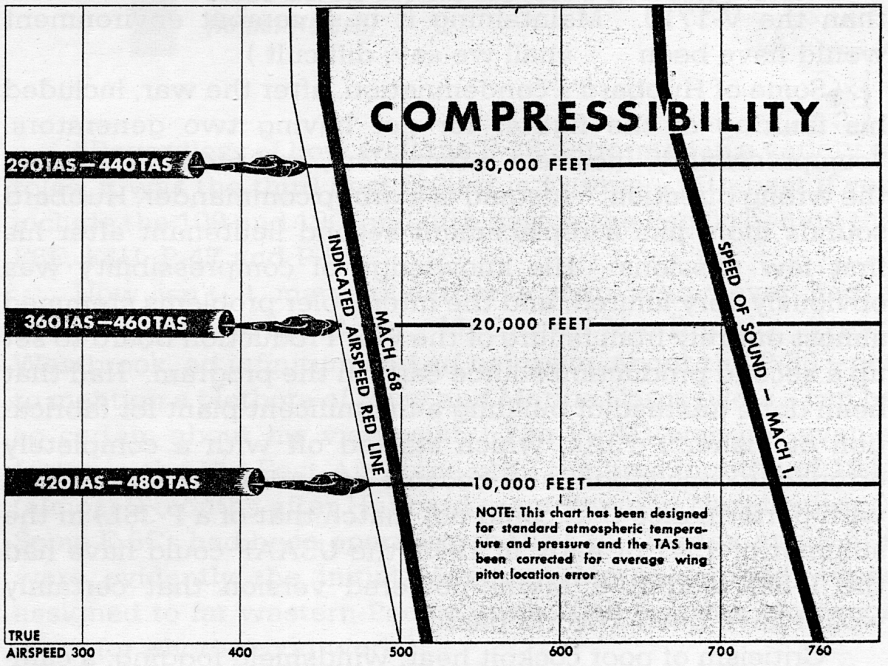
He’d read about it—few lived to explain it. A coffin made of physics. Dive too deep, too fast, and lift vanishes. The plane becomes a projectile. You're no longer flying. You're falling at nearly supersonic speeds. Olds was trapped in it now. Scat II hurtled past 500 miles per hour, canopy warping, control stick useless. The ground was coming up fast.
Engineers had theorized the P-38 could survive this. Now, Olds would prove it, or leave a crater in Germany.
The Lockheed P-38 Lightning is an American single-seat, twin-engined fighter aircraft that was used during World War II. Developed for the United States Army Air Corps (USAAC) by the Lockheed Corporation, the P-38 incorporated a distinctive twin-boom design with a central nacelle containing the cockpit and armament. Along with its use as a general fighter, the P-38 was used in various aerial combat roles, including as a highly effective fighter-bomber, a night fighter, and a long-range escort fighter when equipped with drop tanks.
The P-38 was also used as a bomber-pathfinder, guiding streams of medium and heavy bombers, or even other P-38s equipped with bombs, to their targets. Some 1,200 Lightnings, about 1 of every 9, were assigned to aerial reconnaissance, with cameras replacing weapons to become the F-4 or F-5 model; in this role it was one of the most prolific recon airplanes in the war. Although it was not designated a heavy fighter or a bomber destroyer by the USAAC, the P-38 filled those roles and more; unlike German heavy fighters crewed by two or three airmen, the P-38, with its lone pilot, was nimble enough to compete with single-engined fighters.
The P-38 was used most successfully in the Pacific and the China-Burma-India theaters of operations as the aircraft of America's top aces, Richard Bong (40 victories), Thomas McGuire (38 victories), and Charles H. MacDonald (27 victories). In the South West Pacific theater, the P-38 was the primary long-range fighter of United States Army Air Forces until the introduction of large numbers of P-51D Mustangs toward the end of the war. Unusually for an early-war fighter design, both engines were supplemented by turbosuperchargers, making it one of the earliest Allied fighters capable of performing well at high altitudes. The turbosuperchargers also muffled the exhaust, making the P-38's operation relatively quiet.
The Lightning was extremely forgiving in flight and could be mishandled without incident in many ways, but the initial rate of roll in early versions was low relative to other contemporary fighters; this was addressed in later variants with the introduction of hydraulically boosted ailerons. The smaller and more streamlined P-51 was significantly faster in a dive, which led to the P-51 replacing the P-38 in most European fighter groups by mid-1944. The P-38 was the only American fighter aircraft in large-scale production throughout American involvement in the war, from the Attack on Pearl Harbor to Victory over Japan Day.
Design and Development
The Lockheed Corporation designed the P-38 in response to a February 1937 specification from the United States Army Air Corps (USAAC). Circular Proposal X-608 was a set of aircraft performance goals authored by First Lieutenants Benjamin S. Kelsey and Gordon P. Saville for a twin-engined, high-altitude "interceptor" having "the tactical mission of interception and attack of hostile aircraft at high altitude." Forty years later, Kelsey explained that Saville and he drew up the specification using the word "interceptor" as a way to bypass the inflexible Army Air Corps requirement for pursuit aircraft to carry no more than 500 lb (230 kg) of armament including ammunition, and to bypass the USAAC restriction of single-seat aircraft to one engine. Kelsey was looking for a minimum of 1,000 lb (450 kg) of armament. Kelsey and Saville aimed to get a more capable fighter, better at dog fighting and at high-altitude combat.
Specifications called for a maximum airspeed of at least 360 mph (580 km/h) at altitude, and a climb to 20,000 ft (6,100 m) within six minutes, the toughest set of specifications USAAC had ever presented. The unbuilt Vultee XP1015 design was offered to fill this requirement, but was not advanced enough to merit further investigation. A similar proposal for a single-engined fighter was issued at the same time, Circular Proposal X-609, in response to which the Bell P-39 Airacobra was designed. Both proposals required liquid-cooled Allison V-1710 engines with turbosuperchargers and gave extra points for tricycle landing gear.
Lockheed formed a secretive engineering team to implement the project apart from the main factory; this approach later became known as Skunk Works. The Lockheed design team, under the direction of Hall Hibbard and Clarence "Kelly" Johnson, considered a range of twin-engined configurations, including both engines in a central fuselage with push–pull propellers.
The eventual configuration was rare in contemporary production fighter aircraft design, with the Dutch Fokker G.I heavy fighter, and the later Northrop P-61 Black Widow night fighter and Swedish SAAB 21 having a similar planform. The Lockheed team chose twin booms to accommodate the tail assembly, engines, and turbosuperchargers, with a central nacelle for the pilot and armament. The XP-38 gondola mockup was designed to mount two .50-caliber (12.7 mm) M2 Browning machine guns with 200 rounds per gun (rpg), two .30-caliber (7.62 mm) Brownings with 500 rpg, and a United States Army Ordnance Department prototype T1 23 mm (.90 in) autocannon with a rotary magazine as a substitute for the nonexistent 25 mm Hotchkiss aircraft autocannon specified by Kelsey and Saville.
In the prototype YP-38s, an Army Ordnance Department T9 37 mm (1.46 in) autocannon (later designated as the M4 in production) with 15 rounds replaced the 23 mm T1. The 15 rounds were in three, five-round clips, an unsatisfactory arrangement according to Kelsey, and the T9/M4 did not perform reliably in flight. Further armament experiments from March to June 1941 resulted in the P-38E combat configuration of four M2 Browning machine guns, and one Hispano 20 mm (.79 in) autocannon with 150 rounds.
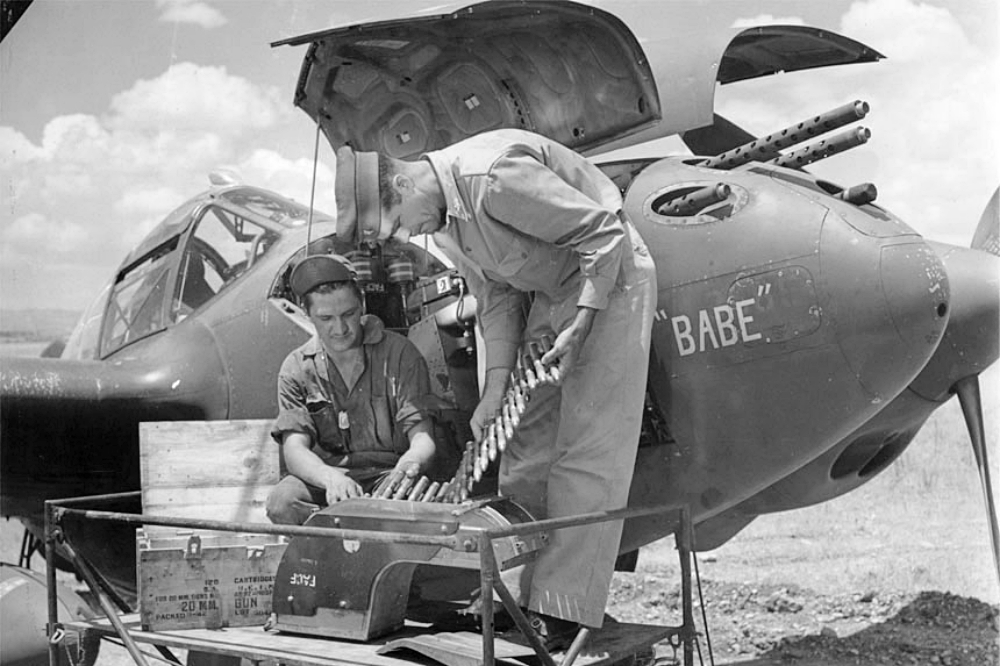
Clustering all the armament in the nose was unusual in U.S. aircraft, which typically used wing-mounted guns with trajectories set up to crisscross at one or more points in a convergence zone. The P-38 cannon used heavier 20 mm rounds, creating a different trajectory, so it was inclined upward slightly more than the four machine guns such that the trajectories of the cannon rounds and .50-caliber bullets came together between 350 and 400 yards/meters. Nose-mounted guns did not suffer as much from having their useful ranges limited by pattern convergence, meaning that good pilots could shoot much farther. A Lightning could reliably hit targets at any range up to 1,000 yd (900 m), whereas the wing guns of other fighters were optimized for a specific range.
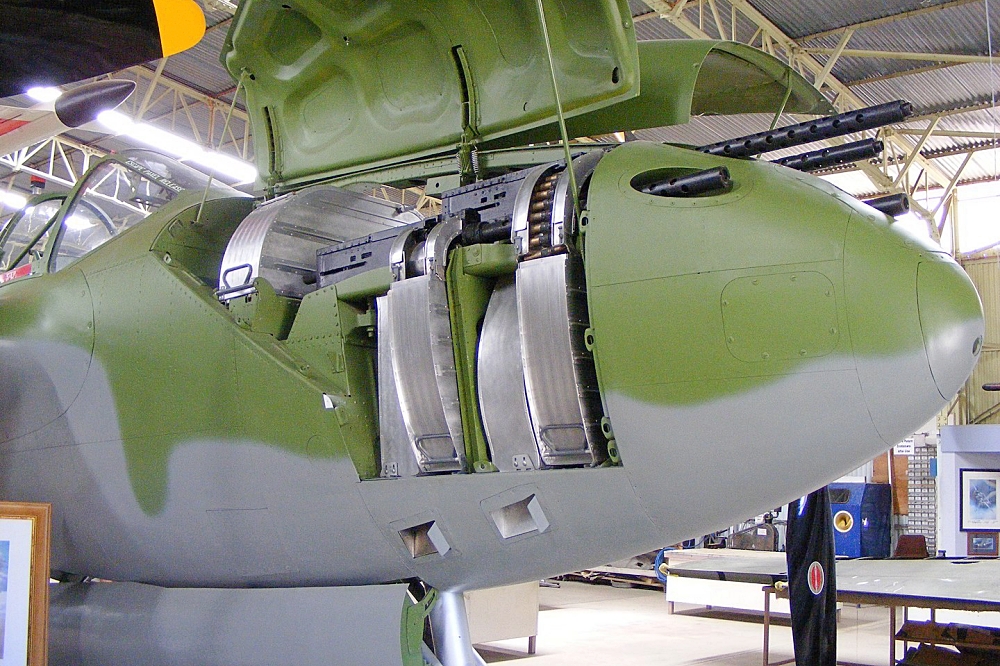
The rate of fire was about 650 rounds per minute for the 20×110 mm cannon round (130-gram shell) at a muzzle velocity of about 2,850 ft/s (870 m/s), and for the .50-caliber machine guns (43-gram rounds), about 850 rpm at 2,900 ft/s (880 m/s) velocity. Combined rate of fire was over 4,000 rpm with roughly every sixth projectile a 20 mm shell. The duration of sustained firing for the 20 mm cannon was about 14 seconds, while the .50-caliber machine guns worked for 35 seconds if each magazine were fully loaded with 500 rounds, or for 21 seconds if 300 rounds were loaded to save weight for long-distance flying.
The Lockheed design incorporated tricycle undercarriage and a bubble canopy, and featured two 1,000 hp (750 kW) turbosupercharged 12-cylinder Allison V-1710 engines fitted with counter-rotating propellers to eliminate the effect of engine torque, with the turbochargers positioned behind the engines, the exhaust side of the units exposed along the dorsal surfaces of the booms. Counter-rotation was achieved by the use of "handed" engines; the crankshafts of the engines turned in opposite directions, a relatively easy task for the V-1710 modular-design aircraft powerplant.
The P-38 was the first American fighter to make extensive use of stainless steel and smooth, flush-riveted, butt-jointed aluminum skin panels. It was also the first military airplane to fly faster than 400 mph (640 km/h) in level flight.
Top Photo: Planes of Fame P-38
Sources: YouTube; Wikipedia