Kratos/Taiwan Jet-Powered Kamikaze Drone to Fly Next Year
Along-range kamikaze drone that U.S. firm Kratos is working on together with Taiwan’s National Chung-Shan Institute of Science and Technology (NCSIST) is set to make its maiden flight early next year.
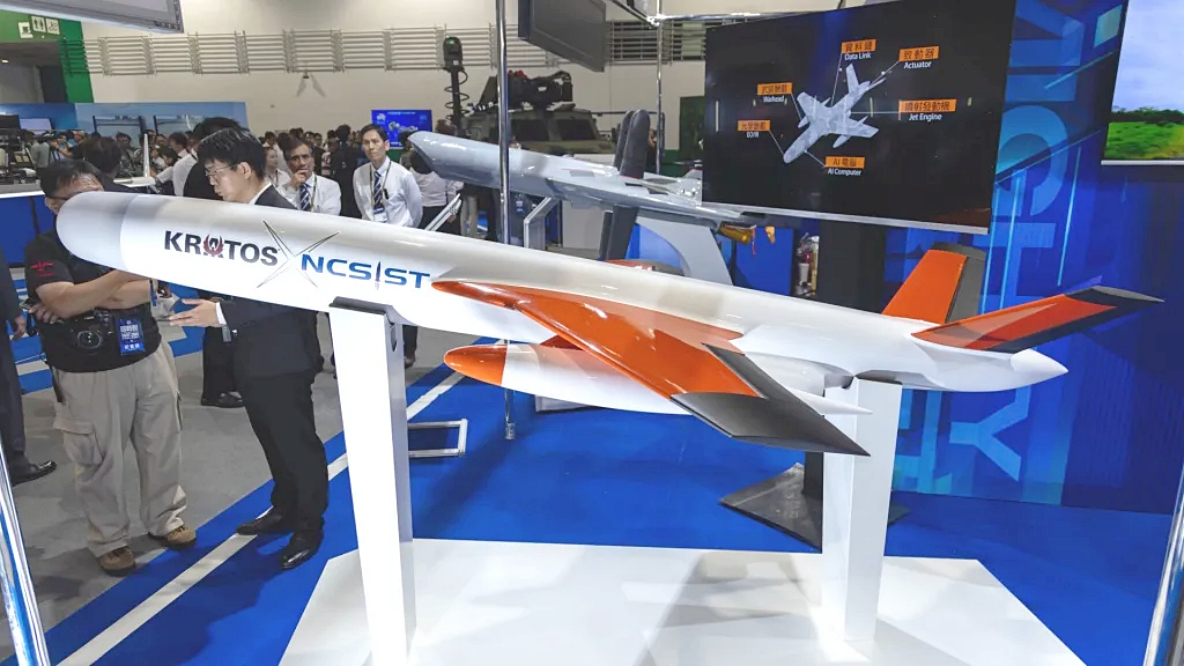
The jet-powered Chien Feng IV (Mighty Hornet IV) will feature artificial intelligence (AI) enabled systems and is being developed with a particular eye toward use as an anti-ship weapon. It could also be employed against targets on land and act as a decoy.
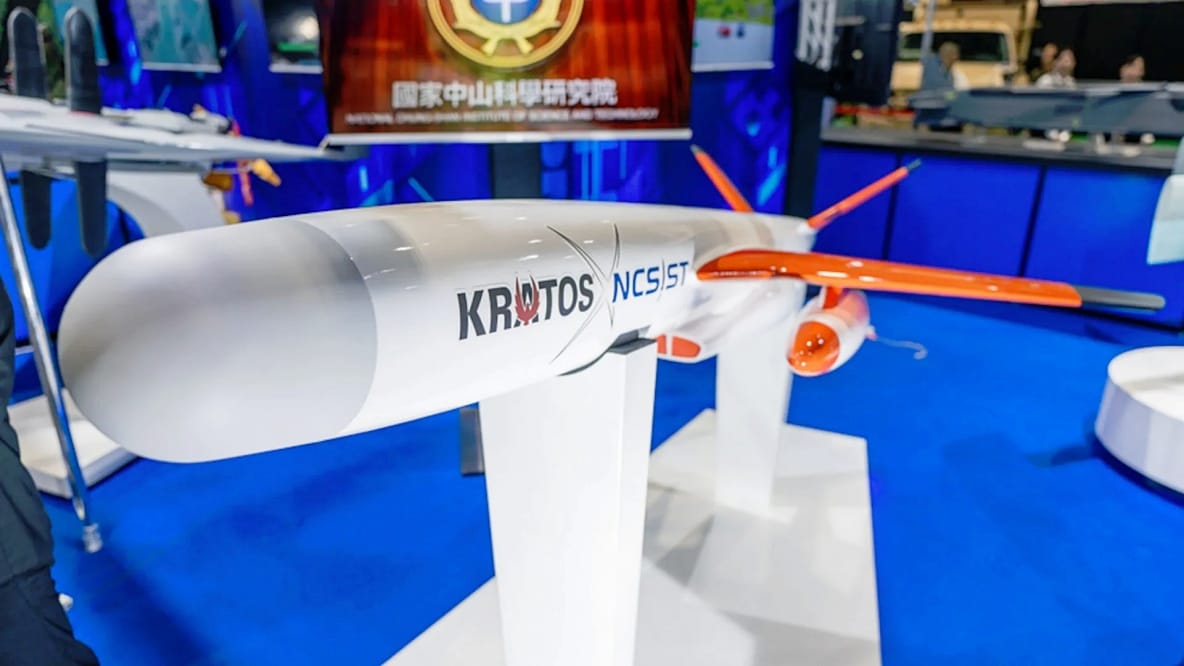
Steve Fendley, president of Kratos’ Unmanned Systems Division, offered new details about the Chien Feng IV while speaking with TWZ‘s Howard Altman on the sidelines of the Air & Space Forces Association’s 2025 Air, Space, and Cyber Conference yesterday. A model of the design, which is derived from Kratos’ MQM-178 Firejet target drone, was shown to the public for the first time last week at the biennial Taipei Aerospace & Defense Technology Exhibition. NCSIST is a government-run organization in Taiwan charged with conducting advanced military research and development and test and evaluation work.
“Our Fire Jet performance characteristics are public, and it’s [Chien Feng IV] a little bit better, pretty much in every category, a little bit more speed, a little bit more altitude, a little bit more endurance,” Fendley added.
“The modified MQM-178’s high-speed capabilities, including a speed of Mach 0.8, high G maneuvering, and a service ceiling of greater than 35,000 feet, make it an ideal base platform for this transformation,”
a press release Kratos put out last week had noted.
At the time of writing, the company’s website also says the MQM-178 can fly at altitudes anywhere between 20 and 35,000 feet, can pull turns down to -2 and up to +9 Gs, and carry around 70 and a half pounds of payload internally, as well as 35 pounds more under each wing and an additional 20 pounds in pods on each wingtip. Range and endurance figures for Firejet are not provided, but are offered for an existing derivative called Airwolf, which is configured for tactical mission sets, including acting as a ‘loyal wingman’ for crewed aircraft. Airwolf, also known as Tactical Firejet, has a stated maximum range of 400 nautical miles and a maximum endurance of 1.3 hours. Both Firejet and Airwolf are designed to be launched via pneumatic catapult, and the latter design at least can be recovered at the end of a mission via parachute.

The Chien Feng IV is “our aircraft and NCSIST, so the Taiwanese government, [their] mission systems and warhead,” Fendley said, and deferred to the Taiwanese side for more details about the latter components of the drone’s design.
A brief video on the Chien Feng IV that NCSIST released around the Taipei Aerospace & Defense Technology Exhibition, seen below, highlights an electro-optical/infrared camera system (EO/IR) in the nose, as well as an AI-driven computer and datalink, as being among the design’s features. In terms of terminal guidance, an EO/IR system would make sense as it is immune to electronic warfare and is passive in nature, meaning it doesn’t pump out signals that can alert the target to the incoming threat.
The Chien Feng IV model shown at the exhibition in Taipei was fitted with small underwing pods, which might be able to hold defensive countermeasures or other equipment, or even just more fuel. It also had an opaque nose cone, which could point to additional sensor options, such as a radar seeker.
The NCSIST video also mentions at least a degree of swarming capability, though it is unclear if Chien Feng IVs will be able to operate in a fully networked collaborative manner.
Source: The War Zone