Kawanishi N1K - the Plane that was Supposed to Win WW2
Pilot Kaneyoshi Muto was surrounded by a dozen American F6F Hellcats. The Americans closed in, confident of an easy victory. But as their guns opened, the wings on Muto’s aircraft appeared to transform. Suddenly, the aircraft snapped into a blinding, high-G turn.
Tracers streaked past empty air as the Japanese fighter danced through the hail of fire. U.S. airmen could barely keep up; Muto was no more than a speck ahead of them. Then, they lost him completely. The Americans looked around, confused. Out of nowhere, Muto was back, right off their wings, cannons locked on target.
Muto struck. One Hellcat spiraled down in flames as a second one exploded. The U.S. pilots tried to regroup, but as they did, two more fighters collapsed. The rest broke formation and fled.
For a moment, the Japanese dared to hope. Even as their Empire crumbled, a new weapon had just taken flight, one fast, agile, and lethal enough to win back the Pacific.
The N1K George was here.
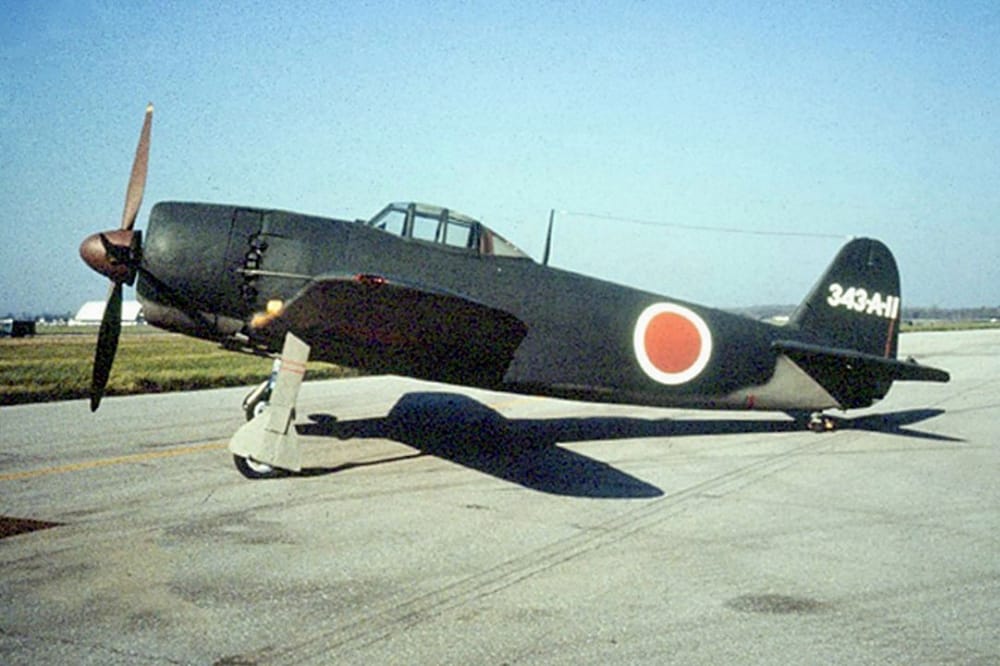
The Kawanishi N1K is an Imperial Japanese Navy fighter aircraft which was developed in two forms: the N1K Kyōfū (強風, "Strong Wind", Allied reporting name Rex), a floatplane designed to support forward offensive operations where no airstrips were available, and the N1K-J Shiden (紫電, "Violet Lightning", reporting name George), a land-based version of the N1K. The N1K-J was considered by both its pilots and opponents to be one of the finest land-based fighters flown by the Japanese during World War II.
An improved variant, the N1K2-J "Shiden-Kai" (紫電改) first flew on 1 January 1944. The Shiden Kai possessed heavy armament, as well as surprisingly good maneuverability, due to a mercury switch that automatically extended the flaps during turns. These "combat" flaps created more lift, thereby allowing tighter turns. Unlike the Mitsubishi A6M Zero, the Shiden Kai could compete against the best late-war Allied fighters, such as the F6F Hellcat, F4U Corsair, and P-51 Mustang.
Design and Development
Kawanishi's N1K was originally built as a single pontoon floatplane fighter to support forward offensive operations where no airstrips were available, but by 1943 when the aircraft entered service, Japan was firmly on the defensive, and there was no longer a need for a fighter to fulfill this role. The Navy's requirements for this fighter were nearly impossible to achieve for a float plane, and the expected protracted development period led Nakajima to develop an interim floatplane fighter based on the Zero, the Nakajima A6M2-N.
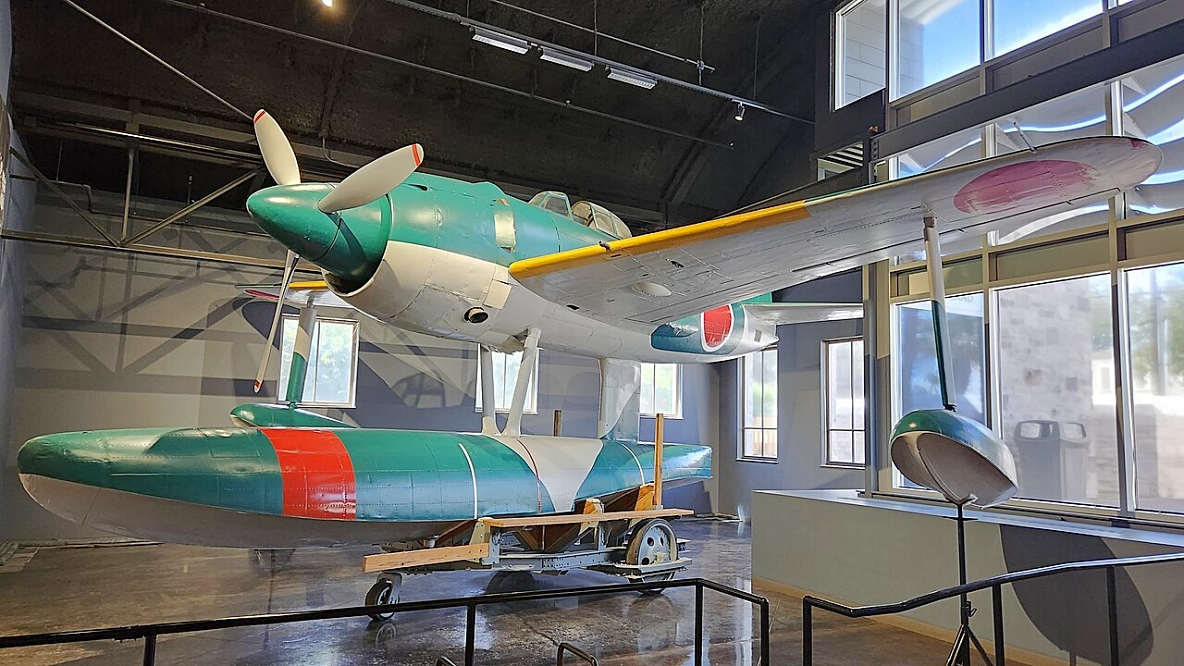
In the end, the Kyofu only saw limited service, mostly in Southeast Asia. A number were flown out of Ambon and the Aru Islands in the Moluccas, while some were stationed at Penang Island, off the Malayan peninsula. They were also used in the Battle of Okinawa. Towards the end of the war, Kyofus were also used in the homeland defense role, operating from Lake Biwa by the Sasebo Air Corps and the Ōtsu Air Corps.
The N1K was powered by the Mitsubishi MK4C Kasei 13 14-cylinder radial engine. Top speed was 489 km/h (304 mph); considerably less than the unrealistic Navy 310 kn (574 km/h; 357 mph) requirement.
Top Photo: A Kawanishi N1K2-Ja Shiden Kai ("George") prior to restoration at the National Museum of the United States Air Force.
Sources: YouTube; Wikipedia