Japan Tests 100 kW Ship‑Based Laser Weapon
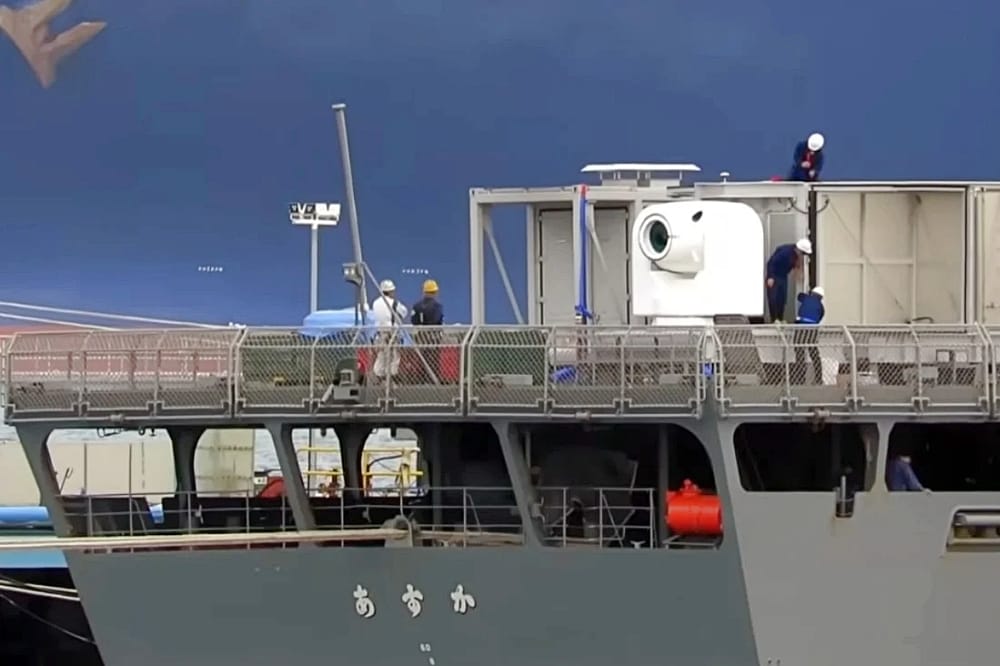
Japan is moving forward with live trials of its new 100-kilowatt-class laser weapon system aboard a military test ship. The high-energy laser was recently installed on the Japan Maritime Self-Defence Force’s (JMSDF) testbed vessel Asuka and is now being readied for sea-based testing at Japan Marine United’s shipyard.
The newly fitted laser system—developed by the Acquisition, Technology & Logistics Agency (ATLA)—is designed to intercept airborne threats such as drones and mortar rounds. It represents the culmination of more than a decade of laser weapons development by ATLA’s Electronic Warfare Integration Office.
In a public technical briefing, ATLA officials confirmed that the agency successfully demonstrated the destruction of mortar rounds and unmanned aerial vehicles (UAVs) using the 100kW system in ground-based tests earlier this year. These results paved the way for installing the weapon on a naval platform for further evaluation in operational conditions.
The compact laser weapon, packed into two 40-foot container-sized modules, includes a fiber laser array, beam control optics, power systems, and cooling infrastructure. According to ATLA, the system fuses ten domestically built 10kW fiber lasers to generate a combined beam output exceeding 100kW.
The agency emphasized that the system offers unlimited magazine depth, requiring only electrical power to fire. Officials pointed out that the cost-per-shot is dramatically lower than traditional interceptors, making the laser system attractive for countering swarms of low-cost drones or mortar threats.
“Provided sufficient power, the system can continue to engage targets without running out of ammunition,”
the agency stated. It also noted the low operational cost of each shot, likening it to the price of electricity consumption.
At present, system size remains a major challenge, primarily due to the bulkiness of the power supply and energy-storage components. In general, the energy-conversion efficiency of high-energy lasers is roughly 30%, meaning that a 100-kW-class laser requires at least 300-kW of electrical power. Future efforts must focus on miniaturization—potentially through the use of commercial technologies—to enable installation aboard naval platforms.
The maritime test aboard Asuka will focus on the laser’s ability to detect, track, and destroy flying targets under real-world conditions at sea. Japan plans to follow this with tests of intercepting projectiles in flight in 2026.
The laser weapon was first unveiled in February 2023, following years of trials with earlier 50kW-class systems. Japan began its laser weapon development with chemical lasers over a decade ago but transitioned to fiber laser systems due to their scalability, safety, and operational efficiency.
Images taken at JMU’s dock show the weapon’s dome-like beam director system installed on the rear deck of Asuka. The director is linked to thermal imaging, fast-steering mirrors, and precision tracking sensors designed to keep the laser focused on fast-moving threats.
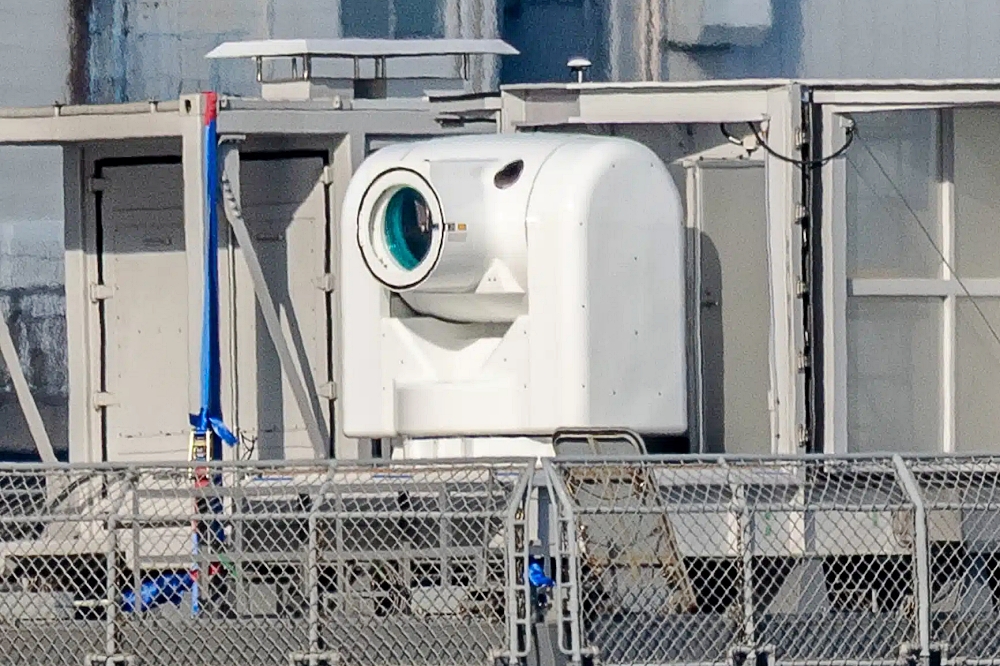
According to ATLA’s roadmap, the next phases will expand testing to cover missile defense roles, although that remains a long-term goal. For now, the 100kW platform will primarily focus on neutralizing drones and indirect fire threats such as mortars.
Beginning in FY2025, ATLA launched a new research program aimed at applying the outcome of the electric-drive high-power laser system to the development of a shipboard laser weapon for the JMSDF. This effort, titled “Research on a Shipboard Laser System,” is intended to neutralize small unmanned aerial vehicles and one-way attack drones approaching naval vessels. ATLA has outlined the following objectives to be achieved under this program:
- Acquisition of Laser Engagement Control System Technology:
Establish technologies required for laser systems intended for use aboard naval vessels, including:
- Technologies for identifying targets and precisely directing laser energy based on air-search radar data and other sensor inputs against multiple simultaneous targets.
- Technologies for transferring targets between multiple beam directors to cover full 360-degree engagement sectors.
- Technologies for directing the beam director toward the zenith.
- Automated battle-damage assessment technology to evaluate the effects of laser engagement on the irradiated target.
2. Achievement of Shipboard Compatibility: Establish technologies required for installation and operation aboard naval vessels, including:
- Technologies ensuring environmental robustness against ship motion, sea spray, and other maritime conditions.
- Technologies enabling installation on both newly constructed vessels and existing JMSDF vessels.
The research prototypes will be developed from FY2025 through the middle of FY2029, with operational demonstration trials scheduled from FY2027 through FY2030.
Sources: Defence Blog; Naval News