Interstate TDR - the US Navy's World War 2 Assault Drone
Over the churning waters of the Pacific in 1944, a new kind of warfare was unfolding. Armed with cutting-edge technology, the US Navy unleashed its secret weapon: the Interstate TDR, a fleet of unmanned drones, each a harbinger of destruction. These mechanical birds of prey, laden with explosives, soared towards their target.
The first drone dove with lethal precision, striking the enemy ship's midsection. The impact was catastrophic, unleashing a massive explosion that ripped through the sea air. Smoke and debris mushroomed into the sky, marking the ferocity of the strike.
The second drone narrowly missed its mark, veering past the ship's superstructure and crashing into the ocean's depths.
The third, with its payload primed, zeroed in on the ship’s bow. In a tense moment of near success, it fell agonizingly short, skimming past the target without detonation.
Then came the fourth drone, the final shot. It found its target near the ship's vulnerable rear, detonating with a thunderous roar. The explosion tore through the hull, engulfing the vessel in a raging inferno.
This operation marked a monumental victory for the US Navy, heralding the dawn of a new era in remote-controlled warfare. The Interstate TDR had not just struck a blow against an enemy ship; it had opened a new chapter in the history of aerial unmanned systems.
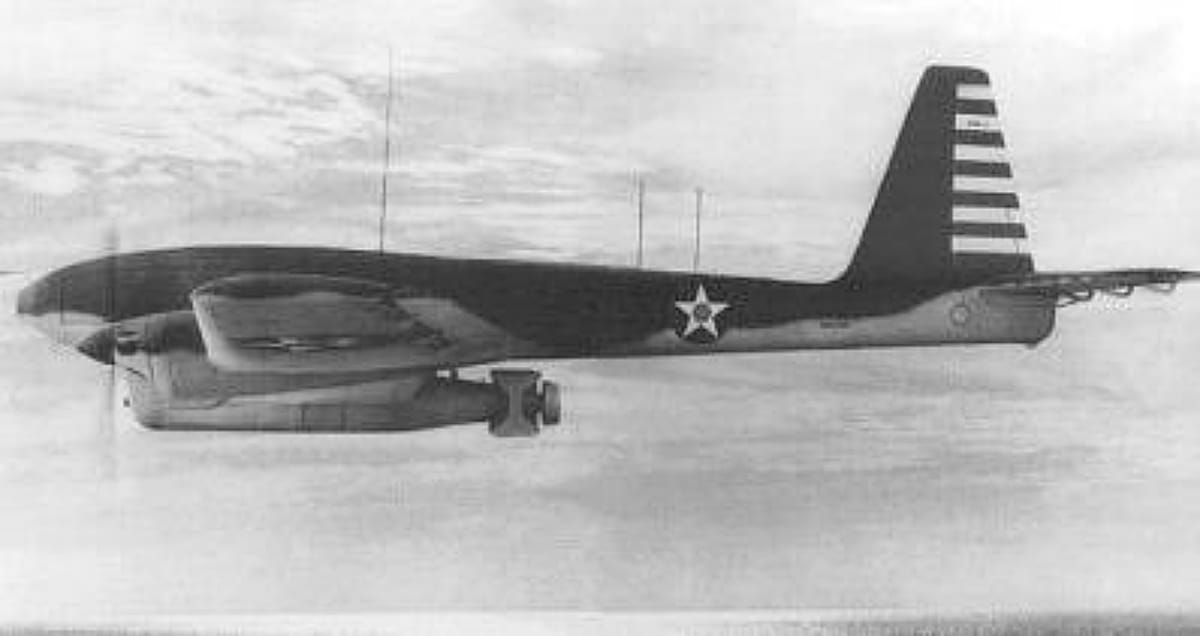
The Interstate TDR was an early unmanned combat aerial vehicle — referred to at the time as an 'assault drone' — developed by the Interstate Aircraft and Engineering Corporation during the Second World War for use by the United States Navy. Capable of being armed with bombs or torpedoes, 2000 aircraft were ordered, but only around 200 were built.
The type saw some service in the Pacific Theater against the Japanese, but continuing developmental issues affecting the aircraft, along with the success of operations using more conventional weapons, led to the decision being made to cancel the assault drone program in October 1944.
Design and Development
In 1936, Lieutenant Commander Delmar S. Fahrney proposed that unpiloted, remotely controlled aircraft had potential for use by the United States Navy in combat operations. Due to the limitations of the technology of the time, development of the 'assault drone' project was given a low priority, but by the early 1940s the development of the radar altimeter and television made the project more feasible, and following trials using converted manned aircraft, the first operational test of a drone against a naval target was conducted in April 1942.
That same month, following trials of the Naval Aircraft Factory TDN assault drone, Interstate Aircraft received a contract from the Navy for two prototype and 100 production aircraft to a simplified and improved design, to be designated TDR-1.
Control of the TDR-1 would be conducted from either a control aircraft, usually a Grumman TBF Avenger, with the operator viewing a television screen showing the view from a camera mounted aboard the drone along with the radar altimeter's readout, or via a pilot on board the TDR-1 for test flights.
Powered by two Lycoming O-435 engines of 220 horsepower (160 kW) each, the TDR-1 used a remarkably simple design, with a steel-tube frame constructed by the Schwinn bicycle company covered with a molded wood skin, thus making little use of strategic materials so as not to impede production of higher priority aircraft.
Capable of being optionally piloted for test flights, an aerodynamic fairing was used to cover the cockpit area during operational missions. The TDR-1 was equipped with a fixed tricycle landing gear that would be jettisoned in operation after takeoff for improved performance.
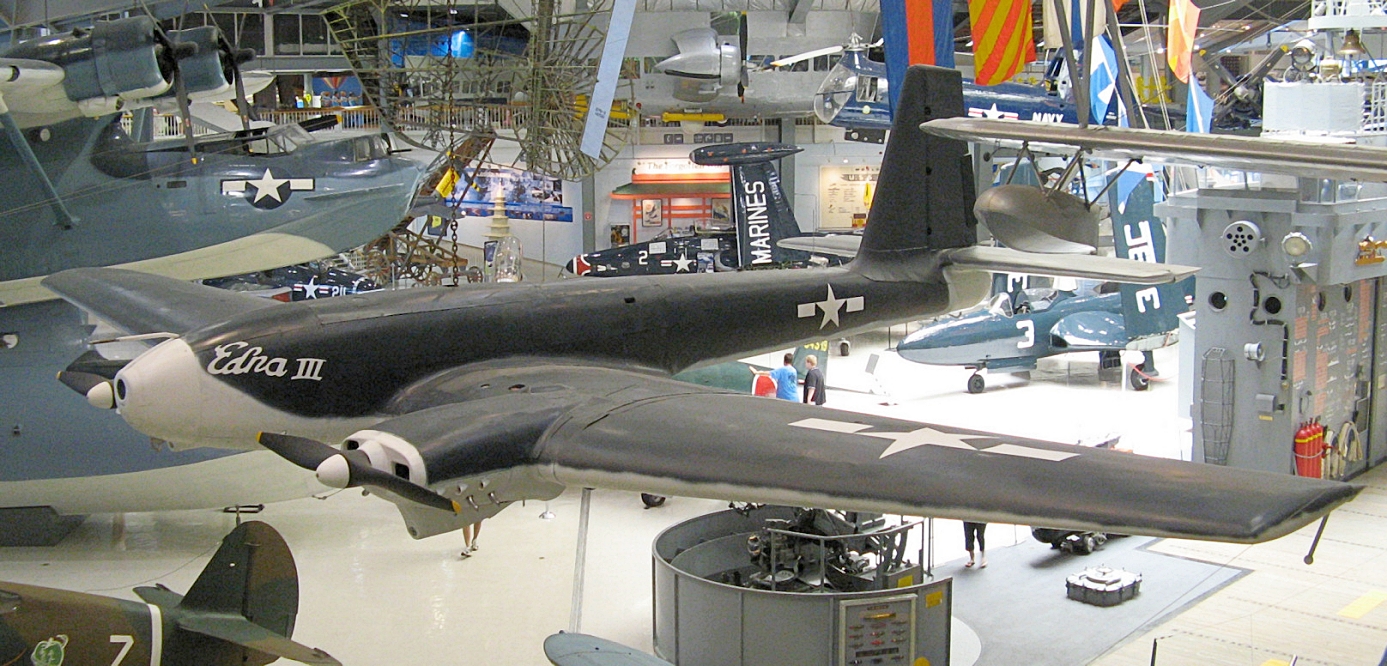
In September 1942, the U.S. Navy chose DeKalb, Illinois to be the site for the manufacture of the drone TDR-1 aircraft, and built an airport on the city's east side. This early airport consisted of an airfield and a large hangar that were fenced and guarded around the clock. DeKalb was chosen because Wurlitzer, manufacturer of pianos, and known for its expertise in the production of wood products, was located there.
Interstate Aircraft and Engineering Corporation (based in El Segundo, California) assembled the planes at the new airport in DeKalb.
About two hundred drones were built, tested, and boxed at the DeKalb Airport and were shipped to the South Pacific, where they were used against the enemy during World War II.
Top Photo: Interstate TDR-1 assault drone in flight, carrying an aerial torpedo - U.S. Navy photograph
Sources: Wikipedia; YouTube