Hawker Sea Fury: The Last Prop Fighter that Outran the Jet Age
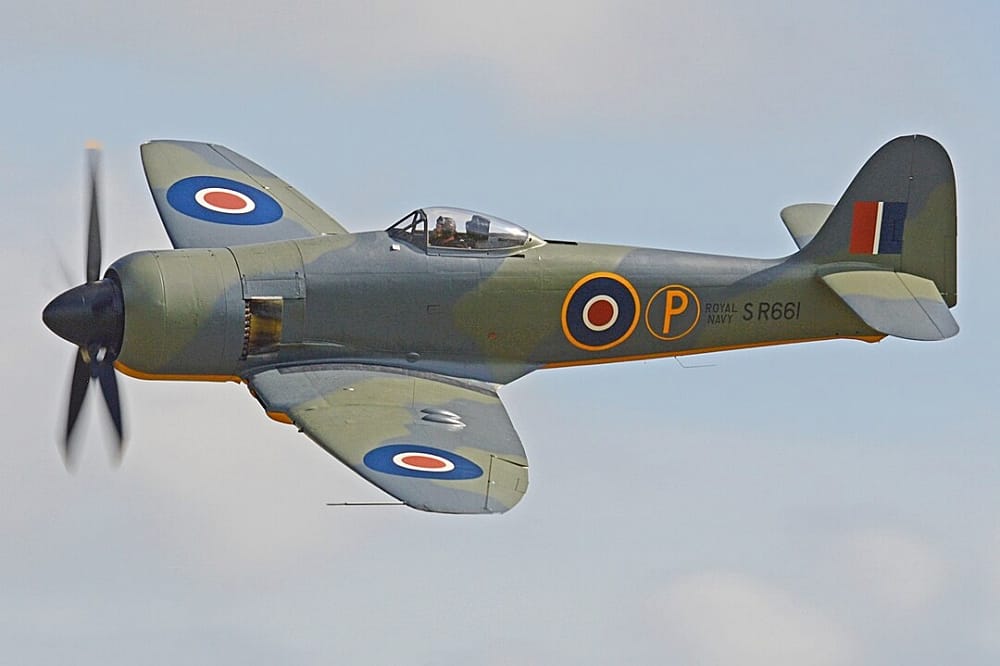
Meet the Hawker Sea Fury, the Royal Navy’s last and fastest piston fighter, a “super prop” born at the edge of the jet age. In this episode we dive into its Sopwith/Hawker roots, the Bristol Centaurus sleeve-valve engine, combat over Korea and the Bay of the Pigs, and its second life dominating the Reno Air Races.
The Hawker Sea Fury is a British fighter aircraft designed and manufactured by Hawker Aircraft. It was the last propeller-driven fighter to serve with the Royal Navy. Developed during the Second World War, the Sea Fury entered service two years after the war ended. It proved to be a popular aircraft with overseas militaries and was used during the Korean War in the early 1950s, and by the Cuban air force during the 1961 Bay of Pigs Invasion.
The development of the Sea Fury began in 1943 in response to a wartime requirement of the Royal Air Force (RAF), with the aircraft first named Fury. As the Second World War drew to a close, the RAF cancelled its order for the aircraft. The Royal Navy saw the type as a suitable carrier aircraft to replace a range of obsolescent and stop-gap aircraft being operated by the Fleet Air Arm. Development of the Sea Fury proceeded, and the type entered operational service in 1947.
The Sea Fury has many design similarities to Hawker's preceding Tempest fighter, having originated from a requirement for a "Light Tempest Fighter". The Sea Fury's wings and fuselage originated from the Tempest but were significantly modified. The production Sea Fury was fitted with the powerful Bristol Centaurus engine and armed with four wing-mounted Hispano V cannon. While originally developed as a pure aerial fighter aircraft, the definitive Sea Fury FB.11 was a fighter-bomber.
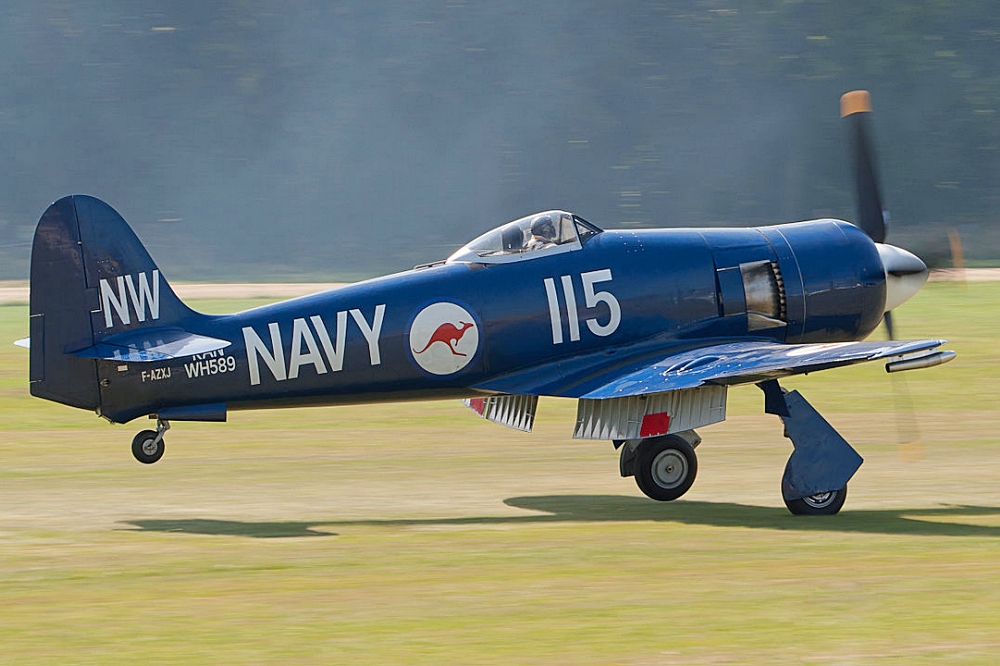
The Sea Fury attracted international orders as a carrier and land-based aircraft. It was operated by countries including Australia, Burma, Canada, Cuba, Egypt, Netherlands, West Germany, Iraq, and Pakistan. The type acquitted itself well in the Korean War, fighting effectively even against the MiG-15 jet fighter. Although the Sea Fury was retired by the majority of its military operators in the late 1950s in favour of jet-propelled aircraft, many aircraft saw use in the civil sector, and several remain airworthy in the 21st century as heritage and racing aircraft.
The Hawker Fury was an evolutionary successor to the successful Hawker Typhoon and Tempest fighters and fighter-bombers of the Second World War. The Fury's design process was initiated in September 1942 by Sydney Camm, one of Hawker's foremost aircraft designers, to meet the Royal Air Force's requirement for a lightweight Tempest Mk II replacement; the Tempest, while a successful aircraft, had been viewed as being heavy and oversized for typical fighter duties. Developed as the "Tempest Light Fighter (Centaurus)", the semi-elliptical wing of the Tempest was incorporated but was shortened in span by eliminating the central bay of the wing centre-section, the inner part of the undercarriage wells now extending almost to the aircraft centreline, instead of being situated level with the fuselage sides. The fuselage was broadly similar in form to that of the Tempest, but was a fully monocoque structure, while the cockpit level was higher, affording the pilot better all-round visibility.
The project was formalised in January 1943 when the Air Ministry issued Specification F.2/42 around the "Tempest Light Fighter". This was followed up by Specification F.2/43, issued in May 1943, which required a high rate of climb of not less than 4,500 ft/min (23 m/s) from ground level to 20,000 feet (6,096 m), good fighting manoeuvrability and a maximum speed of at least 450 mph (724 km/h) at 22,000 feet (6,705 m). The armament was to be four 20mm Hispano V cannon with a total capacity of 600 rounds, plus the capability of carrying two bombs each up to 1,000 pounds (454 kg).
In April 1943, Hawker had also received Specification N.7/43 from the Admiralty, who sought a navalised version of the developing aircraft; in response, Sidney Camm proposed the consolidation of both services' requirements under Specification F.2/43, with the alterations required for naval operations issued on a supplemental basis. Around 1944, the aircraft project finally received its name; the Royal Air Force's version becoming known as the Fury and the Fleet Air Arm's version as the Sea Fury.
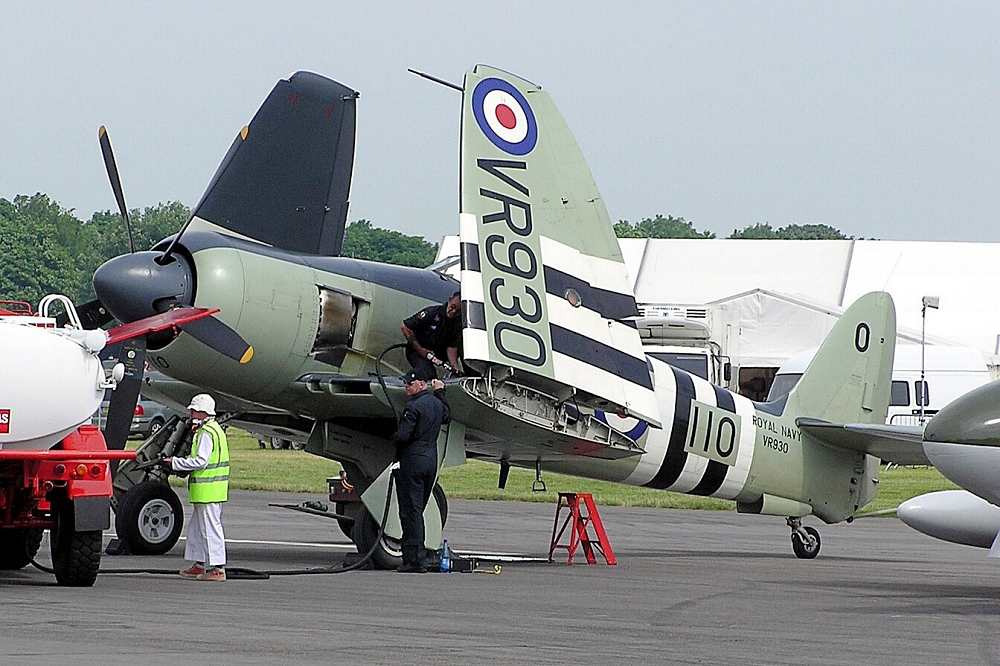
Six prototypes were ordered; two were to be powered by Rolls-Royce Griffon engines, two with Centaurus XXIIs, one with a Centaurus XII and one as a test structure. Hawker used the internal designations P.1019 and P.1020 respectively for the Griffon and Centaurus versions, while P.1018 was also used for a Fury prototype which was to use a Napier Sabre IV.
The first Fury to fly, on 1 September 1944, was NX798 with a Centaurus XII with rigid engine mounts, powering a Rotol four-blade propeller. Second on 27 November 1944 was LA610, which had a Griffon 85 and Rotol six-blade contra-rotating propeller. By now, development of the Fury and Sea Fury was closely interlinked so that the next prototype to fly was a Sea Fury, SR661, described under "Naval version."
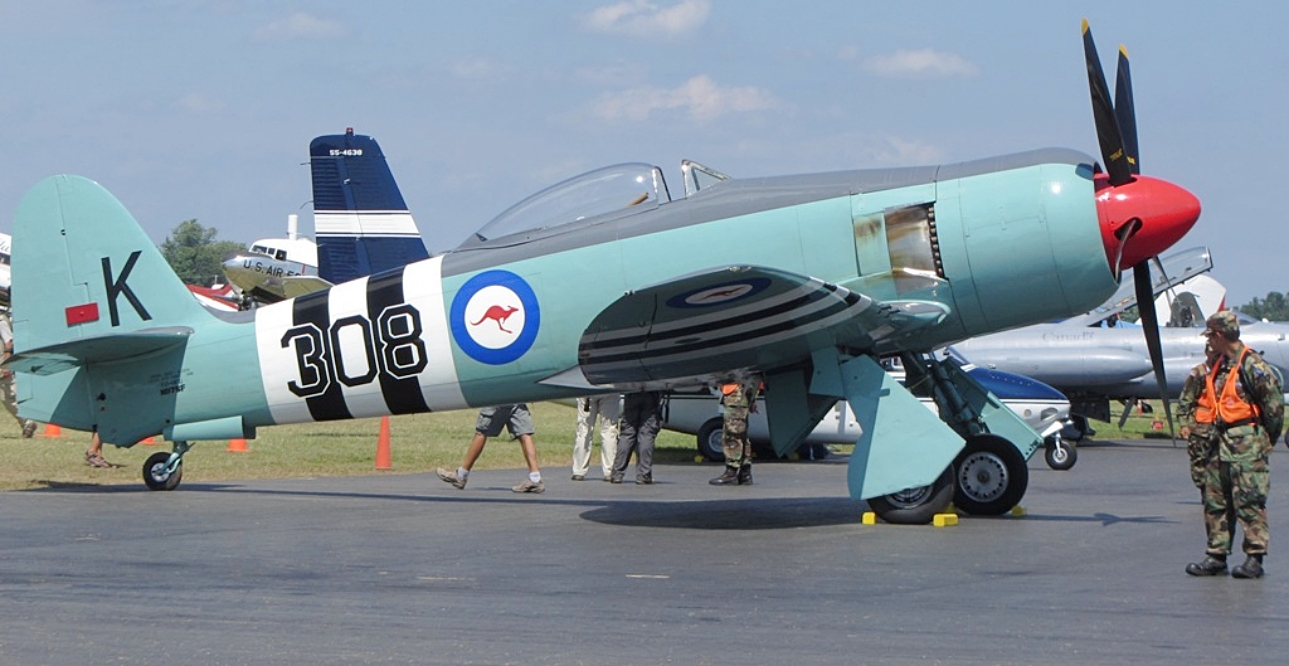
NX802 (25 July 1945) was the last Fury prototype, powered by a Centaurus XV. LA610 was eventually fitted with a Napier Sabre VII, which was capable of developing 3,400 to 4,000 hp (2,535–2,983 kW); this aircraft became possibly the fastest reciprocating-engine Hawker aircraft after reaching a speed of around 485 mph (780 km/h).
Top Photo: Built for the Iraqi Air Force as ‘315’. Recovered in 1979 to the US, it flew again in 1991 and came to the UK for John Bradshaw. He flew it as ‘361’ with Dutch, Australian and Canadian markings. In 2009 it was exported to Australia and has only recently returned, now being based at Sywell. It has been very accurately painted to represent prototype Fury ‘SR661’, which is certainly a different approach to Fury colour schemes!! She is seen displaying at the 2016 Flying Legends airshow, Duxford, Cambridgeshire, UK. 10-7-2016
Sources: YouTube; Wikipedia