Frankenburg Prepares for C-UAS Missile Production
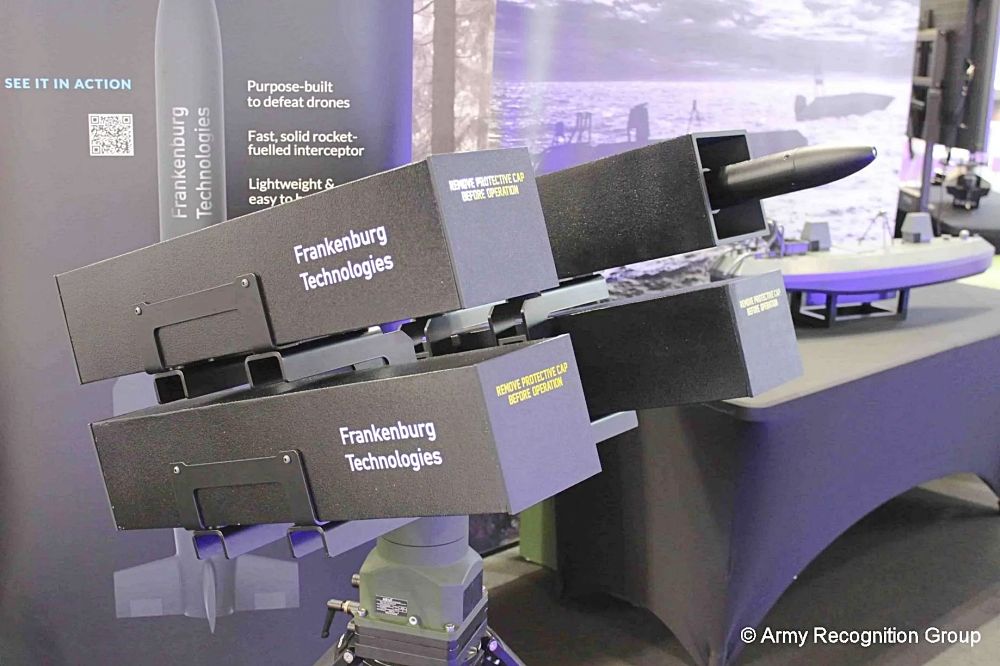
- Frankenburg Technologies has officially unveiled its Mk I counter-unmanned aircraft system (C-UAS) missile at its headquarters in Tallinn, Estonia, signaling a significant advancement in aerial defense capabilities amidst increasing UAV threats in various regions.
Strategic Deployment Plans
During a press briefing on September 22nd, Frankenburg’s CEO, Kusti Salm, shared insights into the missile’s impending production and deployment across Europe. Notably:
- The Mk I missile has already been introduced in all three Baltic nations.
- Future deployments are set for Poland and Denmark, with additional plans for Germany.
Frankenburg maintains a presence in several countries, including Denmark, Germany, Poland, Ukraine, and the United Kingdom.

Cost-Effective Alternative to Traditional Systems
Salm emphasized the economic advantages of the Mk I, which is priced at approximately one-tenth of the Stinger man-portable air defense system (MANPADS). While the Stinger system is geared toward countering helicopters, the Mk I is specifically tailored to address threats from low and slow-flying unmanned aerial vehicles (UAVs), a pressing concern for current defense scenarios in Ukraine.
Target Identification
The Mk I missile is designed to engage a variety of aerial threats, including:
- Long-range attack drones like the Shahed
- Reconnaissance UAVs such as Orlan and ZALA
- Small and slow-moving UAVs
- Loitering munitions, including Lancet and Mavic systems
- First-person-view (FPV) drones
Technical Specifications and Features
Frankenburg characterizes the Mk I missile as a high-precision, compact, ultra-short-range air-defense system, enhanced by artificial intelligence (AI) capabilities. The mark 1 missile is a solid rocket motor which provides immediate acceleration, bringing the round quickly into an intercept geometry suitable for slow or medium-speed unmanned aircraft.
Guidance is handled on board. Once fired, the round does not require a persistent data link to the launcher, which keeps the engagement chain short and less vulnerable to local jamming or network dropouts. The warhead is sized for small aerial targets with a focus on producing a lethal fragment cloud in the last meters of flight. The body is light, which is not only a handling benefit for the crew but also a logistics advantage when hundreds of rounds must be moved by pickup or utility truck rather than by a dedicated ammunition column.
The launcher is deliberately minimal. The display unit combined two sealed pods on a compact traversing mount with integral power and guidance electronics. It can sit on a light vehicle roof, a static tripod, or a small boat, and it looks simple to bolt down and remove. The form factor is friendly to dispersed units that move frequently and do not want to tow a heavy trailer every time they reposition. Setup appears quick: a crew rolls in, powers up, accepts a sensor cue, fires, and relocates before the enemy triangulates the site.
In base defense, the same launcher can be tucked into shelters or behind revetments to cover final approach lanes that guns or non-kinetic systems sometimes miss.
Industrialization is the headline claim: Frankenburg talks about affordable components, short supply chains, and a design that trades materials for repeatable assembly. European sourcing is a recurring theme, which several ministries now ask for because wartime demand has chewed through imported stocks. The company’s target is not to out-range classic SHORAD but to change the arithmetic of the fight. If a battlefield receives dozens of hostile drones in a night, the defenders must be able to fire dozens of interceptors without agonizing over cost. That shift is more important than a few extra kilometers of range on a spec sheet.
Compatibility with the broader counter-UAS ecosystem appears central to the concept. The launcher can be cued by compact 3D radars already fielded with European users and, based on the demonstrations, accepts tracks from electro-optical sensors or acoustic arrays at the edge. Open interfaces matter here because frontline units rarely enjoy a neat, unified air picture. In practice, a perimeter team around a depot or a battalion command post will stitch together the radar they have, an EO tracker, and a local display. The interceptor’s autonomy after launch reduces the need to push bandwidth through that improvised network at the critical moment.
This is a point defense tool that sits close to what commanders want to protect. The missile’s quick boost and onboard endgame allow short reaction times against drones that pop up from cover or dive in from modest altitude. A typical drill would see a small radar catch the track, a tablet operator confirm type and heading, and the launcher execute a two-round ripple to raise kill probability without wasting expensive ammunition. Because the system is light and the pods are sealed, reloads should be relatively fast. Crews can carry spare pods in the same vehicle that transports the mount. That lends itself to shoot-and-scoot behavior and to dispersed tactics where several launchers cover overlapping sectors rather than one large battery drawing fire.
Key specifications include:
Length: Approximately 650 mm
Weight: Less than 2 kg
Deployment: Lightweight and user-friendly for rapid deployment in various operational environments, including urban and frontline settings.
Conclusion
The introduction of the Mk I missile represents a significant innovation in counter-drone technology, poised to enhance defense capabilities against emerging aerial threats. As global defense landscapes evolve, systems like the Mk I will play a crucial role in shaping strategic responses to UAV proliferation.
This breakthrough is part of a broader trend in which nations reassess and augment their air defense strategies in light of rapidly changing security dynamics.
Sources: DEFCROS News; Army Recognition