Dutch Firm Robin Radar Turns Bird-Spotting Skills into Drone Defence
Robin Radar got into drone detection in the early 2010s, when the company needed predictable targets to validate its bird-spotting radars, founder and CEO Siete Hamminga recalls.
In the end, the company turned to drones, their controlled flight allowing to validate detection – a practical move that would prove to be fortuitous. Today, drone detection accounts for a majority of Robin Radar’s revenue, with defense applications dominant, Hamminga said.
The Dutch startup considered partnering with a pigeon club to release homing pigeons,
Robin Radar was Europe’s second-fastest growing company in aerospace and defense behind Finland’s ICEYE, according a Financial Times ranking published in March, with revenue jumping to €43 million ($51 million) in 2023 from €5.5 million in 2020.
Hamminga expects to scale up production capacity to at least six radars per week by the end of 2025, after the company increased the pace to four radars per week last year. Robin was producing around 20 radars annually about five years ago, the CEO said.
The Dutch Ministry of Defence in 2023 bought 51 of the company’s IRIS drone-detection radars to donate to Ukraine, then the biggest contract in Robin Radar history. The ministry ordered the same number of systems for Ukraine in 2024, with the newer radars equipped to be used on the move, and doubled that this year, according to Hamminga.
Roughly the size of a fat beer keg, the IRIS radar weighs 29 kilograms and can be mounted on a vehicle or a tripod. The radar costs less than $1 million per unit, Hamminga said.
The CEO says more than 200 of the company’s radars are now deployed in Ukraine to help detect Russian drones. He said Robin reached out to the Dutch MoD after seeing what drones were doing in the embattled country.
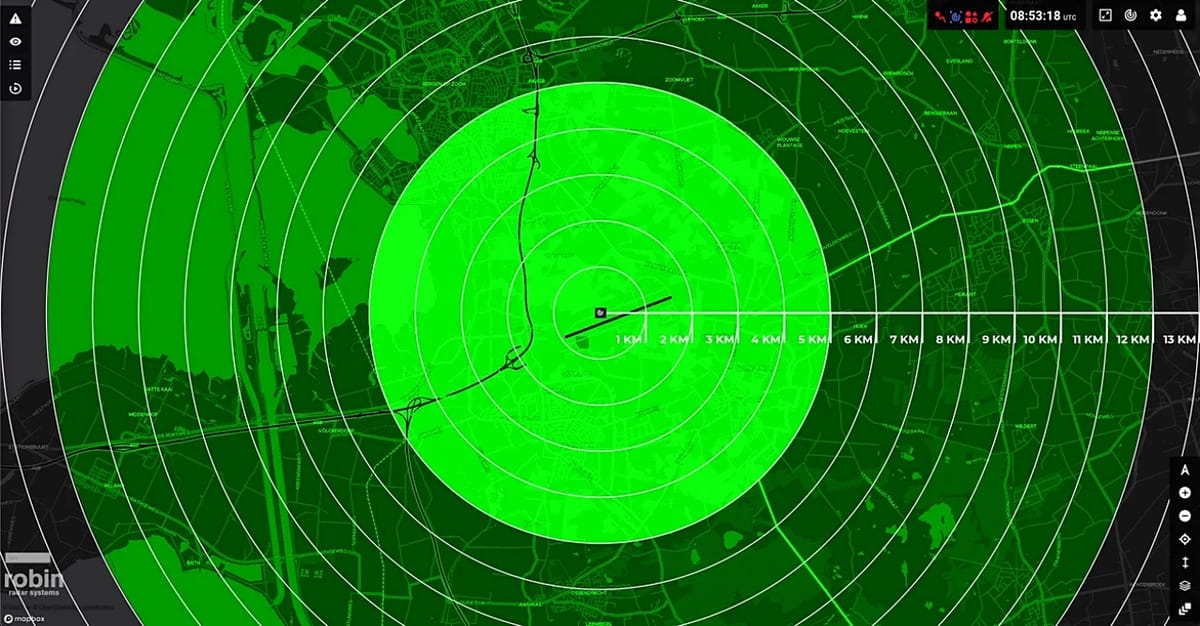
- Robin Radar Systems recently unveiled a breakthrough software update that lifts its counter-UAS radar to new heights. The upgrade, a new IRIS Long-Range Mode, offers the option to switch between 5km (3.1 miles) and 12km (7.45 miles) instrumented ranges in minutes.
The new Long-Range Mode (LRM) was developed and stress-tested through a significant number of IRIS deployments in Ukraine, where Fixed Wing drones have become a near-daily threat to critical infrastructure.
As well as bringing a critical function to Ukrainian frontlines, the upgrade underscores the need for fast, adaptive innovation that matches the speed of the fight.
IRIS Long-Range Mode (LRM)
The innovation makes IRIS one of the first off-the-shelf radars proven to detect and classify Shahed loitering munitions and other Fixed Wing drones at long distances, enhancing crucial early warning against one of the most lethal weapons in modern conflict.
IRIS is lightweight, built to integrate into multi-sensor CUAS architectures and perform at pace, but we also spared no effort in ensuring unparalleled accuracy.
Now, the latest software-only upgrade promises even greater performance in high-pressure environments. It requires no hardware replacement, ensuring all IRIS units can be field-upgraded.
Transforming the Ukrainian frontline
IRIS LRM was developed and stress-tested through a significant number of IRIS deployments in Ukraine, where Shahed drones have become a near-daily threat to critical infrastructure.
The update was built upon direct feedback from Ukrainian operators, fed directly into our development cycle. It’s this fluid, fast feedback loop that has enabled the upgrade in record time.
For Ukrainian forces, the 12km range will offer a potentially life-saving window of warning to prepare for incoming Shaheds travelling at over 180 km/h (111Mph).
“This upgrade isn’t just about range—it’s about time. Every extra kilometer of detection gives defenders more precious seconds to react, more chances to protect critical infrastructure, and ultimately, more lives saved. By delivering this leap forward entirely through software, we’re showing how the decisive edge in counter-drone defence is no longer just built—it’s coded.”
Kristian Brost, General Manager, Robin Radar USA
For U.S. and European customers, the battlefield-tested technology can also be rolled out to critical government agencies, including key European Ministries of Defense and Interior, as well as the US Department of Homeland Security Science & Technology. This will ensure domestic innovations reflect the best available technology currently being used in live conflict zones.
"This upgrade marks a step-change in what counter-drone radar can achieve. By listening to our users on the frontline, we’ve redefined the capabilities of an off-the-shelf system, delivering a battlefield-proven solution that is now being made available worldwide. As software continues to transform defence, it’s our every intention that Robin Radar will hold its position at the forefront of innovation.”
Siete Hamminga, CEO, Robin Radar Systems
Sources: Robin Radar Systems; Defense News