Drone Strikes Could Cause Jet Engine Failure
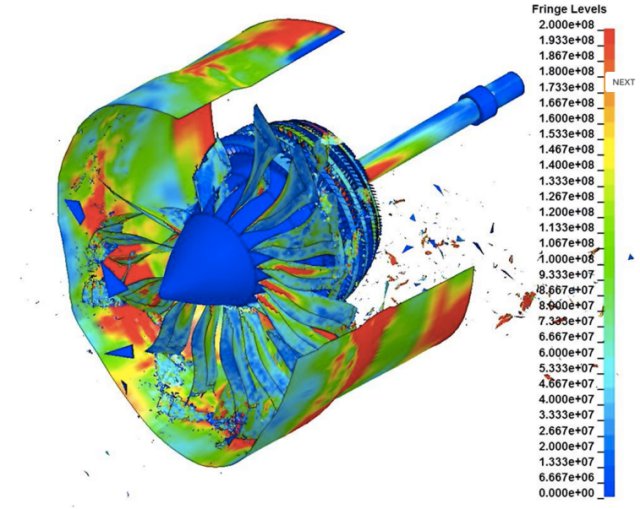
Researchers at Virginia Tech’s College of Engineering say drones as small as 8 pounds will have “devastating” effects if sucked into the turbofan engines of commercial aircrafts.
Computer-simulated tests showed an 8-pound drone would rip apart the fan blades of a a 9-foot diameter turbofan engine during take-off in less than 1/200th of a second. Furthermore, the tests discovered that drone debris thrashing about inside the engine could reach speeds 715 miles per hour and could lead to catastrophic engine failure.
“Because the damage is spread to a large section of the engine, it is unlikely that it will be able to maintain thrust,” says Javid Bayandor, an associate professor of mechanical engineering at Virginia Tech and director of the university’s Crashworthiness for Aerospace Structures and Hybrids (CRASH) Laboratory.
Bayandor and team started three years ago researching the impact of bird-strikes on commercial aircraft engines. However, their research switched to drones as news accounts surfaced of pilots spotting drones in commercial airspace. They’re now pushing for changes in how commercial aircraft engines are designed to prevent a potential disaster if a drone is sucked into a plane’s engine.
“Because of the unprecedented damage a small or even micro unmanned aircraft systems can inflict on a passenger aircraft, pilots cannot risk flying in the same airspace where there are drones,” says Bayandor. “While strict regulations are already in place to isolate drones from operations in controlled airspace, their enforcement have proven challenging, due to the anonymity of drone users.”
“The engines have to be designed and certified for foreign object impact, but I think now we have the definition of foreign object changing,” said Javid Bayandor, an associate professor of mechanical engineering at Virginia Tech and director of the university’s Crashworthiness for Aerospace Structures and Hybrids (CRASH) Laboratory.
Currently, he said turbofan engines are designed to handle the potential ingesting of birds, hail and small runway debris such as tire fragments.
“We never—in the design of these systems decades ago—thought about an actual rigid object as big as a drone flying next to the engine and being ingested by it,” Bayandor said. “Today they can potentially pose a new type of threat altogether. It’s opening a new avenue in foreign object studies and understanding.”
Bayandor and Michael O’Brien, professor of mechanical engineering at Virginia Tech, said they also plan to study the effects of sUAS in a collision with a helicopter.
The computer simulation created by Virginia Tech's College of Engineering demonstrates what could happen if an eight-pound quadcopter struck a nine-foot diameter turbofan engine of an airliner taking off.
According to the research, the speed of drone debris thrashing about inside the engine can reach speeds 715 miles per hour. Broken blades also create more fragments as the fan crumbles and warps the engine block housing, contributing to catastrophic engine failure.
“A jet engine is a very delicate system and the tolerances are minute,” Bayandor said. “If you introduce an unbalance to the system through the impulse that a drone brings with it and then cause even one blade to move a little bit off-center, everything around the shroud will be affected by it.
“The engine starts wobbling severely and then with the blades hitting back and forth to the wall of the casing, it causes even further damage—even though the main culprit might not have been the drone itself,” he noted.
The high velocity of the airliner times the mass of the drone generates the magnitude of the impulse. With the turbofan blades spinning at 2,200 RPM, the impact of the impulse creates shock and vibration throughout the system.
“We also showed that if that mass of the drone is substantial and you have a very heavy core with batteries and cameras then that, on its own, can cause more blades to break off and sheer off,” Bayandor said. “That causes even bigger deformation. The entire casing is now deforming into a shape that you can’t really recognize as a circular casing any more. What happens after that is that your entire engine gets stuck and you may not be able to get any thrust out of it.”
The research began three years ago computer modeling showing the effects of bird impacts on advanced turbofan aircraft engines. The engineering group’s efforts switched to drones as news accounts surfaced of pilots spotting unmanned craft in commercial airspace.
Bayandor and his team are exploring various methods that could be used to prevent more critical collisions of drones and aircraft, noting that engine failure rates and timing can change with different commercial aircraft and different relative impact velocities between the drone and the plane.