Douglas A-26 Invader - the Plane Built for One Job but Did it All
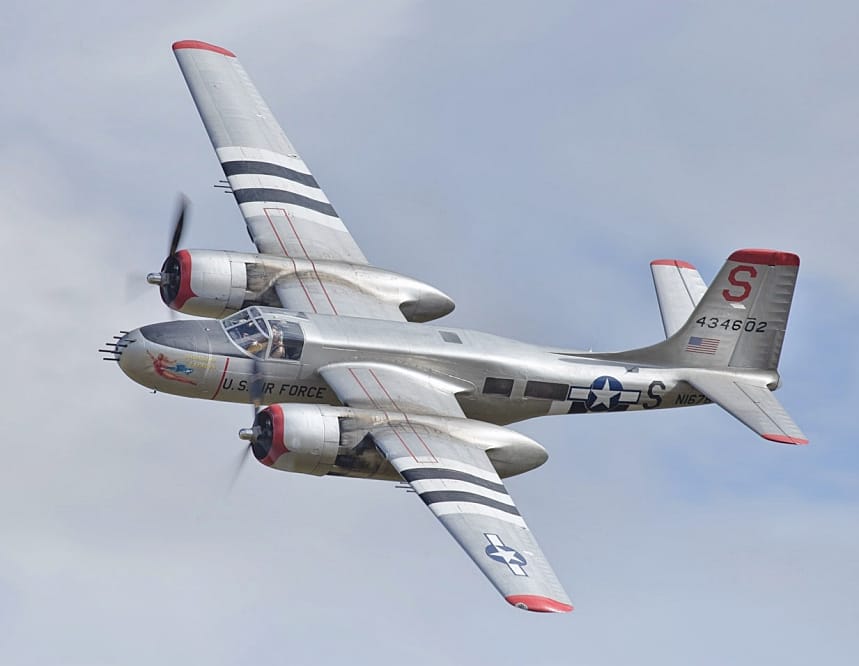
It was every Allied bomber pilot’s worst nightmare. Flying his Douglas A-26 Invader over northern France, Major Myron L. Durkee unexpectedly finds himself picked out as prey for Hitler’s terrifying new weapon: the Messerschmitt Me-262, a jet-powered assassin seemingly sent from the future.
The Invader - a muscular bomber designed for precision strikes, not dogfights - is now alone and vulnerable against the fastest, deadliest machine in the skies.
Durkee knows what he’s supposed to do: dive away and pray. But with the Me-262 nearly 200 miles per hour faster than his Invader, running would be futile.
Suddenly, he has a crazy idea. To hell with the playbook. His A-26 may not have the jet’s speed, but she boasts a surprising agility for her size - and a secret weapon. Gritting his teeth, Durkee’s knuckles turn white as he grasps the yoke.
In the German jet’s cockpit, the pilot’s jaw drops to the floor. The Invader is turning back into the line of fire. It is pointing 8 machine guns right at him…
The Douglas A-26 Invader (designated B-26 between 1948 and 1965) is an American twin-engined light bomber and ground attack aircraft. Built by Douglas Aircraft Company during World War II, the Invader also saw service during several major Cold War conflicts. A limited number of highly modified United States Air Force aircraft served in Southeast Asia until 1969. It was a fast aircraft capable of carrying a large bomb load. A range of guns could be fitted to produce a formidable ground-attack aircraft.
A redesignation of the type from A-26 to B-26 has led to confusion with the earlier and unrelated medium bomber Martin B-26 Marauder, which had already been withdrawn from service when the designation was reused.
Design and Development
The A-26 was Douglas Aircraft's successor to the A-20 (DB-7) Havoc, also known as Douglas Boston. Designed by Ed Heinemann, Robert Donovan, and Ted R. Smith, the innovative NACA 65-215 laminar-flow airfoil wing of the A-26 was the work of project aerodynamics expert A.M.O. Smith.
The Douglas XA-26 prototype (AAC Ser. No. 41-19504) first flew on 10 July 1942 at Mines Field, El Segundo, with test pilot Benny Howard at the controls. Flight tests revealed excellent performance and handling but engine-cooling problems led to cowling changes and elimination of the propeller spinners on production aircraft. During testing, the nose wheel was found to be structurally inadequate, so it was strengthened.
The early A-26 versions were built in two forms
The A-26B gun-nose could be equipped with a combination of armament, including .50 caliber machine guns, 20 or 37mm auto cannon, or an experimental 75mm pack howitzer (never used operationally). The 'B' gun-nose version housed six (and later, eight) .50 caliber machine guns, officially the "all-purpose nose", later known as the "six-gun nose" or "eight-gun nose".
The A-26C's "glass" "Bombardier nose", contained a Norden bombsight for medium-altitude precision bombing. The A-26C nose section included two fixed M-2 guns, but those were eliminated after underwing gun packs or internal guns in the wings proved effective during colder weather.
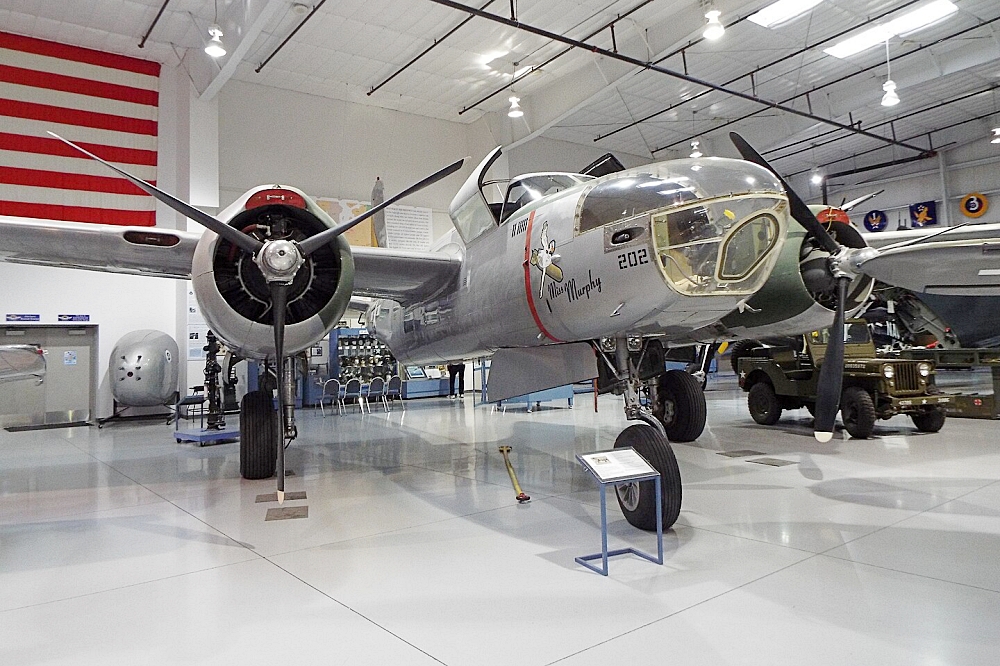
After about 1,570 production aircraft, three guns were installed in each wing, coinciding with the introduction of the "eight-gun nose" for A-26Bs, giving some versions as many as 14 .50 in (12.7 mm) machine guns in fixed forward mounts. An A-26C nose section could be replaced with an A-26B nose section, or vice versa, in a few hours, thus physically (and officially) changing the designation and operational role. The "flat-topped" canopy was changed in late 1944 after about 820 production aircraft, to a clamshell style with greatly improved visibility.
Alongside the pilot in an A-26B, a crew member served as navigator and gun loader for the pilot-operated nose guns. In an A-26C, that crew member served as navigator and bombardier, and moved to the nose section to bomb. A few A-26Cs were fitted with dual flight controls, some parts of which could be disabled in flight for access to the nose section.
Access for the bombardier was through the lower section of the right instrument panel; he normally sat next to the pilot. This was similar to British designs such as the Lancaster, Blenheim/Beaufort and Wellington. A tractor-style "jump seat" was behind the "navigator's seat". In most missions, a third crew member in the rear gunner's compartment operated the remote-controlled dorsal and ventral gun turrets, with access to-and-from the cockpit via the bomb bay only if that was empty.
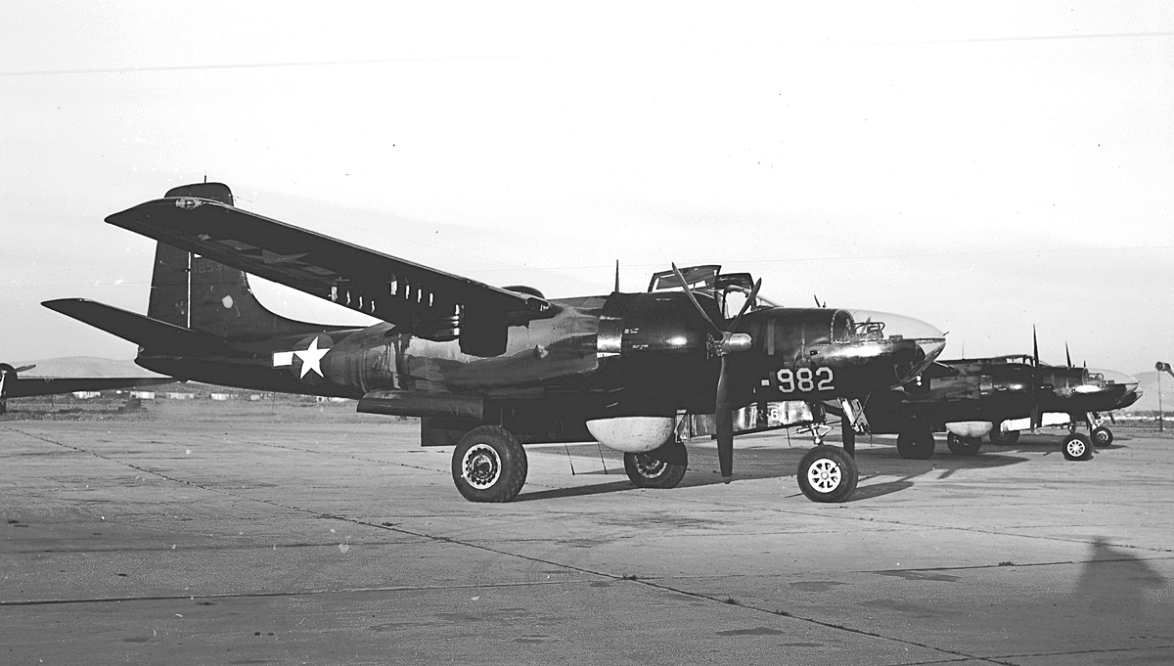
The gunner operated both dorsal and ventral turrets via a novel, complex and unreliable dual-ended periscope sight, a vertical column running through the center of the rear compartment, with traversing and elevating/depressing periscope sights on each end. The gunner sat on a seat facing rearwards looking into a binocular periscope sight mounted on the column, controlling the guns with a pair of handles on the sides of the column. Aimed above the centerline of the aircraft, the mirror in the center of the column 'flipped', showing the gunner a limited view similar to the view the upper periscope was seeing. As he pressed the handles downward, and as the bead passed the centerline, the mirror automatically flipped, transferring the sight "seamlessly" to the lower periscope.
The guns aimed in the approximate direction the periscope was aimed, automatically transferring between upper and lower turrets as required, and computing for parallax and other factors. While novel and sound in principle, the developers invested a great deal of time and effort in their attempts to get the system to work, delaying production. As might be expected, the complex system was difficult to maintain in the field.
Sources: YouTube; Wikipedia