Douglas A-1 Skyraider - America’s Prop Monster No Jet Could Kill
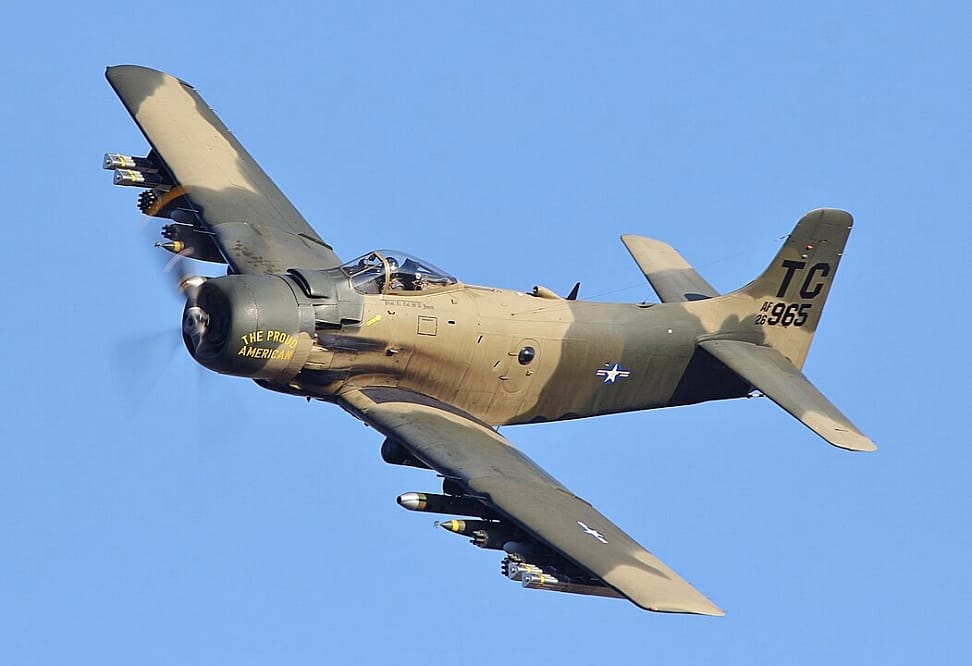
On June 20, 1965, two MiG-17s circled the smoking wreckage of an F-4 Phantom deep in North Vietnam, the first of its kind shot down in the war. The MiG pilots expected what usually came next: more Phantoms screaming in at twice the speed of sound. Then they heard a sound that didn't belong in 1965: the deep, thundering growl of massive propellers.
Four Douglas A-1 Skyraiders burst through the clouds. Straight-winged beasts from another era, painted bright and wide, grinding through the sky at barely 200 knots. The MiGs could see they were loaded down, flying heavy and slow with bulging hardpoints under their wings. Basically sitting ducks for nimble jets.
What the MiG pilots didn't know was that these prop planes had a nasty trick up their sleeves. They were about to learn this the hard way.
The Douglas A-1 Skyraider (formerly designated AD before the 1962 unification of Navy and Air Force designations) is an American single-seat attack aircraft in service from 1946 to the early 1980s, which served during the Korean War and Vietnam War. The Skyraider had an unusually long career, remaining in frontline service well into the Jet Age (when most piston-engine attack or fighter aircraft were replaced by jet aircraft); thus becoming known by some as an "anachronism". The aircraft was nicknamed "Spad", after the French World War I fighter.
It was operated by the United States Navy (USN), the United States Marine Corps (USMC), and the United States Air Force (USAF), and also saw service with the British Royal Navy, the French Air Force, the Republic of Vietnam Air Force (RVNAF), and others. It remained in US service until the early 1970s.
Design and Development
The piston-engined, propeller-driven Skyraider was designed during World War II to meet United States Navy requirements for a carrier-based, single-seat, long-range, high performance dive/torpedo bomber, to follow on from earlier aircraft such as the Douglas SBD Dauntless, the Curtiss SB2C Helldiver and the Grumman TBF Avenger. Designed by Ed Heinemann of the Douglas Aircraft Company, prototypes were ordered on 6 July 1944 as the XBT2D-1. The XBT2D-1 made its first flight on 18 March 1945, and the USN began evaluation of the aircraft at the Naval Air Test Center (NATC) in April 1945. In December 1946, after a designation change to AD-1, delivery of the first production aircraft to a fleet squadron was made to VA-19A.
The AD-1 was built at Douglas's El Segundo plant in Southern California. The low-wing monoplane design started with an 18-cylinder Wright R-3350 Duplex-Cyclone radial engine capable of producing well over 2,000 hp (1,500 kW), which was upgraded several times, ultimately to 2,800 hp (2,100 kW). The aircraft had distinctive large straight wings with seven hardpoints apiece. The Skyraider had excellent maneuverability at low speed, and carried a large amount of ordnance over a considerable combat radius. It had a long loiter time for its size, compared to much heavier subsonic or supersonic jets. The aircraft was optimized for ground attack and was armored against ground fire in key locations, unlike faster fighters adapted to carry bombs, such as the Vought F4U Corsair or North American P-51 Mustang, which were retired by US forces before the 1960s.
Shortly after Heinemann began designing the XBT2D-1, a study was issued showing that for every 100 lb (45 kg) of weight reduction, the takeoff run was decreased by 8 ft (2.4 m), the combat radius increased by 22 mi (35 km) and the rate-of-climb increased by 18 ft/min (0.091 m/s). Heinemann immediately had his design engineers begin a program for finding weight savings on the XBT2D-1 design, no matter how small. Simplifying the fuel system resulted in a reduction of 270 lb (120 kg); 200 lb (91 kg) by eliminating an internal bomb bay and hanging external stores from the wings or fuselage; 70 lb (32 kg) by using a fuselage dive brake; and 100 lb (45 kg) by using an older tailwheel design. In the end, Heinemann and his design engineers achieved more than 1,800 lb (820 kg) of weight reduction on the original XBT2D-1 design.
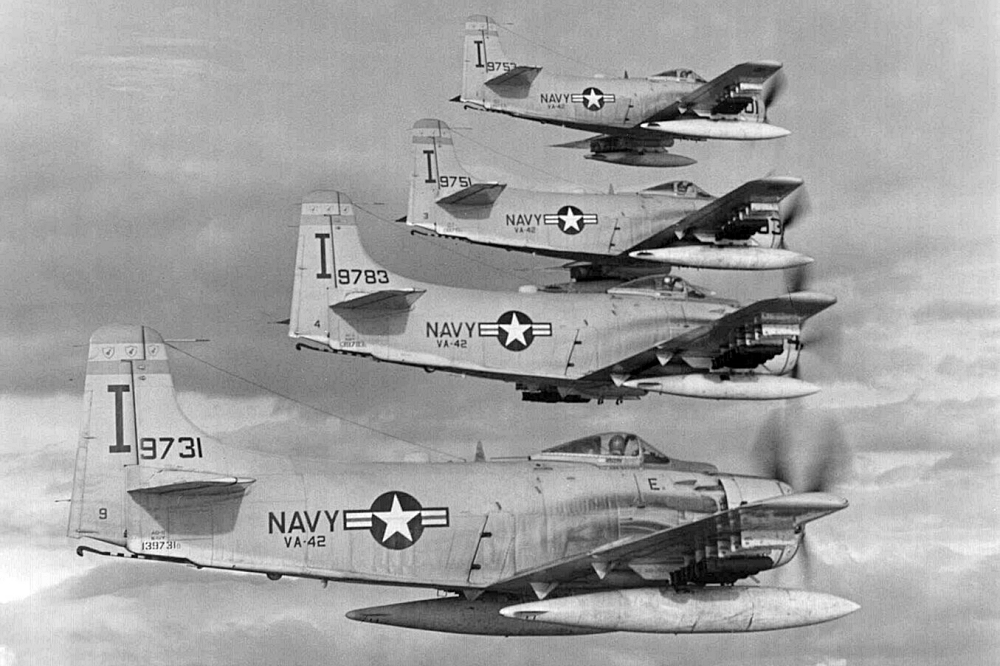
The Navy AD series was initially painted in ANA 623 glossy sea blue, but during the 1950s, following the Korean War, the color scheme was changed to light gull gray and white (Fed Std 595 27875). Initially using the gray and white Navy scheme, by 1967 the USAF began to paint its Skyraiders in a camouflaged pattern using two shades of green, and one of tan.
Used by the US Navy over Korea and Vietnam, the A-1 was a primary close air support aircraft for the USAF and RVNAF during the Vietnam War. The A-1 was famous for being able to take hits and keep flying thanks to armor plating around the cockpit area for pilot protection. It was replaced beginning in the mid-1960s by the Grumman A-6 Intruder as the Navy's primary medium-attack plane in supercarrier-based air wings; however Skyraiders continued to operate from the smaller Essex-class aircraft carriers.
The Skyraider went through seven versions, starting with the AD-1, then AD-2 and AD-3 with various minor improvements, then the AD-4 with a more powerful R-3350-26WA engine. The AD-5 was significantly widened, allowing two crew to sit side-by-side (this was not the first multiple-crew variant, the AD-1Q being a two-seater and the AD-3N a three-seater); it also came in a four-seat night-attack version, the AD-5N. The AD-6 was an improved AD-4B with improved low-level bombing equipment, and the final production version AD-7 was upgraded to an R-3350-26WB engine.
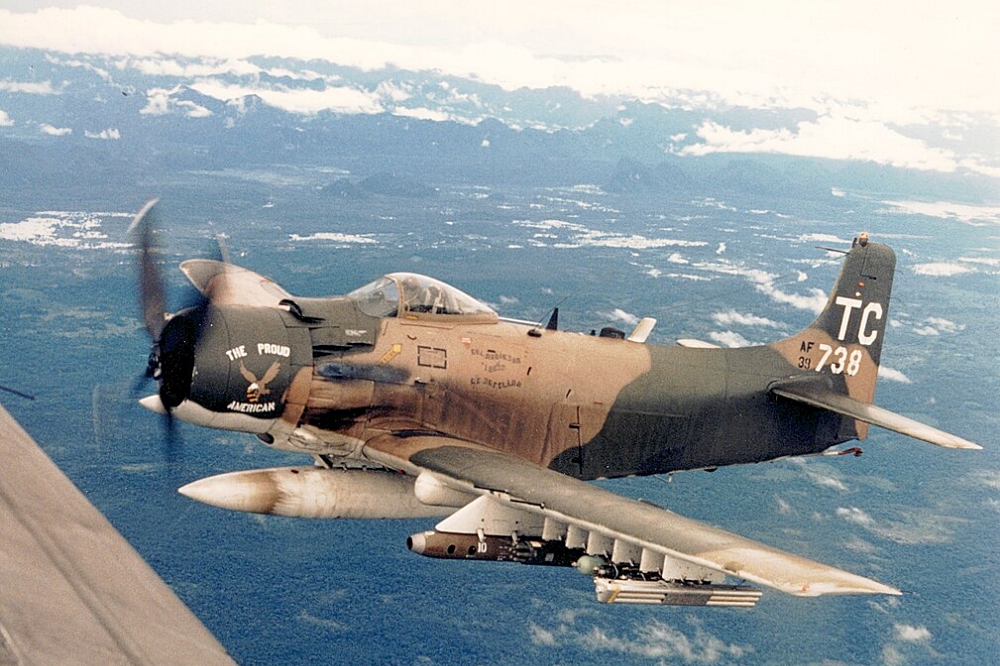
For service in Vietnam, USAF Skyraiders were fitted with the Stanley Yankee extraction system, which acted in a similar manner to an ejection seat, though with twin rockets extracting the pilot from the cockpit.
In addition to serving in Korea and Vietnam as an attack aircraft, the Skyraider was modified to serve as a carrier-based airborne early warning aircraft, replacing the Grumman TBM-3W Avenger. It fulfilled this function in the USN and Royal Navy, being replaced by the Grumman E-1 Tracer and Fairey Gannet, respectively, in those services.
Skyraider production ended in 1957 with a total of 3,180 having been built. In 1962, the existing Skyraiders were redesignated A-1D through A-1J and later used by both the USAF and the Navy in the Vietnam War.
Top Photo: The Douglas A-1 Skyraider (AD-4NA, 126965) in flight. This aircraft is owned by Heritage Flight Museum.
Sources: YouTube; Wikipedia