Counter-Drone Task Force Selects Directed Energy Systems for December Shoot-Off
The three laser weapons and one microwave system are the first to be selected for the Joint Interagency Task Force 401’s counter-unmanned aircraft systems directed energy pilot program
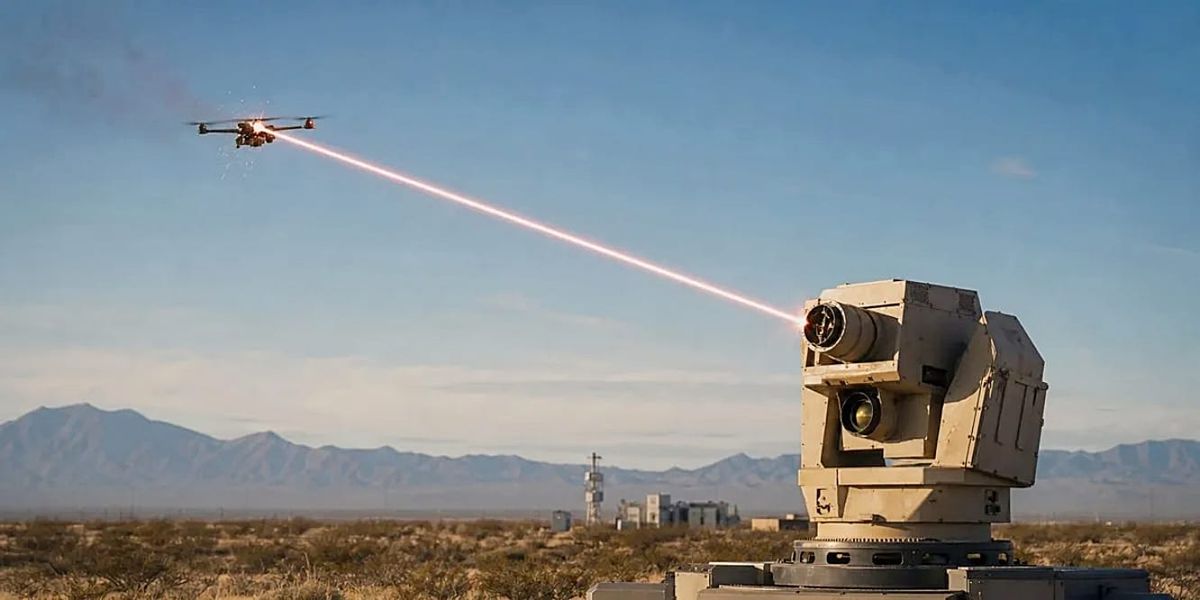
The Pentagon announced the directed-energy systems selected following the Joint Interagency Task Force 401's (JIATF-401) counter-unmanned aircraft systems (UAS) directed energy pilot program, marking the next phase of efforts to expand the operational use of high-energy laser (HEL) and high-powered microwave (HPM) capabilities across the homeland.
The three laser weapons and one microwave system are the first to be selected for the Joint Interagency Task Force 401’s counter-unmanned aircraft systems directed energy pilot program. The pilot is a congressional requirement in the 2026 National Defense Authorization Act.
Systems selected for the pilot include:
- AeroVironment Palletized High-Energy Laser system
- Epirus Leonidas High-Powered Microwave system
- Kord Firefly High-Energy Laser system
- Boeing Compact Laser Weapon system
"High-energy lasers and high-powered microwave systems are tools that can be effectively used in a layered drone defence,"
said U.S. Army Brig. Gen. Matt Ross, director of JIATF 401.
"This pilot program will test these capabilities in an operational environment so we can understand how best to integrate and sustain them to defend the homeland."
Directed by the Fiscal Year 2026 National Defense Authorization Act, the pilot will evaluate these systems' performance providing real-time data and feedback on the systems' requirements, costs, and best practices.
JIATF-401 is conducting this pilot program in close coordination with the Federal Aviation Administration (FAA), U.S. Northern Command and the Services. Earlier this year, JIATF-401 partnered with the FAA to conduct a safety risk assessment during a live-fire HEL demonstration at White Sands Missile Range, New Mexico. As a result of this testing, the FAA determined that the system posed minimal risk to the National Airspace System and established a framework for continued coordination.
"There is no silver bullet, or one size fits all solution to countering the threat of drones,"
Ross said.
"Directed energy gives commanders another option within a layered defense, complementing existing counter-UAS capabilities with a scalable, safe, and effective way to respond to drone threats. This pilot program will give us vital information in a real-world environment so we can employ these systems to protect the homeland."
While these systems represent the first capabilities selected for the pilot program, the DoW and JIATF-401 will continue to evaluate additional directed-energy technologies. In December, the Department will host a directed-energy shoot-off at Dugway Proving Ground to assess additional high-energy laser and high-powered microwave systems to identify promising capabilities for future operational use.
Epirus’ Leonidas system is the only high-powered microwave selected for the shoot-off so far. The Army awarded a $43.5 million contract to Epirus in July 2025, which included the delivery of two Integrated Fires Protection Capability High-Power Microwave, or IFPC-HPM Generation II systems, which rely on “weaponized electromagnetic interference” to down drones.
AeroVironment’s Palletized High-Energy Laser system features the firm’s LOCUST X3, a 30-kilowatt system the Army selected in September with a production contract valued at roughly $465 million.
Boeing’s Compact Laser Weapon is available in 2-kilowatt and 5-kilowatt versions. The 5-kilowatt system plugged into the Army’s Forward Area Air Defense Command and Control network to defeat Group 3 drones weighing up to 1,320 pounds during the September 2024 Red Sands Integrated Experimentation Center in Saudi Arabia, according to Boeing.
Kord’s Firefly High-Energy Laser is a palletized, mobile system that features scalable power from 5-kilowatts up to 30-kilowatts. It relies on advanced AI detection and tracking algorithms to “detect, track, intercept and defeat incoming drones at standoff ranges,” according to Kord, a subsidiary of KBR.
Sources: DOW; Air&Space Forces Magazine