Chinese Engineers Test Artillery-Launched Drones
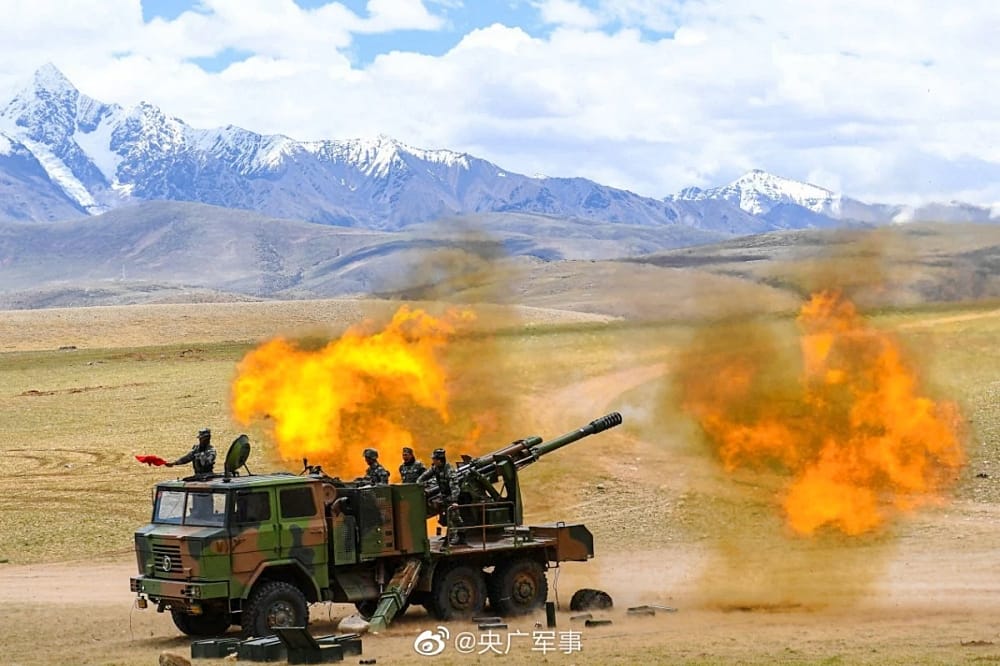
After 12 years of technical hurdles and scepticism, China has successfully tested artillery-launched drones capable of surviving the crushing load in a 155mm (6 inches) cannon shell. Five live-fire trials at a western test base confirmed the drones endured launch forces exceeding 3,000 times their own weight – comparable to 35 adult African elephants on a person.
The advance centres on a pyrotechnic ejection mechanism co-developed by the Shaanxi Applied Physics and Chemistry Research Institute, the Chinese air force, and defence contractor Norinco.
This highly reliable but low-cost system orchestrates a sequence of precisely timed detonations to separate the drone from its artillery shell mid-flight while shielding it from aerodynamic damage – all without electronic controls.
These drones can “reach distances exceeding 10 kilometres (6.2 miles) in seconds, multiply flight range, significantly save power consumption and extend loiter time,”
the team, led by senior engineer Huang Yunluan, wrote.
First proposed by Chinese military scientists in 2013, a cannon-launching design named Tianyan (“sky eye”) gained attention in a new-concept aircraft competition, according to state-run China News Service. However, the idea faced decade-long doubts over sensitive components surviving artillery launches.
As recently as last year, military experts told the military channel of state broadcaster CCTV that electronics could not withstand the ultra-high g-forces – or gravitational force equivalent – of artillery launch, hampering progress of such technology.
Undeterred and supported by long-term government and military funding, scientists and engineers have now overcome these hurdles.
Huang’s team abandoned initial attempts to use electronic controls for separation, opting instead for a highly reliable, chip-free pyrotechnic device to achieve the required complex and precise actions.
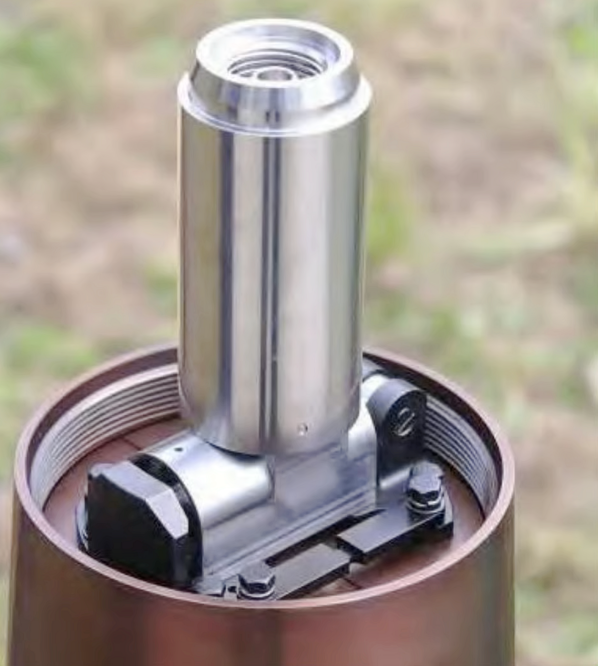
The device’s resilience begins with its hardened stainless steel frame, engineered to endure stresses of up to 1,100 megapascals (MPa).
Inside, lead azide and boron-based explosives remained intact even when subjected to extreme forces. Rigorous hammer impact tests proved the system survives loads 36,000 times higher than gravity for over 20 milliseconds. Ignition reliability hinges on a clever “maze channel” design, according to Huang’s team.
Four precisely spaced 1mm (0.04 inches) holes reduce destructive detonation pressure significantly while still allowing flames to propagate. A grooved boss structure prevents explosive debris from blocking these critical pathways.
The entire separation sequence operates through an eight-stage chain reaction requiring no electronics or external power. It starts with fuse detonation, progressing through bulkhead ignition, generating a powerful axial thrust to eject the drone capsule, triggering a delayed igniter and finally releasing another radial thrust to shed protective panels.
In temperature extremes ranging from -50 degrees Celsius (-58 degrees Fahrenheit) to 80°C and across bulkhead thickness variations from 1 to 4mm (0.04 to 0.15 inches), the ignition system fired flawlessly while preventing blockages.
Most critically, all five ground detonation tests and five live artillery launches achieved perfectly timed separation of drone components, proving the system could withstand loads at least 3,500 times to gravity in real-life settings.
These drones “will undoubtedly hold a pivotal position in future military development”, Huang and his colleagues wrote.
Source: South China Morning Post