Chinese Algorithm Beats Veteran Human Controller in FPV Drone Race
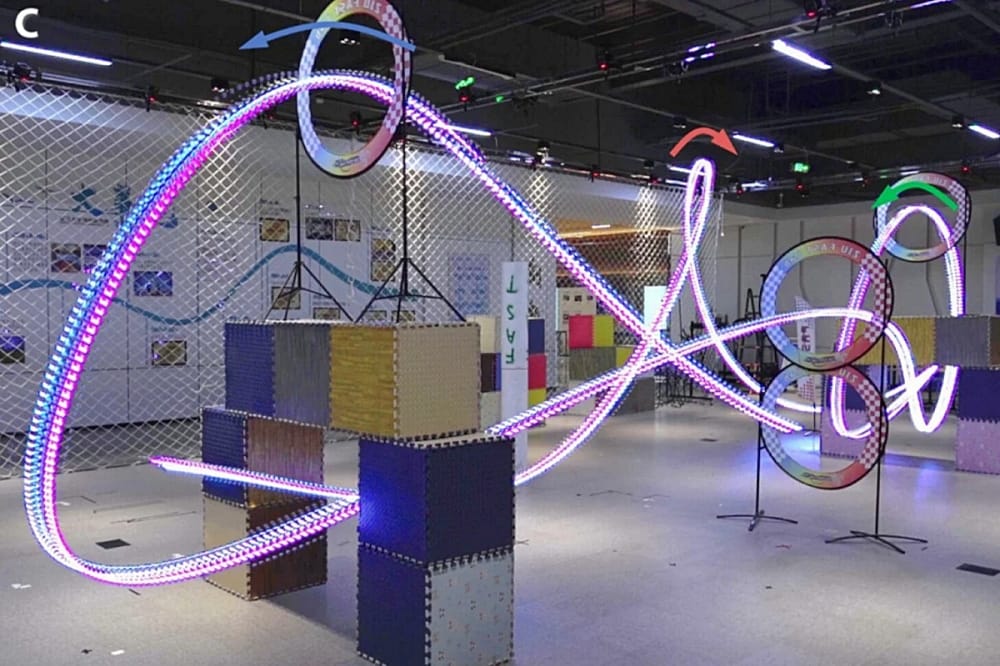
Chinese researchers have allegedly developed a new algorithm that lets first-person-view (FPV) drones perform autonomous aerobatic manoeuvres better than those by veteran human operators during flight missions.
Inspired by sparrowhawks, falcons, and bats, the new artificial intelligence (AI) upgrade can facilitate high-speed, high-risk movements that usually only the most skilled human pilots can execute.
Traditionally, FPV drone performance has been improved by upgrading hardware (stronger motors, better sensors). However, with the latest attempt, scientists instead focused on smarter software, using advanced motion planning and decision-making algorithms to unlock next-level performance.
“This biological wisdom—transforming ‘high-risk manoeuvres’ into ‘high-survival rewards’—holds the key to redefining traditional drone flight paradigms,”
said Gao Fei, an associate professor at Zhejiang University and one of the scientists associated with the project, while speaking to the South China Morning Post.
“We have demonstrated that quadrotor drones can unlock more sophisticated flight manoeuvres and graceful postures solely through intelligent algorithms alone – no hardware upgrades required,” he added.
The system works based on two key frameworks: motion-intent translation, which converts desired flight manoeuvres into actionable goals, and risk-reward evaluation, which balances obstacle avoidance, energy efficiency, and aerobatic performance.
“When physical limits cannot be breached, motion intelligence becomes the new frontier of performance,” the team noted.
After users provide their desired aerobatic trajectory, the system can generate complex flight paths and ensure stable execution in known environments, all without human intervention. The drone can autonomously execute these manoeuvres in intricate settings.
Giving Drones New Brains
According to the team, the new FPV AI has two main components. The first is a motion-intent translator that converts a pilot’s desired manoeuvre (e.g., a flip or loop) into specific, executable drone commands.
The second is a risk-reward evaluation that analyzes the trade-offs between safety (avoiding obstacles), efficiency (energy use), and performance (aerobatics). Essentially, these give the drone the ‘brains’ to understand what it needs to do.
“We have demonstrated that quadrotor drones can unlock more sophisticated flight manoeuvres and graceful postures solely through intelligent algorithms alone—no hardware upgrades required,” he added.
The algorithm also enables the drone to perform tasks efficiently and avoid crashing, all without needing GPS or remote human input. What’s more impressive is that the team’s claims about its new drone brains are not just theoretical.
During ensuing trails, the drone flew through tight obstacle courses, even inverted, with hummingbird-like agility. In a one-on-one test, it beat a professional human pilot with a perfect success rate of 100% versus the 12.5% exhibited by the pilot.
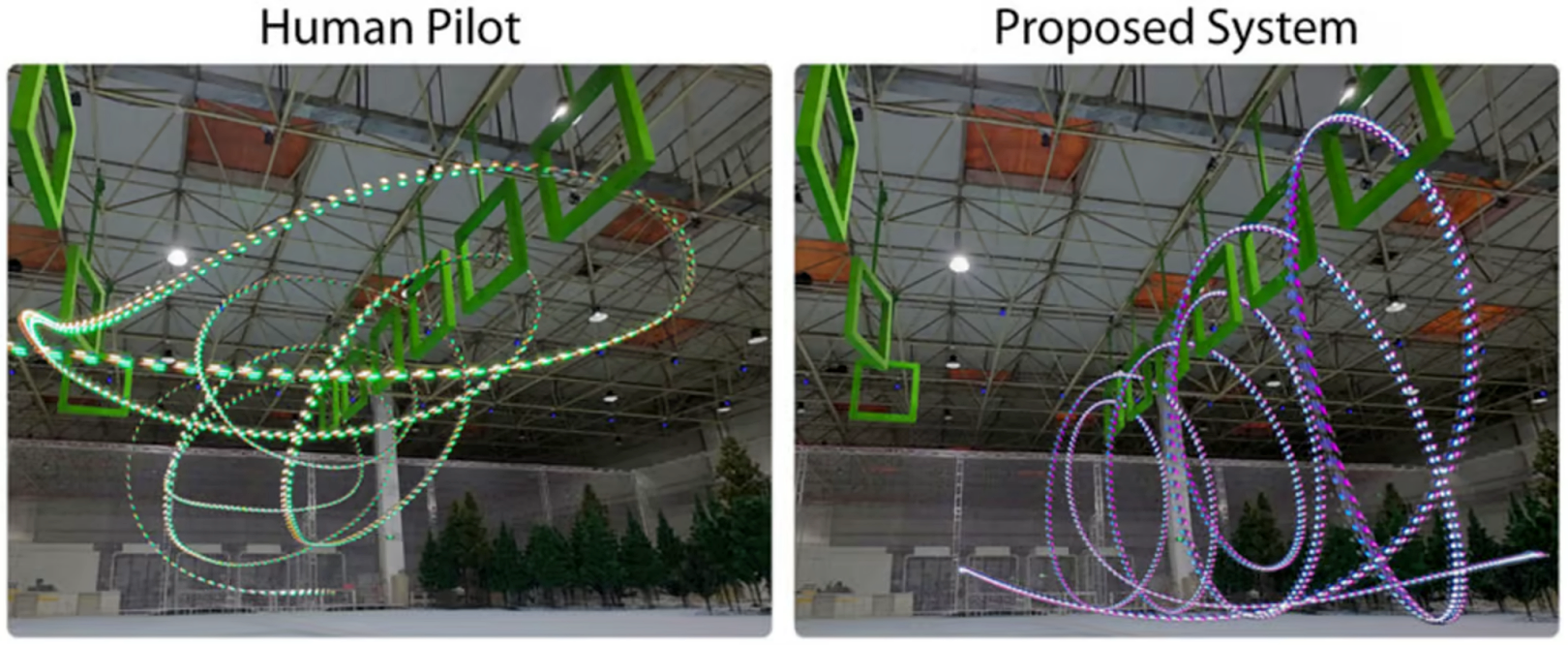
“We believe that aerobatic flight can enhance a vehicle’s adaptability and flexibility in complex environments, improving its performance in practical applications,” Gao said.
Applications in Film, Military and Space
The AI-enabled FPV drone also executed smoother, tighter manoeuvres with less recovery time between stunts. This level of autonomous aerial acrobatics has significant implications beyond having fun with races.
It could, for example, have military applications, enabling drones to be far more agile in urban or forested environments, evading detection and striking with precision. Navigating tight or dangerous spaces like collapsed buildings or volcanic vents would also greatly benefit search and rescue operations. It could also be used in filmmaking and space missions.